 Add to Chrome
 Add to Firefox
 Add to Edge
Domain Arithmetic: One-Shot VLA Adaptation under Environmental Shifts
Jul 01, 2026
Vision-Language-Action (VLA) models often fail to perform the same learned tasks under environmental shifts, such as changes in camera pose and shifts to a different but similar robot (e.g., from Panda to UR5e). Adapting these models to the shifted environment (i.e., target domain) often requires training on multiple demonstrations for each task, which are costly to collect. To reduce the burden of data curation and training, we propose an analogy-based method that adapts VLA models under environmental shifts through weight vector arithmetic with domain-specific information addition, named Domain ARiThmetic (DART). Unlike prior approaches, DART requires collecting only a single demonstration, enabling efficient adaptation. To accurately isolate domain-specific information for addition, DART performs subspace alignment between singular components in weight vectors to filter out noisy components. In both simulated and real-world experiments, DART outperforms existing VLA adaptation methods in one-shot scenarios across diverse visual and embodiment shifts. Code is available at https://github.com/snumprlab/dart.

uCLIP: Parameter-Efficient Multilingual Extension of Vision-Language Models with Unpaired Data
Nov 17, 2025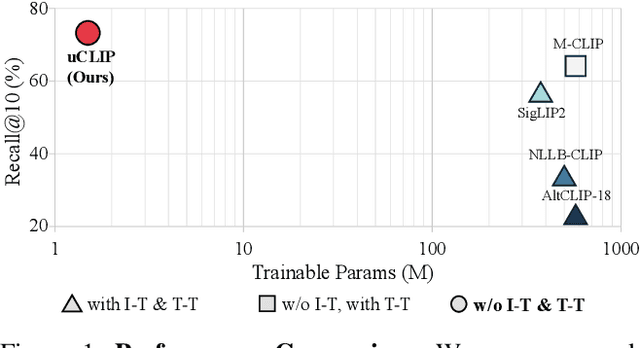
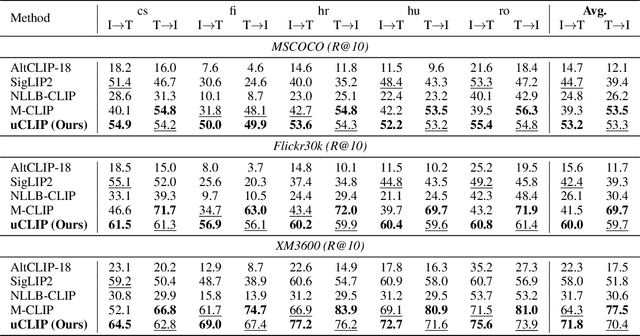
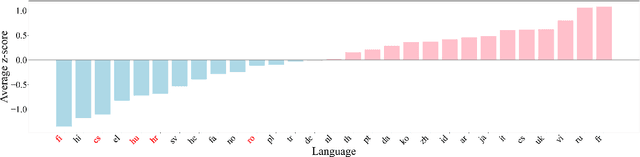
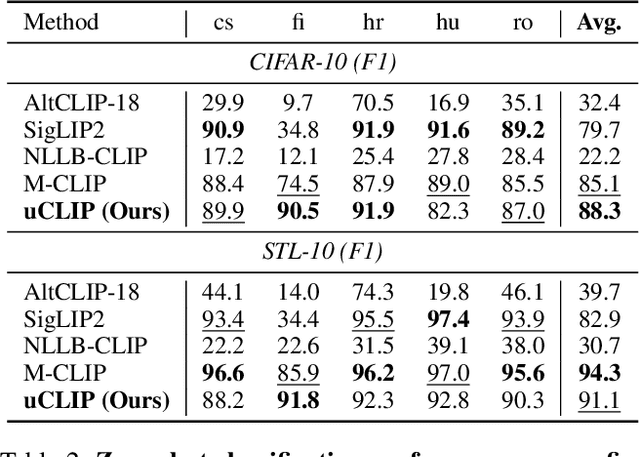
Contrastive Language-Image Pre-training (CLIP) has demonstrated strong generalization across a wide range of visual tasks by leveraging large-scale English-image pairs. However, its extension to low-resource languages remains limited due to the scarcity of high-quality multilingual image-text data. Existing multilingual vision-language models exhibit consistently low retrieval performance in underrepresented languages including Czech, Finnish, Croatian, Hungarian, and Romanian on the Crossmodal-3600 (XM3600) benchmark. To address this, we propose a lightweight and data-efficient framework for multilingual vision-language alignment. Our approach requires no image-text pairs or text-text pairs and freezes both the pretrained image encoder and multilingual text encoder during training. Only a compact 1.7M-parameter projection module is trained, using a contrastive loss over English representations as semantic anchors. This minimal training setup enables robust multilingual alignment even for languages with limited supervision. Extensive evaluation across multiple multilingual retrieval benchmarks confirms the effectiveness of our method, showing significant gains in five underrepresented languages where existing models typically underperform. These findings highlight the effectiveness of our pivot-based, parameter-efficient alignment strategy for inclusive multimodal learning.