 Add to Chrome
 Add to Firefox
 Add to Edge
Adapting a Pre-trained Single-Cell Foundation Model to Spatial Gene Expression Generation from Histology Images
Mar 20, 2026
Spatial transcriptomics (ST) enables spot-level in situ expression profiling, but its high cost and limited throughput motivate predicting expression directly from HE-stained histology. Recent advances explore using score- or flow-based generative models to estimate the conditional distribution of gene expression from histology, offering a flexible alternative to deterministic regression approaches. However, most existing generative approaches omit explicit modeling of gene-gene dependencies, undermining biological coherence. Single-cell foundation models (sc-FMs), pre-trained across diverse cell populations, capture these critical gene relationships that histology alone cannot reveal. Yet, applying expression-only sc-FMs to histology-conditioned expression modeling is nontrivial due to the absence of a visual pathway, a mismatch between their pre-training and conditional ST objectives, and the scarcity of mixed-cell ST supervision. To address these challenges, we propose HINGE (HIstology-coNditioned GEneration), which retrofits a pre-trained sc-FM into a conditional expression generator while mostly preserving its learned gene relationships. We achieve this by introducing SoftAdaLN, a lightweight, identity-initialized modulation that injects layer-wise visual context into the backbone, coupled with an expression-space masked diffusion objective and a warm-start curriculum to ensure objective alignment and training stability. Evaluated on three ST datasets, ours outperforms state-of-the-art baselines on mean Pearson correlation and yields more accurate spatial marker expression patterns and higher pairwise co-expression consistency, establishing a practical route to adapt pre-trained sc-FMs for histology-conditioned spatial expression generation.

Masked Graph Autoencoders with Contrastive Augmentation for Spatially Resolved Transcriptomics Data
Aug 09, 2024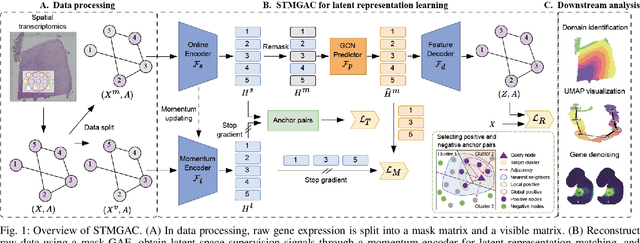
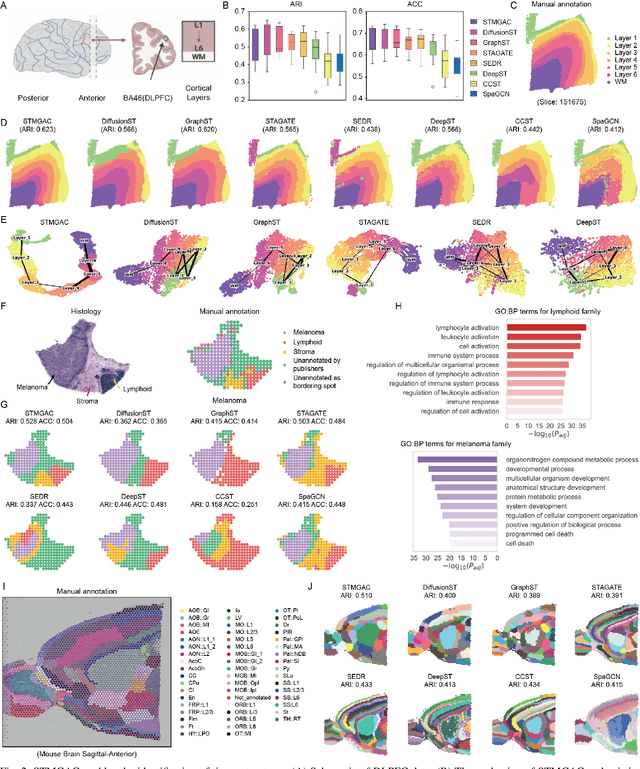

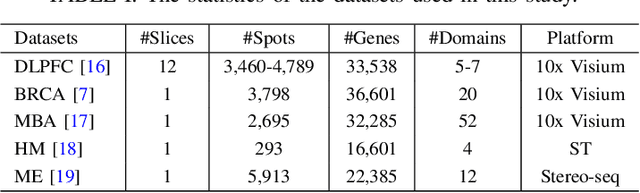
With the rapid advancement of Spatial Resolved Transcriptomics (SRT) technology, it is now possible to comprehensively measure gene transcription while preserving the spatial context of tissues. Spatial domain identification and gene denoising are key objectives in SRT data analysis. We propose a Contrastively Augmented Masked Graph Autoencoder (STMGAC) to learn low-dimensional latent representations for domain identification. In the latent space, persistent signals for representations are obtained through self-distillation to guide self-supervised matching. At the same time, positive and negative anchor pairs are constructed using triplet learning to augment the discriminative ability. We evaluated the performance of STMGAC on five datasets, achieving results superior to those of existing baseline methods. All code and public datasets used in this paper are available at https://github.com/wenwenmin/STMGAC and https://zenodo.org/records/13253801.