 Add to Chrome
 Add to Firefox
 Add to Edge
Super-Resolving Coarse-Resolution Weather Forecasts With Flow Matching
Apr 01, 2026
Machine learning-based weather forecasting models now surpass state-of-the-art numerical weather prediction systems, but training and operating these models at high spatial resolution remains computationally expensive. We present a modular framework that decouples forecasting from spatial resolution by applying learned generative super-resolution as a post-processing step to coarse-resolution forecast trajectories. We formulate super-resolution as a stochastic inverse problem, using a residual formulation to preserve large-scale structure while reconstructing unresolved variability. The model is trained with flow matching exclusively on reanalysis data and is applied to global medium-range forecasts. We evaluate (i) design consistency by re-coarsening super-resolved forecasts and comparing them to the original coarse trajectories, and (ii) high-resolution forecast quality using standard ensemble verification metrics and spectral diagnostics. Results show that super-resolution preserves large-scale structure and variance after re-coarsening, introduces physically consistent small-scale variability, and achieves competitive probabilistic forecast skill at 0.25° resolution relative to an operational ensemble baseline, while requiring only a modest additional training cost compared with end-to-end high-resolution forecasting.

ORCAst: Operational High-Resolution Current Forecasts
Jan 21, 2025We present ORCAst, a multi-stage, multi-arm network for Operational high-Resolution Current forecAsts over one week. Producing real-time nowcasts and forecasts of ocean surface currents is a challenging problem due to indirect or incomplete information from satellite remote sensing data. Entirely trained on real satellite data and in situ measurements from drifters, our model learns to forecast global ocean surface currents using various sources of ground truth observations in a multi-stage learning procedure. Our multi-arm encoder-decoder model architecture allows us to first predict sea surface height and geostrophic currents from larger quantities of nadir and SWOT altimetry data, before learning to predict ocean surface currents from much more sparse in situ measurements from drifters. Training our model on specific regions improves performance. Our model achieves stronger nowcast and forecast performance in predicting ocean surface currents than various state-of-the-art methods.
Learning 4DVAR inversion directly from observations
Nov 17, 2022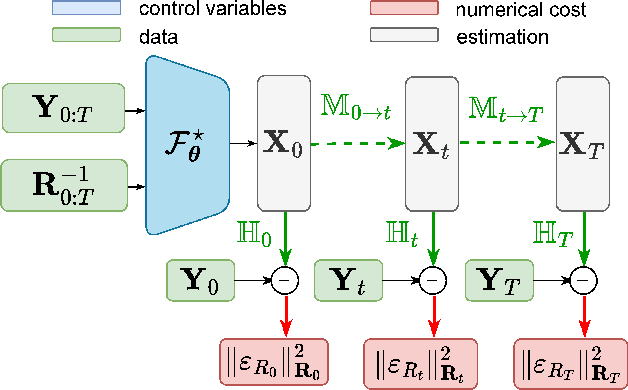

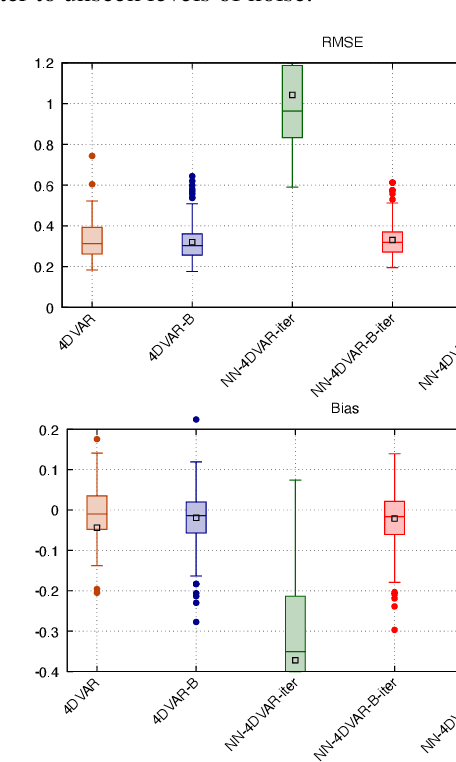
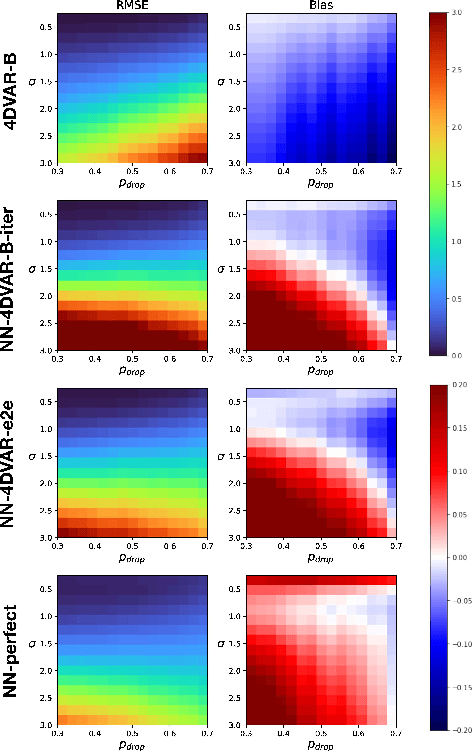
Variational data assimilation and deep learning share many algorithmic aspects in common. While the former focuses on system state estimation, the latter provides great inductive biases to learn complex relationships. We here design a hybrid architecture learning the assimilation task directly from partial and noisy observations, using the mechanistic constraint of the 4DVAR algorithm. Finally, we show in an experiment that the proposed method was able to learn the desired inversion with interesting regularizing properties and that it also has computational interests.
Fusion of rain radar images and wind forecasts in a deep learning model applied to rain nowcasting
Jan 12, 2021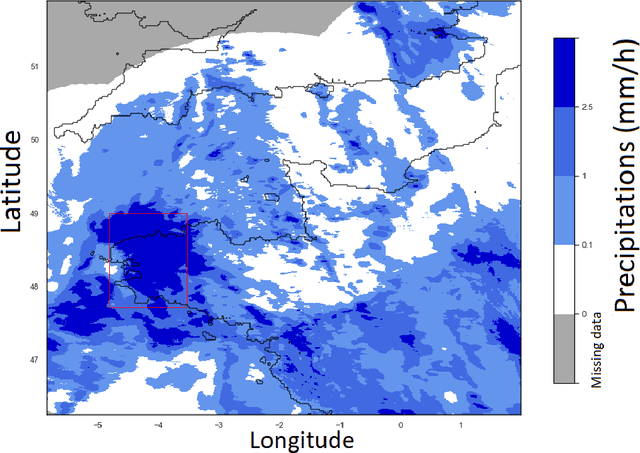
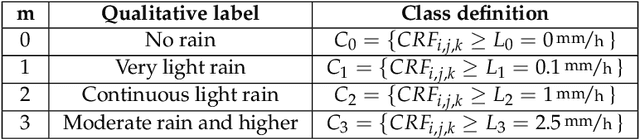
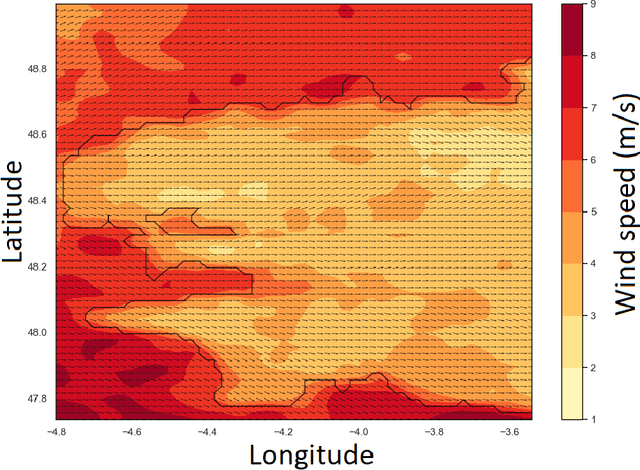
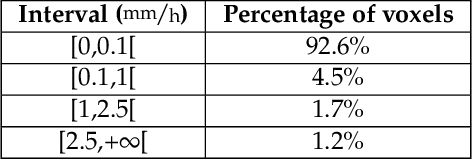
Short- or mid-term rainfall forecasting is a major task with several environmental applications such as agricultural management or flood risk monitoring. Existing data-driven approaches, especially deep learning models, have shown significant skill at this task, using only rainfall radar images as inputs. In order to determine whether using other meteorological parameters such as wind would improve forecasts, we trained a deep learning model on a fusion of rainfall radar images and wind velocity produced by a weather forecast model. The network was compared to a similar architecture trained only on radar data, to a basic persistence model and to an approach based on optical flow. Our network outperforms by 8% the F1-score calculated for the optical flow on moderate and higher rain events for forecasts at a horizon time of 30 min. Furthermore, it outperforms by 7% the same architecture trained using only rainfall radar images. Merging rain and wind data has also proven to stabilize the training process and enabled significant improvement especially on the difficult-to-predict high precipitation rainfalls.