 Add to Chrome
 Add to Firefox
 Add to Edge
AgriPINN: A Process-Informed Neural Network for Interpretable and Scalable Crop Biomass Prediction Under Water Stress
Jan 22, 2026
Accurate prediction of crop above-ground biomass (AGB) under water stress is critical for monitoring crop productivity, guiding irrigation, and supporting climate-resilient agriculture. Data-driven models scale well but often lack interpretability and degrade under distribution shift, whereas process-based crop models (e.g. DSSAT, APSIM, LINTUL5) require extensive calibration and are difficult to deploy over large spatial domains. To address these limitations, we propose AgriPINN, a process-informed neural network that integrates a biophysical crop-growth differential equation as a differentiable constraint within a deep learning backbone. This design encourages physiologically consistent biomass dynamics under water-stress conditions while preserving model scalability for spatially distributed AGB prediction. AgriPINN recovers latent physiological variables, including leaf area index (LAI), absorbed photosynthetically active radiation (PAR), radiation use efficiency (RUE), and water-stress factors, without requiring direct supervision. We pretrain AgriPINN on 60 years of historical data across 397 regions in Germany and fine-tune it on three years of field experiments under controlled water treatments. Results show that AgriPINN consistently outperforms state-of-the-art deep-learning baselines (ConvLSTM-ViT, SLTF, CNN-Transformer) and the process-based LINTUL5 model in terms of accuracy (RMSE reductions up to $43\%$) and computational efficiency. By combining the scalability of deep learning with the biophysical rigor of process-based modeling, AgriPINN provides a robust and interpretable framework for spatio-temporal AGB prediction, offering practical value for planning of irrigation infrastructure, yield forecasting, and climate-adaptation planning.

Deep Learning Meets Process-Based Models: A Hybrid Approach to Agricultural Challenges
Apr 22, 2025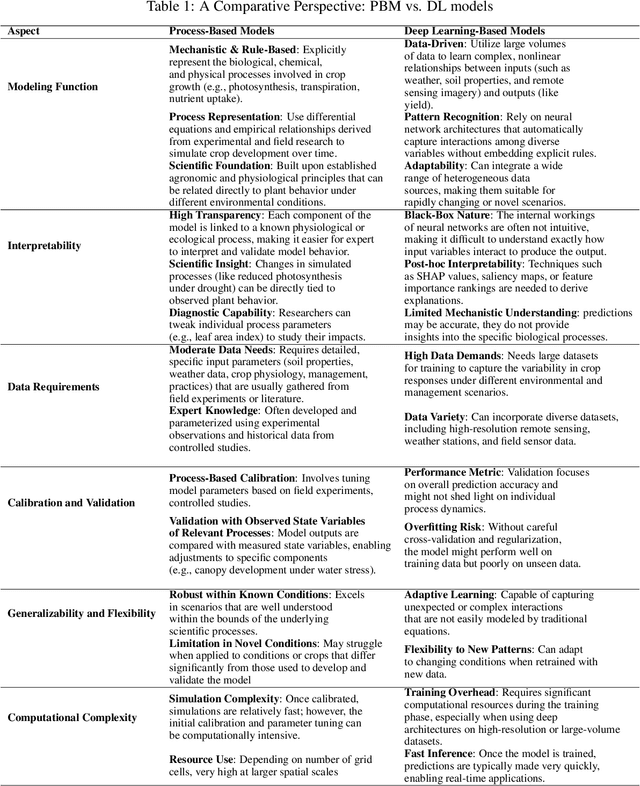
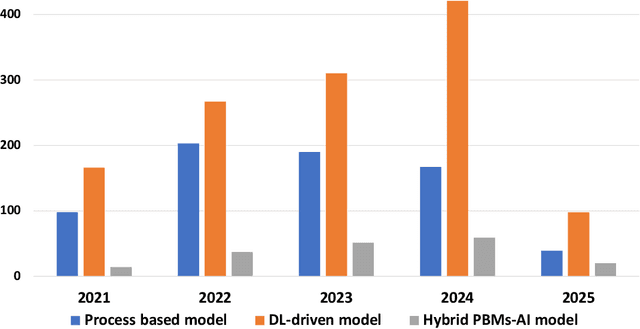

Process-based models (PBMs) and deep learning (DL) are two key approaches in agricultural modelling, each offering distinct advantages and limitations. PBMs provide mechanistic insights based on physical and biological principles, ensuring interpretability and scientific rigour. However, they often struggle with scalability, parameterisation, and adaptation to heterogeneous environments. In contrast, DL models excel at capturing complex, nonlinear patterns from large datasets but may suffer from limited interpretability, high computational demands, and overfitting in data-scarce scenarios. This study presents a systematic review of PBMs, DL models, and hybrid PBM-DL frameworks, highlighting their applications in agricultural and environmental modelling. We classify hybrid PBM-DL approaches into DL-informed PBMs, where neural networks refine process-based models, and PBM-informed DL, where physical constraints guide deep learning predictions. Additionally, we conduct a case study on crop dry biomass prediction, comparing hybrid models against standalone PBMs and DL models under varying data quality, sample sizes, and spatial conditions. The results demonstrate that hybrid models consistently outperform traditional PBMs and DL models, offering greater robustness to noisy data and improved generalisation across unseen locations. Finally, we discuss key challenges, including model interpretability, scalability, and data requirements, alongside actionable recommendations for advancing hybrid modelling in agriculture. By integrating domain knowledge with AI-driven approaches, this study contributes to the development of scalable, interpretable, and reproducible agricultural models that support data-driven decision-making for sustainable agriculture.