 Add to Chrome
 Add to Firefox
 Add to Edge
RLDX-1 Technical Report
May 05, 2026
While Vision-Language-Action models (VLAs) have shown remarkable progress toward human-like generalist robotic policies through the versatile intelligence (i.e. broad scene understanding and language-conditioned generalization) inherited from pre-trained Vision-Language Models, they still struggle with complex real-world tasks requiring broader functional capabilities (e.g. motion awareness, memory-aware decision making, and physical sensing). To address this, we introduce RLDX-1, a general-purpose robotic policy for dexterous manipulation built on the Multi-Stream Action Transformer (MSAT), an architecture that unifies these capabilities by integrating heterogeneous modalities through modality-specific streams with cross-modal joint self-attention. RLDX-1 further combines this architecture with system-level design choices, including synthesizing training data for rare manipulation scenarios, learning procedures specialized for human-like manipulation, and inference optimizations for real-time deployment. Through empirical evaluation, we show that RLDX-1 consistently outperforms recent frontier VLAs (e.g. $π_{0.5}$ and GR00T N1.6) across both simulation benchmarks and real-world tasks that require broad functional capabilities beyond general versatility. In particular, RLDX-1 shows superiority in ALLEX humanoid tasks by achieving success rates of 86.8% while $π_{0.5}$ and GR00T N1.6 achieve around 40%, highlighting the ability of RLDX-1 to control a high-DoF humanoid robot under diverse functional demands. Together, these results position RLDX-1 as a promising step toward reliable VLAs for complex, contact-rich, and dynamic real-world dexterous manipulation.

EgoX: Egocentric Video Generation from a Single Exocentric Video
Dec 09, 2025Egocentric perception enables humans to experience and understand the world directly from their own point of view. Translating exocentric (third-person) videos into egocentric (first-person) videos opens up new possibilities for immersive understanding but remains highly challenging due to extreme camera pose variations and minimal view overlap. This task requires faithfully preserving visible content while synthesizing unseen regions in a geometrically consistent manner. To achieve this, we present EgoX, a novel framework for generating egocentric videos from a single exocentric input. EgoX leverages the pretrained spatio temporal knowledge of large-scale video diffusion models through lightweight LoRA adaptation and introduces a unified conditioning strategy that combines exocentric and egocentric priors via width and channel wise concatenation. Additionally, a geometry-guided self-attention mechanism selectively attends to spatially relevant regions, ensuring geometric coherence and high visual fidelity. Our approach achieves coherent and realistic egocentric video generation while demonstrating strong scalability and robustness across unseen and in-the-wild videos.
Statistical Analysis by Semiparametric Additive Regression and LSTM-FCN Based Hierarchical Classification for Computer Vision Quantification of Parkinsonian Bradykinesia
Mar 31, 2024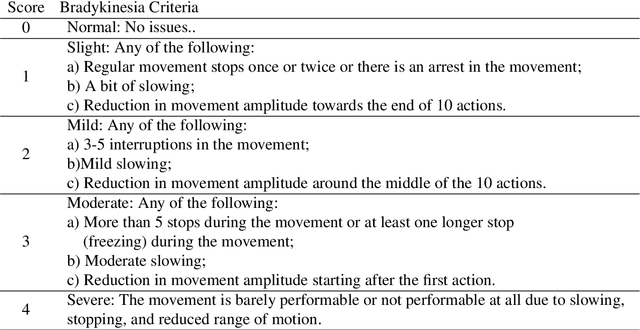
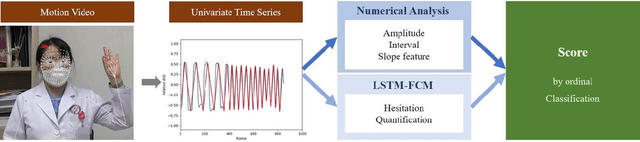
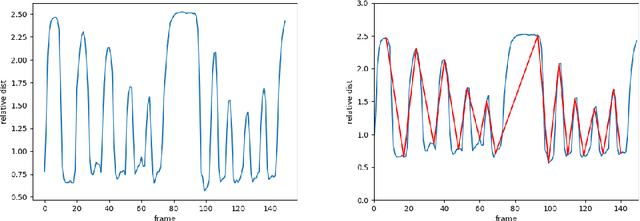
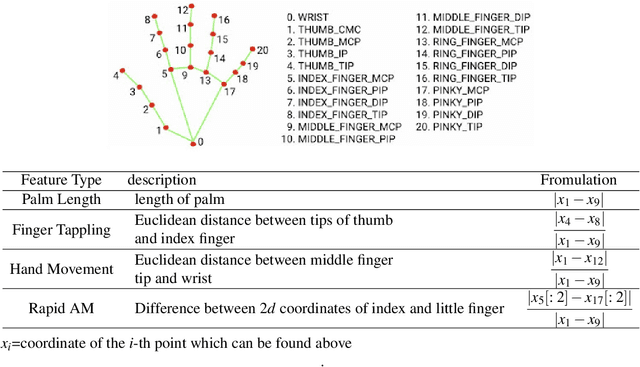
Bradykinesia, characterized by involuntary slowing or decrement of movement, is a fundamental symptom of Parkinson's Disease (PD) and is vital for its clinical diagnosis. Despite various methodologies explored to quantify bradykinesia, computer vision-based approaches have shown promising results. However, these methods often fall short in adequately addressing key bradykinesia characteristics in repetitive limb movements: "occasional arrest" and "decrement in amplitude." This research advances vision-based quantification of bradykinesia by introducing nuanced numerical analysis to capture decrement in amplitudes and employing a simple deep learning technique, LSTM-FCN, for precise classification of occasional arrests. Our approach structures the classification process hierarchically, tailoring it to the unique dynamics of bradykinesia in PD. Statistical analysis of the extracted features, including those representing arrest and fatigue, has demonstrated their statistical significance in most cases. This finding underscores the importance of considering "occasional arrest" and "decrement in amplitude" in bradykinesia quantification of limb movement. Our enhanced diagnostic tool has been rigorously tested on an extensive dataset comprising 1396 motion videos from 310 PD patients, achieving an accuracy of 80.3%. The results confirm the robustness and reliability of our method.
A Reliable, Self-Adaptive Face Identification Framework via Lyapunov Optimization
Sep 02, 2021
Realtime face identification (FID) from a video feed is highly computation-intensive, and may exhaust computation resources if performed on a device with a limited amount of resources (e.g., a mobile device). In general, FID performs better when images are sampled at a higher rate, minimizing false negatives. However, performing it at an overwhelmingly high rate exposes the system to the risk of a queue overflow that hampers the system's reliability. This paper proposes a novel, queue-aware FID framework that adapts the sampling rate to maximize the FID performance while avoiding a queue overflow by implementing the Lyapunov optimization. A preliminary evaluation via a trace-based simulation confirms the effectiveness of the framework.