 Add to Chrome
 Add to Firefox
 Add to Edge
Sequential Minimal Optimization Algorithm for One-Class Support Vector Machines With Privileged Information
Jun 20, 2026
One of the powerful techniques in data modeling is accounting for features that are available at the training stage, but are not available when the trained model is used to classify or predict test data -- the Learning Using Privileged Information paradigm (LUPI). Sequential Minimal Optimization (SMO) methods have been developed for supervised Support Vector Machines (SVM), unsupervised one-class SVM, and SVM with privileged information (SVM+). The missing brick in this research has long been a one-class SVM with privileged information (OC-SVM+). In this paper, we propose an SMO algorithm for OC-SVM+ that significantly outperforms non-sequential algorithms for training the OC-SVM+ model. Its finite-time convergence is established. The experiments show how privileged information affects a descriptive domain in the space of original features. Comparative benchmark tests demonstrate that our algorithm is superior over interior point algorithms.
* 19 pages, 4 figures. Author-prepared preprint of the article published in IEEE Access. The published article is licensed under CC BY-NC-ND 4.0

Model Selection for Anomaly Detection
Jul 12, 2017Anomaly detection based on one-class classification algorithms is broadly used in many applied domains like image processing (e.g. detection of whether a patient is "cancerous" or "healthy" from mammography image), network intrusion detection, etc. Performance of an anomaly detection algorithm crucially depends on a kernel, used to measure similarity in a feature space. The standard approaches (e.g. cross-validation) for kernel selection, used in two-class classification problems, can not be used directly due to the specific nature of a data (absence of a second, abnormal, class data). In this paper we generalize several kernel selection methods from binary-class case to the case of one-class classification and perform extensive comparison of these approaches using both synthetic and real-world data.
* 6 pages, 3 figures, Eighth International Conference on Machine Vision (December 8, 2015)
One-Class SVM with Privileged Information and its Application to Malware Detection
Nov 20, 2016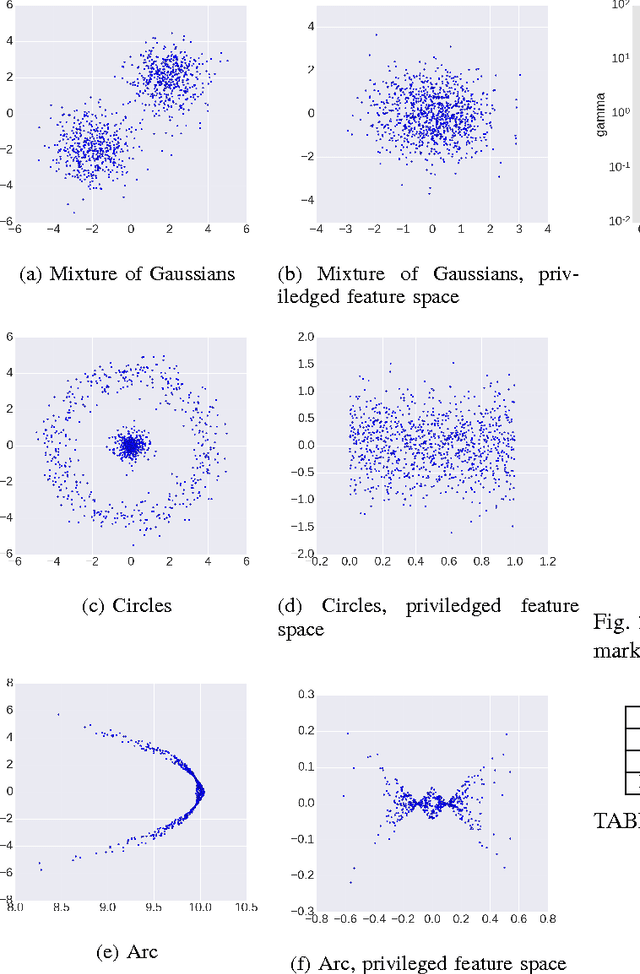
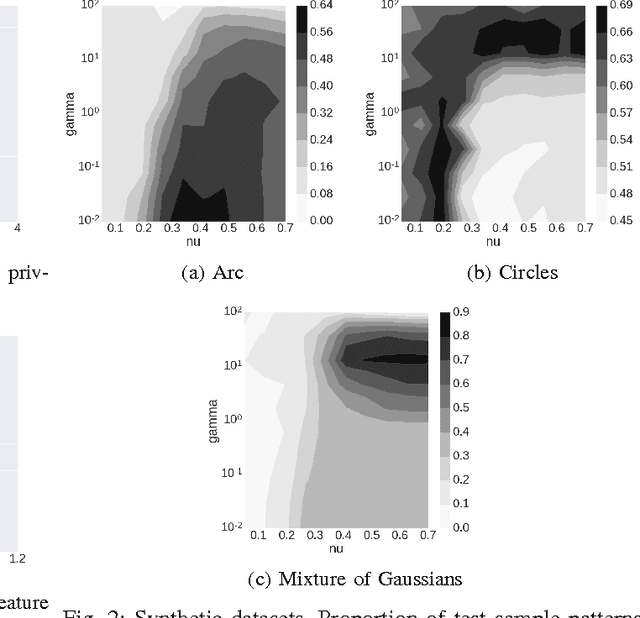
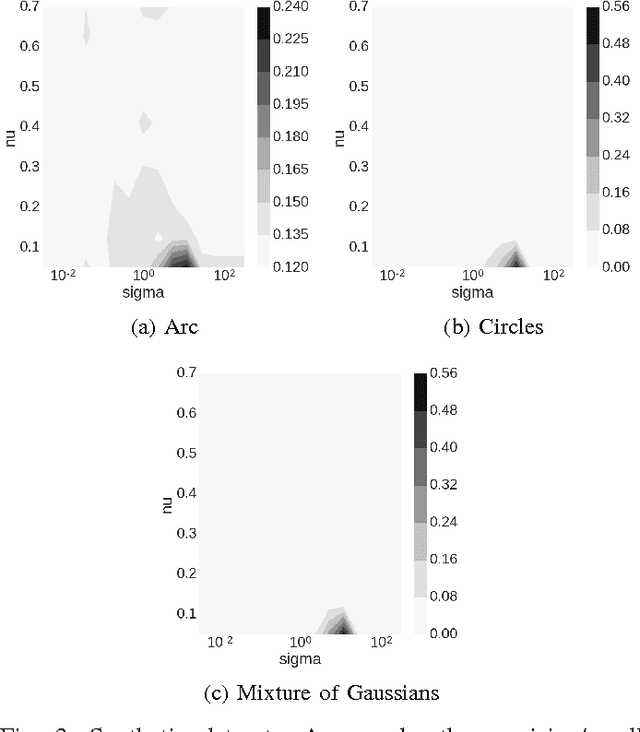
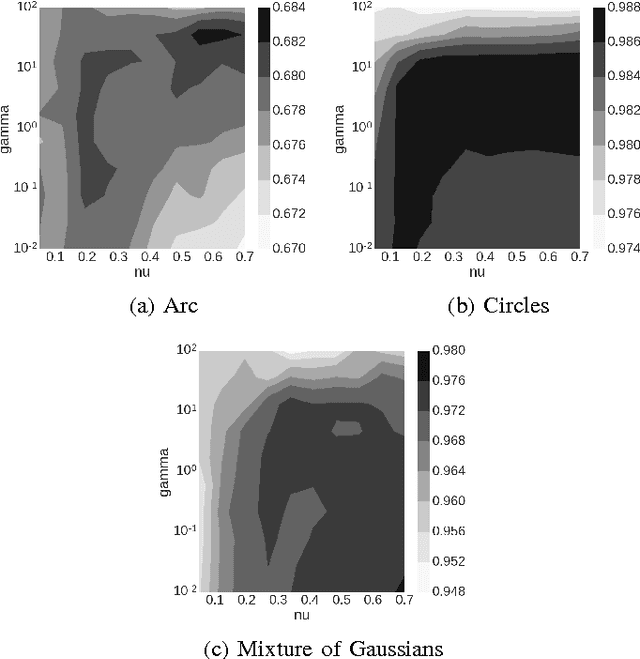
A number of important applied problems in engineering, finance and medicine can be formulated as a problem of anomaly detection. A classical approach to the problem is to describe a normal state using a one-class support vector machine. Then to detect anomalies we quantify a distance from a new observation to the constructed description of the normal class. In this paper we present a new approach to the one-class classification. We formulate a new problem statement and a corresponding algorithm that allow taking into account a privileged information during the training phase. We evaluate performance of the proposed approach using a synthetic dataset, as well as the publicly available Microsoft Malware Classification Challenge dataset.