 Add to Chrome
 Add to Firefox
 Add to Edge
Team RAS in 10th ABAW Competition: Multimodal Valence and Arousal Estimation Approach
Mar 13, 2026
Continuous emotion recognition in terms of valence and arousal under in-the-wild (ITW) conditions remains a challenging problem due to large variations in appearance, head pose, illumination, occlusions, and subject-specific patterns of affective expression. We present a multimodal method for valence-arousal estimation ITW. Our method combines three complementary modalities: face, behavior, and audio. The face modality relies on GRADA-based frame-level embeddings and Transformer-based temporal regression. We use Qwen3-VL-4B-Instruct to extract behavior-relevant information from video segments, while Mamba is used to model temporal dynamics across segments. The audio modality relies on WavLM-Large with attention-statistics pooling and includes a cross-modal filtering stage to reduce the influence of unreliable or non-speech segments. To fuse modalities, we explore two fusion strategies: a Directed Cross-Modal Mixture-of-Experts Fusion Strategy that learns interactions between modalities with adaptive weighting, and a Reliability-Aware Audio-Visual Fusion Strategy that combines visual features at the frame-level while using audio as complementary context. The results are reported on the Aff-Wild2 dataset following the 10th Affective Behavior Analysis in-the-Wild (ABAW) challenge protocol. Experiments demonstrate that the proposed multimodal fusion strategy achieves a Concordance Correlation Coefficient (CCC) of 0.658 on the Aff-Wild2 development set.

Team LEYA in 10th ABAW Competition: Multimodal Ambivalence/Hesitancy Recognition Approach
Mar 13, 2026Ambivalence/hesitancy recognition in unconstrained videos is a challenging problem due to the subtle, multimodal, and context-dependent nature of this behavioral state. In this paper, a multimodal approach for video-level ambivalence/hesitancy recognition is presented for the 10th ABAW Competition. The proposed approach integrates four complementary modalities: scene, face, audio, and text. Scene dynamics are captured with a VideoMAE-based model, facial information is encoded through emotional frame-level embeddings aggregated by statistical pooling, acoustic representations are extracted with EmotionWav2Vec2.0 and processed by a Mamba-based temporal encoder, and linguistic cues are modeled using fine-tuned transformer-based text models. The resulting unimodal embeddings are further combined using multimodal fusion models, including prototype-augmented variants. Experiments on the BAH corpus demonstrate clear gains of multimodal fusion over all unimodal baselines. The best unimodal configuration achieved an average MF1 of 70.02%, whereas the best multimodal fusion model reached 83.25%. The highest final test performance, 71.43%, was obtained by an ensemble of five prototype-augmented fusion models. The obtained results highlight the importance of complementary multimodal cues and robust fusion strategies for ambivalence/hesitancy recognition.
Team RAS in 9th ABAW Competition: Multimodal Compound Expression Recognition Approach
Jul 02, 2025Compound Expression Recognition (CER), a subfield of affective computing, aims to detect complex emotional states formed by combinations of basic emotions. In this work, we present a novel zero-shot multimodal approach for CER that combines six heterogeneous modalities into a single pipeline: static and dynamic facial expressions, scene and label matching, scene context, audio, and text. Unlike previous approaches relying on task-specific training data, our approach uses zero-shot components, including Contrastive Language-Image Pretraining (CLIP)-based label matching and Qwen-VL for semantic scene understanding. We further introduce a Multi-Head Probability Fusion (MHPF) module that dynamically weights modality-specific predictions, followed by a Compound Expressions (CE) transformation module that uses Pair-Wise Probability Aggregation (PPA) and Pair-Wise Feature Similarity Aggregation (PFSA) methods to produce interpretable compound emotion outputs. Evaluated under multi-corpus training, the proposed approach shows F1 scores of 46.95% on AffWild2, 49.02% on Acted Facial Expressions in The Wild (AFEW), and 34.85% on C-EXPR-DB via zero-shot testing, which is comparable to the results of supervised approaches trained on target data. This demonstrates the effectiveness of the proposed approach for capturing CE without domain adaptation. The source code is publicly available.
Audio-Visual Compound Expression Recognition Method based on Late Modality Fusion and Rule-based Decision
Mar 29, 2024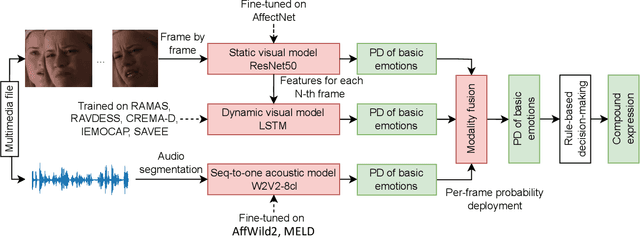
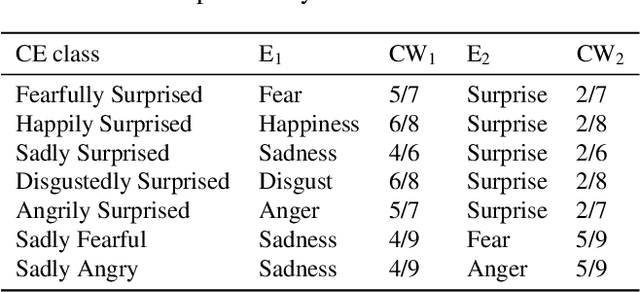
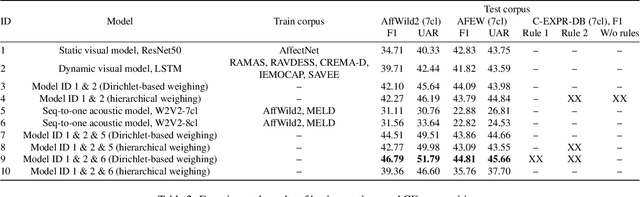
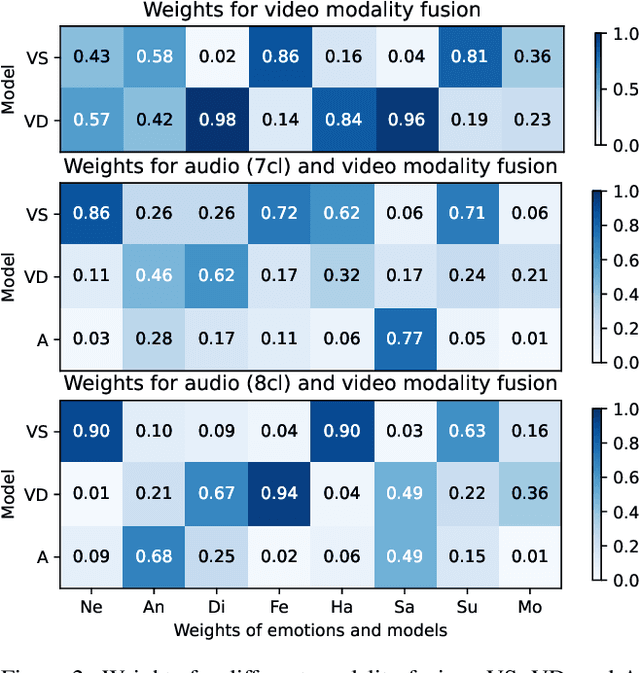
This paper presents the results of the SUN team for the Compound Expressions Recognition Challenge of the 6th ABAW Competition. We propose a novel audio-visual method for compound expression recognition. Our method relies on emotion recognition models that fuse modalities at the emotion probability level, while decisions regarding the prediction of compound expressions are based on predefined rules. Notably, our method does not use any training data specific to the target task. Thus, the problem is a zero-shot classification task. The method is evaluated in multi-corpus training and cross-corpus validation setups. Using our proposed method is achieved an F1-score value equals to 22.01% on the C-EXPR-DB test subset. Our findings from the challenge demonstrate that the proposed method can potentially form a basis for developing intelligent tools for annotating audio-visual data in the context of human's basic and compound emotions.