 Add to Chrome
 Add to Firefox
 Add to Edge
Recurrent Transformer-Based Near- and Far-Field THz Wideband Channel Estimation for UM-MIMO
May 12, 2026
The integration of terahertz communications and ultra-massive multiple-input multiple-output (UM-MIMO) systems in 6G networks is motivated by their ability to enable unprecedented data rates, mitigate spectrum congestion, and enhance overall network performance. However, the enlarged antenna apertures and higher carrier frequencies in these systems increase the Rayleigh distance, causing users to span both the near-field and conventional far-field regions. Accurate spatial precoding thus requires exact channel estimation at the base station - a task made more challenging by the hybrid coexistence of near- and far-field effects and the limited number of digital chains available in hybrid beamforming architectures. In this paper, we propose a block recurrent transformer model to address this challenge. We demonstrate that a single transformer block equipped with state memory can be trained once and then iteratively applied for hybrid-field channel estimation. Furthermore, we train the model such that it generalizes to wireless channels with varying scatterer distances, different numbers of propagation paths, and wideband operation. Simulation results show that the proposed method achieves performance gains of approximately 5 dB and 7.5 dB in normalized mean squared error (NMSE) over state-of-the-art solutions in narrowband and wideband scenarios, respectively.
* 15 pages, 15 figures

Scalable Mamba-Based Message-Passing Neural Decoder for Error-Correcting Codes
May 11, 2026Forward error correction is essential for reliable communication over noisy channels. Attention-based model-free neural decoders have shown strong performance for short codes, but their scalability to longer codes is limited by the quadratic memory and computational cost of attention. In this paper, we introduce the Mamba message-passing decoder (MMPD), an attention-free syndrome-based neural decoder for binary linear codes. MMPD retains the Tanner-graph structure of a message-passing decoder by performing local pairwise aggregation along variable-check edges. To enable efficient long-range information propagation, these local updates are combined with bidirectional Mamba state-space blocks. By avoiding dense attention matrices, MMPD scales more favorably for long codes in both memory and computation. Experiments on the (1056, 880) LDPC code show that MMPD achieves a 0.45 dB gain over the state-of-the-art CrossMPT decoder at a specified target bit error rate, while reducing memory consumption by a factor of 1.5. This reduction factor increases substantially for longer codes, demonstrating the applicability of MMPD to scalable neural decoding of practical long codes.
DMD Prediction of MIMO Channel Using Tucker Decomposition
Mar 16, 2026Accurate channel state information (CSI) prediction is crucial for next-generation multiple-input multiple-output (MIMO) communication systems. Classical prediction methods often become inefficient for high-dimensional and rapidly time-varying channels. To improve prediction efficiency, it is essential to exploit the inherent low-rank tensor structure of the MIMO channel. Motivated by this observation, we propose a dynamic mode decomposition (DMD)-based prediction framework operating on the low-dimensional core tensors obtained via a Tucker decomposition. The proposed method predicts reduced-order channel cores, significantly lowering computational complexity. Simulation results demonstrate that the proposed approach preserves the dominant channel dynamics and achieves high prediction accuracy.
Soft-Output Deep Neural Network-Based Decoding
Apr 18, 2023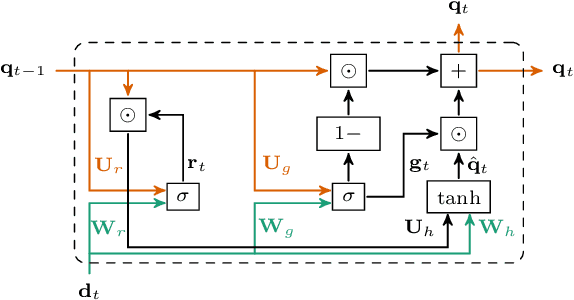
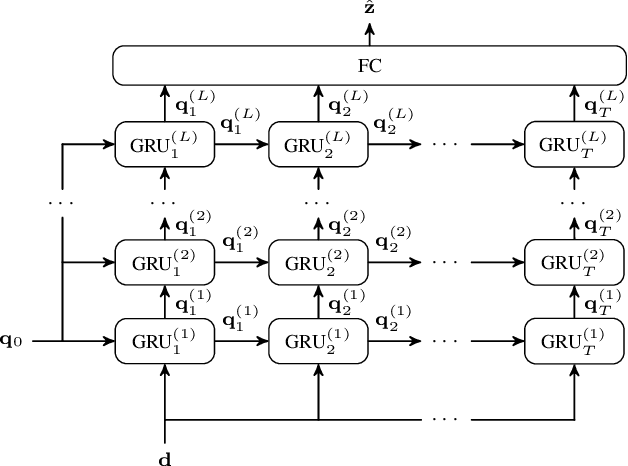
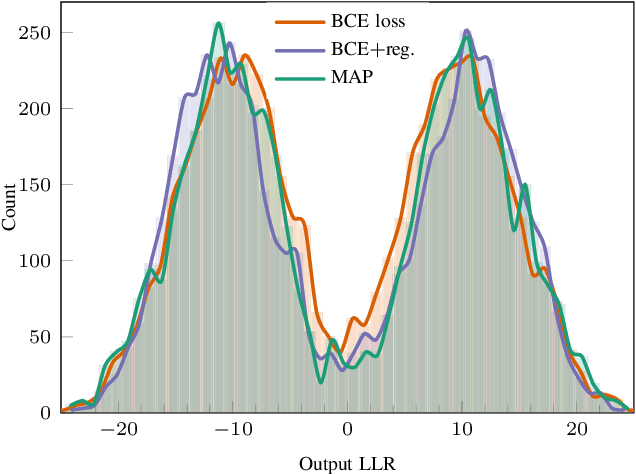
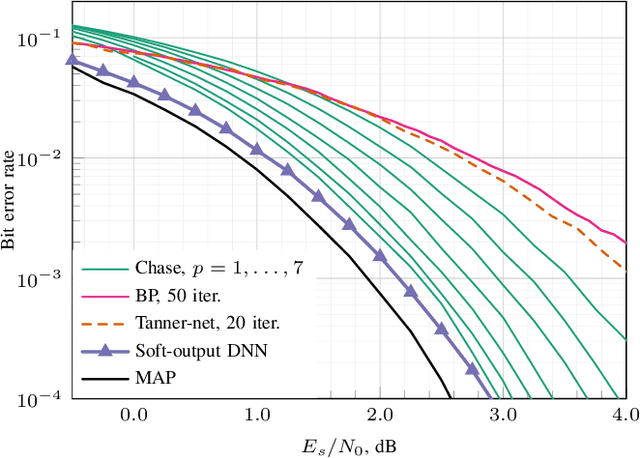
Deep neural network (DNN)-based channel decoding is widely considered in the literature. The existing solutions are investigated for the case of hard output, i.e. when the decoder returns the estimated information word. At the same time, soft-output decoding is of critical importance for iterative receivers and decoders. In this paper, we focus on the soft-output DNN-based decoding problem. We start with the syndrome-based approach proposed by Bennatan et al. (2018) and modify it to provide soft output in the AWGN channel. The new decoder can be considered as an approximation of the MAP decoder with smaller computation complexity. We discuss various regularization functions for joint DNN-MAP training and compare the resulting distributions for [64, 45] BCH code. Finally, to demonstrate the soft-output quality we consider the turbo-product code with [64, 45] BCH codes as row and column codes. We show that the resulting DNN-based scheme is very close to the MAP-based performance and significantly outperforms the solution based on the Chase decoder. We come to the conclusion that the new method is prospective for the challenging problem of DNN-based decoding of long codes consisting of short component codes.