 Add to Chrome
 Add to Firefox
 Add to Edge
Pre-AF 13: An Interpretable Atrial Fibrillation Risk Score Mined from Discharge Reports
Jun 09, 2026
Background. Atrial fibrillation (AF) is the most prevalent cardiac arrhythmia and a major determinant of prognosis. Established AF risk scores rely on factors (older age, hypertension) nearly ubiquitous among patients with cardiovascular disease (CVD), offering limited stratification in this high-risk group. Most target long-term (5-10 year) rather than medium-term prediction. We developed interpretable ML models predicting AF risk over a 24-month and entire follow-up horizon in CVD patients using routinely collected hospital data. Methods. Single-center retrospective study of electronic health records from the National Research Cardiology Center (Russia) for patients aged >=18 with CVD but without pre-existing AF, hospitalized more than once between January 2012 and May 2019. A custom NLP pipeline transformed unstructured discharge reports into 73 structured features, combining a rule-based parser with transformer-based NER. Using LightAutoML we built a full model (73 features), a simple model (reduced subset), and a linear model for a bedside risk score. Performance was assessed by ROC AUC, compared with CHARGE-AF, C2HEST, MHS, and HAVOC, and interpreted via SHAP. Results. Of 80,576 records from 45,000 patients, 17,562 met inclusion criteria; 1,438 (8.19%) developed AF. The full model reached ROC AUC 0.735 (24-month) and 0.696 (entire follow-up); the simple model was nearly identical (0.725, 0.696). All non-linear models outperformed the four clinical risk scores (ROC AUC 0.53-0.64). The simple model uses 13 features and is named Pre-AF 13. SHAP identified age and left atrial volume as dominant predictors. A linear risk score (Pre-AF 9) stratified observed 24-month AF incidence from ~7% to 36%. Conclusion. Interpretable ML models built from routinely collected EHR data identify high-AF-risk CVD patients, outperforming established clinical risk scores.

COLD: Concurrent Loads Disaggregator for Non-Intrusive Load Monitoring
Jun 04, 2021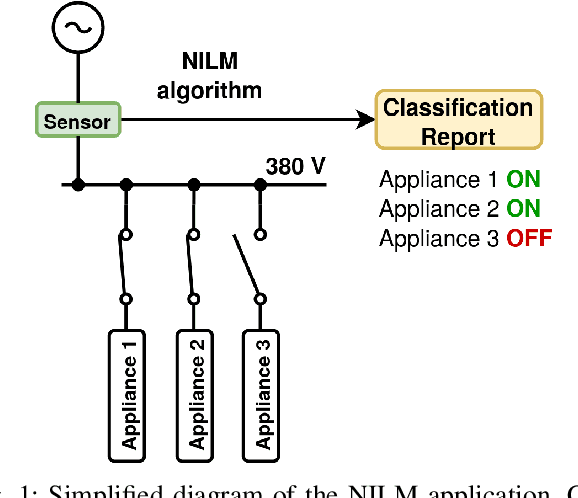
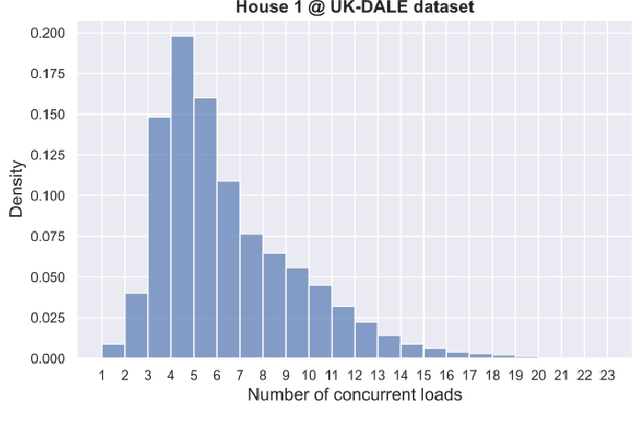
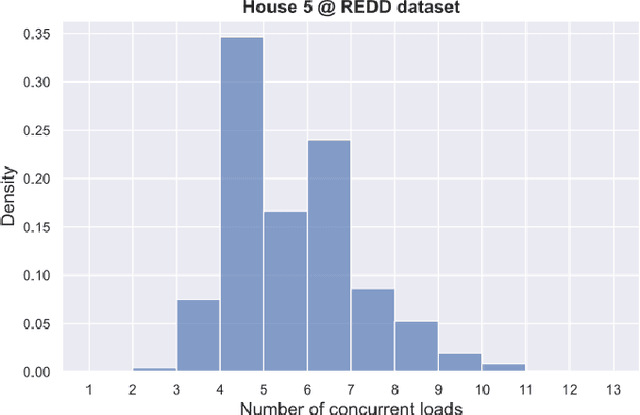
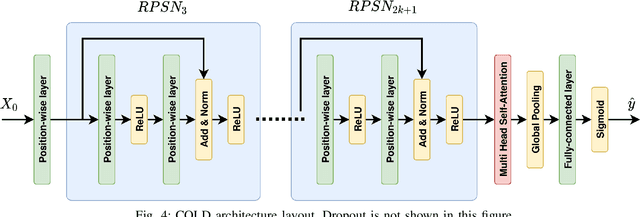
The modern artificial intelligence techniques show the outstanding performances in the field of Non-Intrusive Load Monitoring (NILM). However, the problem related to the identification of a large number of appliances working simultaneously is underestimated. One of the reasons is the absence of a specific data. In this research we propose the Synthesizer of Normalized Signatures (SNS) algorithm to simulate the aggregated consumption with up to 10 concurrent loads. The results show that the synthetic data provides the models with at least as a powerful identification accuracy as the real-world measurements. We have developed the neural architecture named Concurrent Loads Disaggregator (COLD) which is relatively simple and easy to understand in comparison to the previous approaches. Our model allows identifying from 1 to 10 appliances working simultaneously with mean F1-score 78.95%. The source code of the experiments performed is available at https://github.com/arx7ti/cold-nilm.