 Add to Chrome
 Add to Firefox
 Add to Edge
How Much is Left? LLMs Linearly Encode Their Remaining Output Length
Jul 06, 2026
Large language models generate one token at a time, yet their responses show remarkably consistent length structure: step-by-step solutions converge in predictable token counts, retrievals stop after a few sentences, retractions extend responses by measurable amounts. We ask whether the model carries an internal estimate of how much response remains. Training minimal-capacity linear probes on frozen hidden states of three open-weight 7-8B models across seven completion-style datasets, we find three converging pieces of evidence. First, total response length is linearly decodable from the prompt's last hidden state alone, before any output is emitted. Second, probe directions trained on natural-language datasets transfer broadly, including to controlled synthetic completions never seen in training, outperforming a statistical baseline; the converse direction generally fails, and this asymmetry is itself informative. Third, on curated high-loss completions, the probe's per-position estimate shifts upward at the moment the model retracts and restarts a partial solution, a directional behavior no position-only predictor can reproduce (qualitative, not aggregate). We frame this as approximate estimation of remaining generation length, distinct from exact-counting impossibility results for transformers, and interpret it as evidence that LLMs maintain a plan-like internal representation of output length (decodable, not necessarily used causally).

Meta-learning framework with applications to zero-shot time-series forecasting
Feb 07, 2020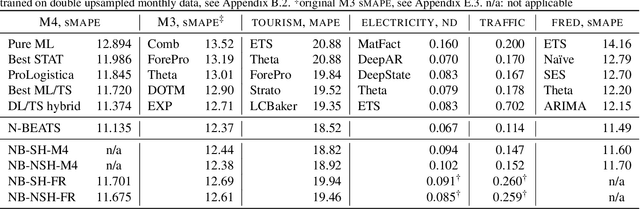
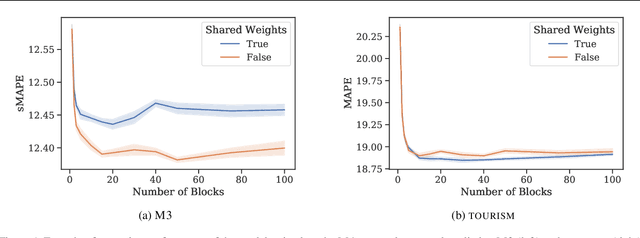
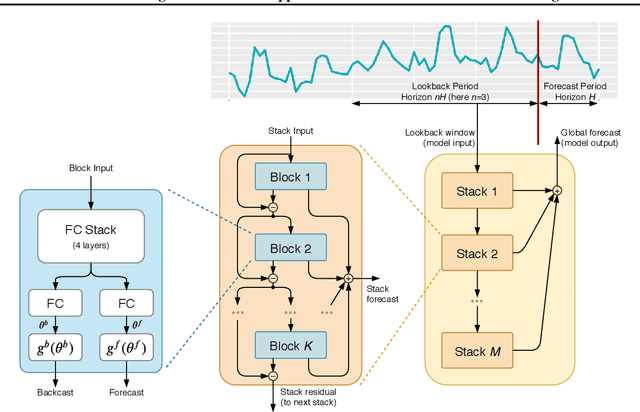
Can meta-learning discover generic ways of processing time-series (TS) from a diverse dataset so as to greatly improve generalization on new TS coming from different datasets? This work provides positive evidence to demonstrate this using a broad meta-learning framework which we show subsumes many existing meta-learning algorithms as specific cases. We further identify via theoretical analysis the meta-learning adaptation mechanisms within N-BEATS, a recent neural TS forecasting model. Our meta-learning theory predicts that N-BEATS iteratively generates a subset of its task-specific parameters based on a given TS input, thus gradually expanding the expressive power of the architecture on-the-fly. Our empirical results emphasize the importance of meta-learning for successful zero-shot forecasting to new sources of TS, supporting the claim that it is viable to train a neural network on a source TS dataset and deploy it on a different target TS dataset without retraining, resulting in performance that is at least as good as that of state-of-practice univariate forecasting models.
N-BEATS: Neural basis expansion analysis for interpretable time series forecasting
May 28, 2019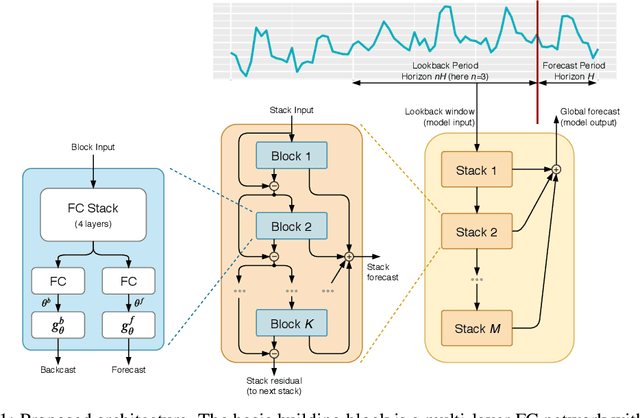
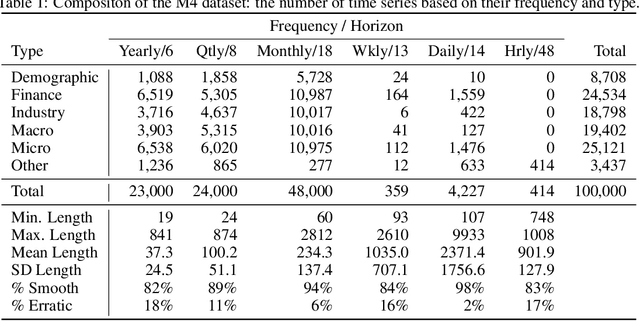
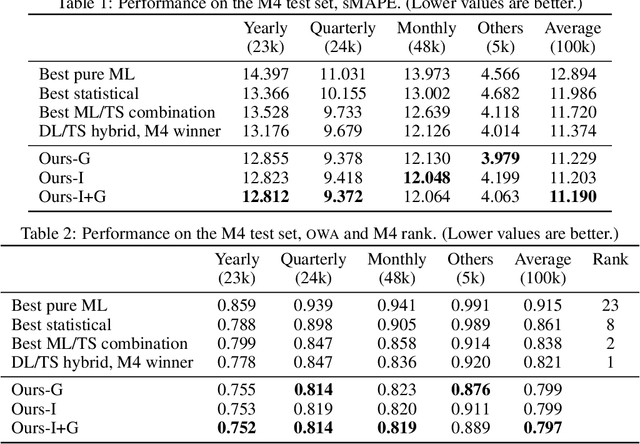
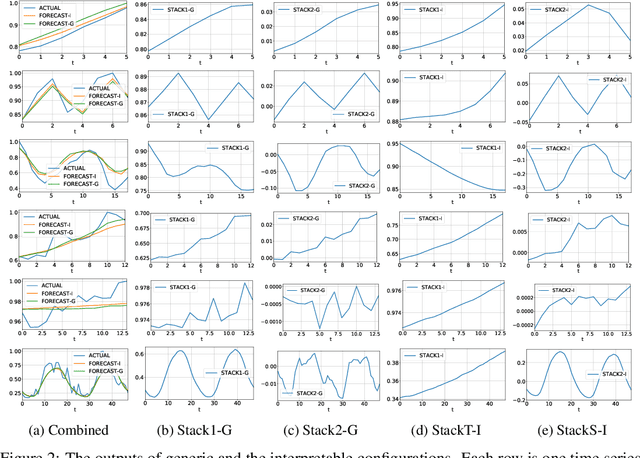
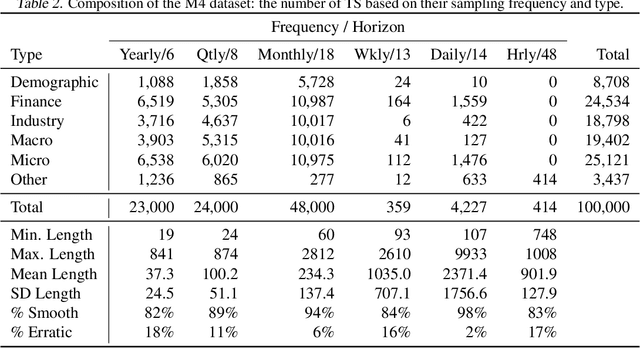
We focus on solving the univariate times series point forecasting problem using deep learning. We propose a deep neural architecture based on backward and forward residual links and a very deep stack of fully-connected layers. The architecture has a number of desirable properties, being interpretable, applicable without modification to a wide array of target domains, and fast to train. We test the proposed architecture on the well-known M4 competition dataset containing 100k time series from diverse domains. We demonstrate state-of-the-art performance for two configurations of N-BEATS, improving forecast accuracy by 11% over a statistical benchmark and by 3% over last year's winner of the M4 competition, a domain-adjusted hand-crafted hybrid between neural network and statistical time series models. The first configuration of our model does not employ any time-series-specific components and its performance on the M4 dataset strongly suggests that, contrarily to received wisdom, deep learning primitives such as residual blocks are by themselves sufficient to solve a wide range of forecasting problems. Finally, we demonstrate how the proposed architecture can be augmented to provide outputs that are interpretable without loss in accuracy.