 Add to Chrome
 Add to Firefox
 Add to Edge
Active Continual Learning with Metaplastic Binary Bayesian Neural Networks
May 28, 2026
Always-on edge systems must keep learning as conditions change under tight compute budgets and must detect unreliable predictions. Bayesian binary neural networks are attractive in this setting, but mean-field Bernoulli posteriors can saturate on long non-stationary streams, wiping out epistemic uncertainty and freezing plasticity. We propose BiMU, derived from a bounded-memory variational objective that balances stability, plasticity, and forgetting. BiMU combines a data term with controlled relaxation toward the prior and an uncertainty-dependent step size that prevents saturation and sustains informative uncertainty. This non-degenerate posterior enables fully online, buffer-free active querying via Monte Carlo disagreement, reducing label queries and backpropagation updates under imbalance. BiMU sustains learning and strong OOD detection on 1000-tasks Permuted-MNIST, and on OpenLORIS-Object achieves up to 32$\times$ label/update savings at matched accuracy under class imbalance and feature compression.

Learning to Remember, Learn, and Forget in Attention-Based Models
Feb 11, 2026In-Context Learning (ICL) in transformers acts as an online associative memory and is believed to underpin their high performance on complex sequence processing tasks. However, in gated linear attention models, this memory has a fixed capacity and is prone to interference, especially for long sequences. We propose Palimpsa, a self-attention model that views ICL as a continual learning problem that must address a stability-plasticity dilemma. Palimpsa uses Bayesian metaplasticity, where the plasticity of each attention state is tied to an importance state grounded by a prior distribution that captures accumulated knowledge. We demonstrate that various gated linear attention models emerge as specific architecture choices and posterior approximations, and that Mamba2 is a special case of Palimpsa where forgetting dominates. This theoretical link enables the transformation of any non-metaplastic model into a metaplastic one, significantly expanding its memory capacity. Our experiments show that Palimpsa consistently outperforms baselines on the Multi-Query Associative Recall (MQAR) benchmark and on Commonsense Reasoning tasks.
Bayesian continual learning and forgetting in neural networks
Apr 18, 2025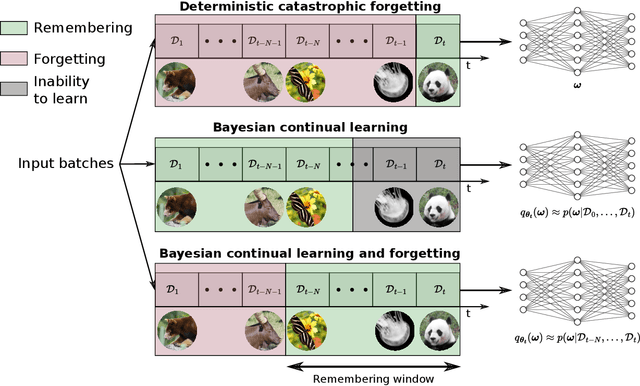
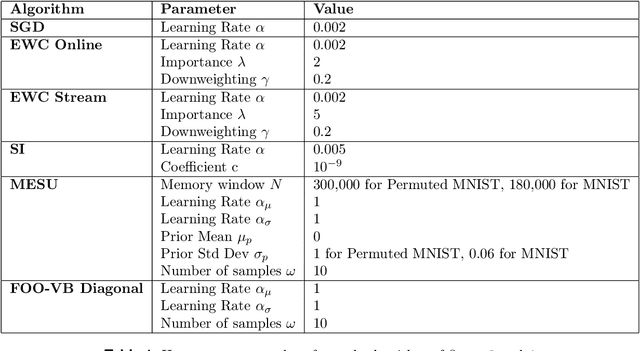
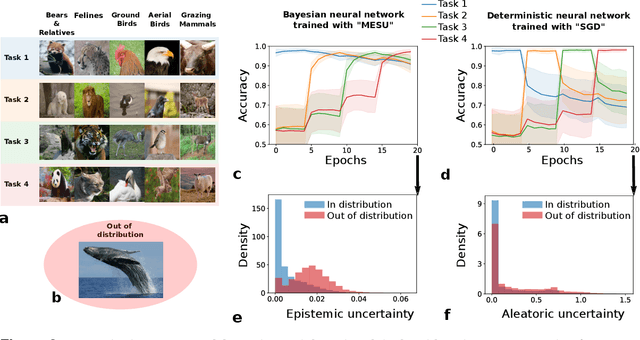
Biological synapses effortlessly balance memory retention and flexibility, yet artificial neural networks still struggle with the extremes of catastrophic forgetting and catastrophic remembering. Here, we introduce Metaplasticity from Synaptic Uncertainty (MESU), a Bayesian framework that updates network parameters according their uncertainty. This approach allows a principled combination of learning and forgetting that ensures that critical knowledge is preserved while unused or outdated information is gradually released. Unlike standard Bayesian approaches -- which risk becoming overly constrained, and popular continual-learning methods that rely on explicit task boundaries, MESU seamlessly adapts to streaming data. It further provides reliable epistemic uncertainty estimates, allowing out-of-distribution detection, the only computational cost being to sample the weights multiple times to provide proper output statistics. Experiments on image-classification benchmarks demonstrate that MESU mitigates catastrophic forgetting, while maintaining plasticity for new tasks. When training 200 sequential permuted MNIST tasks, MESU outperforms established continual learning techniques in terms of accuracy, capability to learn additional tasks, and out-of-distribution data detection. Additionally, due to its non-reliance on task boundaries, MESU outperforms conventional learning techniques on the incremental training of CIFAR-100 tasks consistently in a wide range of scenarios. Our results unify ideas from metaplasticity, Bayesian inference, and Hessian-based regularization, offering a biologically-inspired pathway to robust, perpetual learning.
Bayesian Metaplasticity from Synaptic Uncertainty
Dec 15, 2023Catastrophic forgetting remains a challenge for neural networks, especially in lifelong learning scenarios. In this study, we introduce MEtaplasticity from Synaptic Uncertainty (MESU), inspired by metaplasticity and Bayesian inference principles. MESU harnesses synaptic uncertainty to retain information over time, with its update rule closely approximating the diagonal Newton's method for synaptic updates. Through continual learning experiments on permuted MNIST tasks, we demonstrate MESU's remarkable capability to maintain learning performance across 100 tasks without the need of explicit task boundaries.