 Add to Chrome
 Add to Firefox
 Add to Edge
SAMM2D: Scale-Aware Multi-Modal 2D Dual-Encoder for High-Sensitivity Intracrania Aneurysm Screening
Dec 20, 2025
Effective aneurysm detection is essential to avert life-threatening hemorrhages, but it remains challenging due to the subtle morphology of the aneurysm, pronounced class imbalance, and the scarcity of annotated data. We introduce SAMM2D, a dual-encoder framework that achieves an AUC of 0.686 on the RSNA intracranial aneurysm dataset; an improvement of 32% over the clinical baseline. In a comprehensive ablation across six augmentation regimes, we made a striking discovery: any form of data augmentation degraded performance when coupled with a strong pretrained backbone. Our unaugmented baseline model outperformed all augmented variants by 1.75--2.23 percentage points (p < 0.01), overturning the assumption that "more augmentation is always better" in low-data medical settings. We hypothesize that ImageNet-pretrained features already capture robust invariances, rendering additional augmentations both redundant and disruptive to the learned feature manifold. By calibrating the decision threshold, SAMM2D reaches 95% sensitivity, surpassing average radiologist performance, and translates to a projected \$13.9M in savings per 1,000 patients in screening applications. Grad-CAM visualizations confirm that 85% of true positives attend to relevant vascular regions (62% IoU with expert annotations), demonstrating the model's clinically meaningful focus. Our results suggest that future medical imaging workflows could benefit more from strong pretraining than from increasingly complex augmentation pipelines.

TissUnet: Improved Extracranial Tissue and Cranium Segmentation for Children through Adulthood
Jun 06, 2025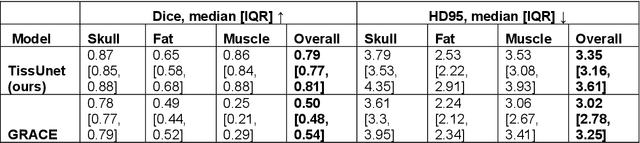
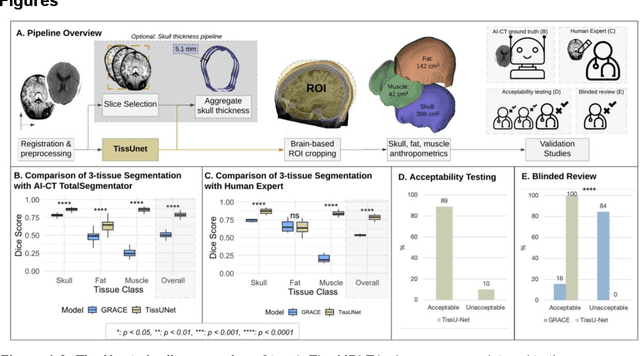

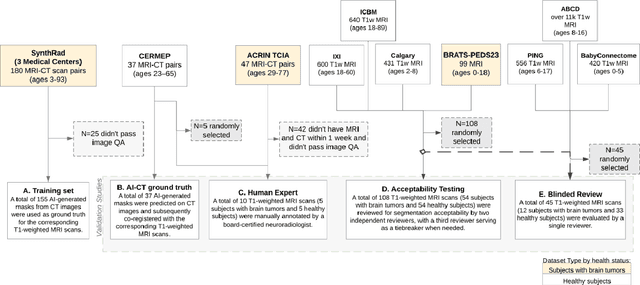
Extracranial tissues visible on brain magnetic resonance imaging (MRI) may hold significant value for characterizing health conditions and clinical decision-making, yet they are rarely quantified. Current tools have not been widely validated, particularly in settings of developing brains or underlying pathology. We present TissUnet, a deep learning model that segments skull bone, subcutaneous fat, and muscle from routine three-dimensional T1-weighted MRI, with or without contrast enhancement. The model was trained on 155 paired MRI-computed tomography (CT) scans and validated across nine datasets covering a wide age range and including individuals with brain tumors. In comparison to AI-CT-derived labels from 37 MRI-CT pairs, TissUnet achieved a median Dice coefficient of 0.79 [IQR: 0.77-0.81] in a healthy adult cohort. In a second validation using expert manual annotations, median Dice was 0.83 [IQR: 0.83-0.84] in healthy individuals and 0.81 [IQR: 0.78-0.83] in tumor cases, outperforming previous state-of-the-art method. Acceptability testing resulted in an 89% acceptance rate after adjudication by a tie-breaker(N=108 MRIs), and TissUnet demonstrated excellent performance in the blinded comparative review (N=45 MRIs), including both healthy and tumor cases in pediatric populations. TissUnet enables fast, accurate, and reproducible segmentation of extracranial tissues, supporting large-scale studies on craniofacial morphology, treatment effects, and cardiometabolic risk using standard brain T1w MRI.