 Add to Chrome
 Add to Firefox
 Add to Edge
Modality-Invariant Coarse-to-Fine Retinal Image Registration
Aug 14, 2026
Retinal image registration is essential for ophthalmic diagnosis, longitudinal disease monitoring, and multimodal retinal image analysis. Existing retinal registration methods are typically modality-dependent: they are designed or optimized either for a single imaging modality in mono-modal registration or for a fixed pair of modalities in cross-modal registration. This limits their flexibility and applicability in practical scenarios involving diverse retinal imaging modalities and different combinations of them. In this work, we propose a generalizable two-stage, modality-invariant framework for retinal image registration. First, we introduce a sparse feature-matching model driven by a universal retinal vessel segmentation to achieve robust coarse global alignment across modalities. Second, we develop a modality-invariant optical flow estimation network, termed MI-RAFT, to refine the alignment through dense local registration. Extensive experiments demonstrate that the proposed method can handle diverse combinations of commonly used retinal imaging modalities, exhibiting strong modality invariance while outperforming state-of-the-art modality-dependent registration methods.

Universal Vessel Segmentation for Multi-Modality Retinal Images
Feb 10, 2025
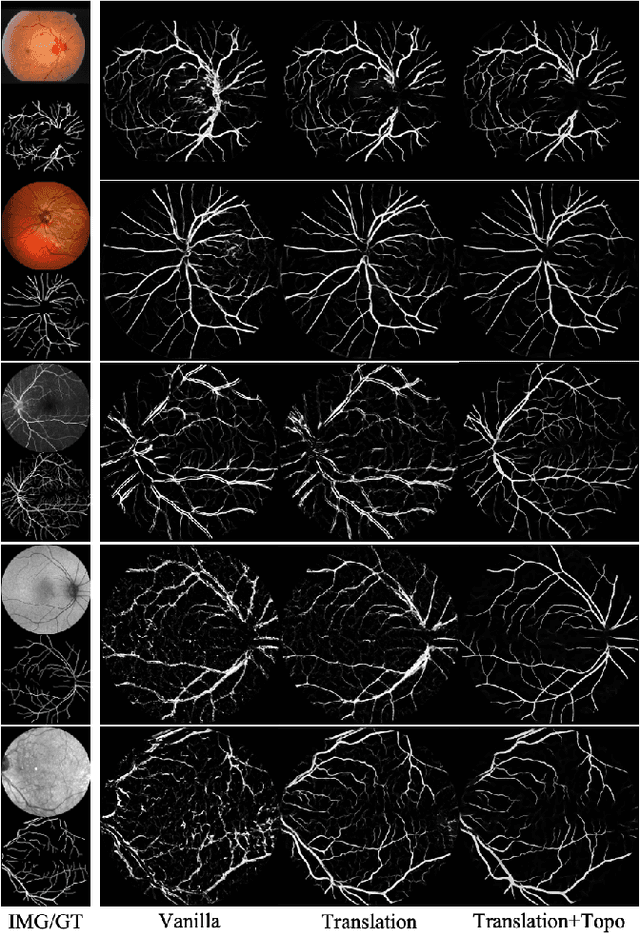
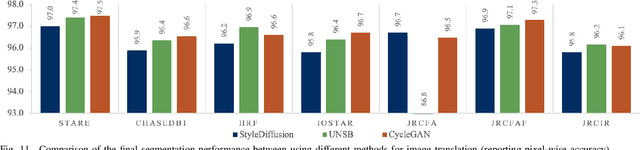
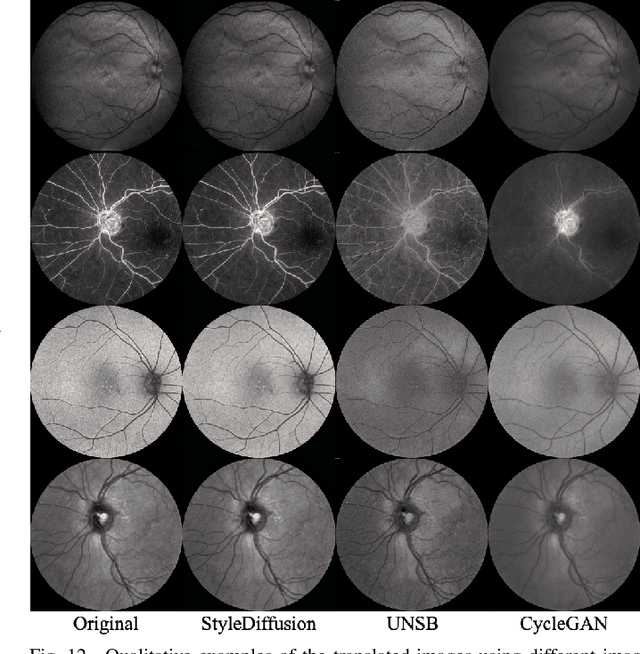
We identify two major limitations in the existing studies on retinal vessel segmentation: (1) Most existing works are restricted to one modality, i.e, the Color Fundus (CF). However, multi-modality retinal images are used every day in the study of retina and retinal diseases, and the study of vessel segmentation on the other modalities is scarce; (2) Even though a small amount of works extended their experiments to limited new modalities such as the Multi-Color Scanning Laser Ophthalmoscopy (MC), these works still require finetuning a separate model for the new modality. And the finetuning will require extra training data, which is difficult to acquire. In this work, we present a foundational universal vessel segmentation model (UVSM) for multi-modality retinal images. Not only do we perform the study on a much wider range of modalities, but also we propose a universal model to segment the vessels in all these commonly-used modalities. Despite being much more versatile comparing with existing methods, our universal model still demonstrates comparable performance with the state-of-the- art finetuned methods. To the best of our knowledge, this is the first work that achieves cross-modality retinal vessel segmentation and also the first work to study retinal vessel segmentation in some novel modalities.