 Add to Chrome
 Add to Firefox
 Add to Edge
Acoustic disguising: a unified framework for cloaking and holography
Jun 07, 2026
Cloaking and holography -- usually treated as distinct problems -- are two limits of a single operation that we call acoustic disguising, realized here using immersive boundary conditions on a closed surface. Driving the boundary with homogeneous Green's functions suppresses any incident field inside the enclosed volume and cloaks unknown objects broadband; driving it with scattering Green's functions synthesizes a holographic scatterer indistinguishable from a target for arbitrary illuminations. Combining the two, using heterogeneous Green's functions, replaces the scattering signature of one object with that of another, transforming its acoustic identity. We demonstrate the framework in three-dimensional FDTD simulations driven by impulsive Green's functions, complemented by data-driven Green's-function retrieval, establishing a direct route to real-time 3D acoustic cloaking, holography, cloning, and disguising.

Acoustic Cloning
Jun 07, 2026Cloning refers to producing identical copies of existing objects. Here, we experimentally show how to clone acoustic scattering objects. We acquire a digital twin and bring it back to life - a simple two-step process. First, we use broadband speakers to illuminate the scattering object within a closed receiver aperture. From these recorded reverberative data, we retrieve the object's scattering Green's functions using multidimensional deconvolution. In the second step, the acoustic scatterer is holographically reconstructed using the acquired scattering Green's functions. The hologram scatters any wavefield in real-time exactly like the original object would. Low-latency feedback reproduces all orders of interactions between the physical wavefield and the numerically defined hologram. This two-step process is demonstrated by cloning and modifying several rigid scatterers in a two-dimensional acoustic waveguide. Applications range from fully realistic digital scattering models to efficient metamaterial experimentation.
* 17 pages, 14 figures. Author-prepared version of the article published in Phys. Rev. Applied 20, 064014 (2023). Supporting data: https://doi.org/10.5281/zenodo.16880576 Website: https://jmullerresearch.ch Contact: jmuller.research@gmail.com
Binary classification of spoken words with passive elastic metastructures
Nov 14, 2021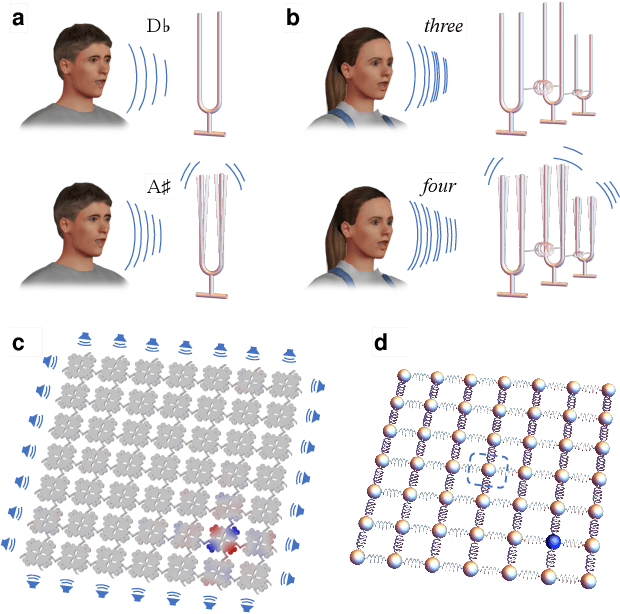
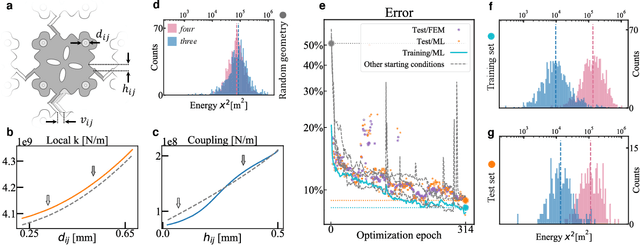
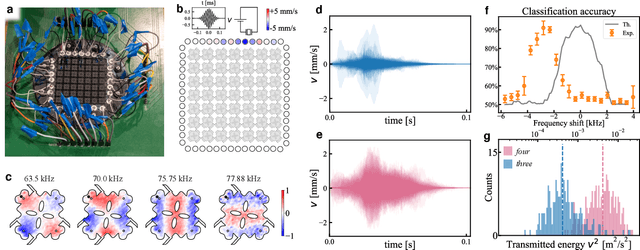
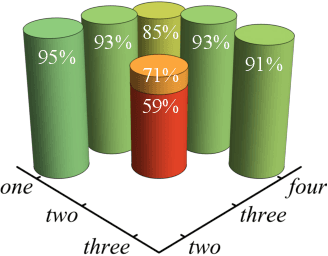
Many electronic devices spend most of their time waiting for a wake-up event: pacemakers waiting for an anomalous heartbeat, security systems on alert to detect an intruder, smartphones listening for the user to say a wake-up phrase. These devices continuously convert physical signals into electrical currents that are then analyzed on a digital computer -- leading to power consumption even when no event is taking place. Solving this problem requires the ability to passively distinguish relevant from irrelevant events (e.g. tell a wake-up phrase from a regular conversation). Here, we experimentally demonstrate an elastic metastructure, consisting of a network of coupled silicon resonators, that passively discriminates between pairs of spoken words -- solving the wake-up problem for scenarios where only two classes of events are possible. This passive speech recognition is demonstrated on a dataset from speakers with significant gender and accent diversity. The geometry of the metastructure is determined during the design process, in which the network of resonators ('mechanical neurones') learns to selectively respond to spoken words. Training is facilitated by a machine learning model that reduces the number of computationally expensive three-dimensional elastic wave simulations. By embedding event detection in the structural dynamics, mechanical neural networks thus enable novel classes of always-on smart devices with no standby power consumption.