 Add to Chrome
 Add to Firefox
 Add to Edge
EEG Emotion Classification Using an Enhanced Transformer-CNN-BiLSTM Architecture with Dual Attention Mechanisms
Feb 06, 2026
Electroencephalography (EEG)-based emotion recognition plays a critical role in affective computing and emerging decision-support systems, yet remains challenging due to high-dimensional, noisy, and subject-dependent signals. This study investigates whether hybrid deep learning architectures that integrate convolutional, recurrent, and attention-based components can improve emotion classification performance and robustness in EEG data. We propose an enhanced hybrid model that combines convolutional feature extraction, bidirectional temporal modeling, and self-attention mechanisms with regularization strategies to mitigate overfitting. Experiments conducted on a publicly available EEG dataset spanning three emotional states (neutral, positive, and negative) demonstrate that the proposed approach achieves state-of-the-art classification performance, significantly outperforming classical machine learning and neural baselines. Statistical tests confirm the robustness of these performance gains under cross-validation. Feature-level analyses further reveal that covariance-based EEG features contribute most strongly to emotion discrimination, highlighting the importance of inter-channel relationships in affective modeling. These findings suggest that carefully designed hybrid architectures can effectively balance predictive accuracy, robustness, and interpretability in EEG-based emotion recognition, with implications for applied affective computing and human-centered intelligent systems.

MRANet: A Modified Residual Attention Networks for Lung and Colon Cancer Classification
Dec 23, 2024Lung and colon cancers are predominant contributors to cancer mortality. Early and accurate diagnosis is crucial for effective treatment. By utilizing imaging technology in different image detection, learning models have shown promise in automating cancer classification from histopathological images. This includes the histopathological diagnosis, an important factor in cancer type identification. This research focuses on creating a high-efficiency deep-learning model for identifying lung and colon cancer from histopathological images. We proposed a novel approach based on a modified residual attention network architecture. The model was trained on a dataset of 25,000 high-resolution histopathological images across several classes. Our proposed model achieved an exceptional accuracy of 99.30%, 96.63%, and 97.56% for two, three, and five classes, respectively; those are outperforming other state-of-the-art architectures. This study presents a highly accurate deep learning model for lung and colon cancer classification. The superior performance of our proposed model addresses a critical need in medical AI applications.
Early diagnosis of autism spectrum disorder using machine learning approaches
Sep 20, 2023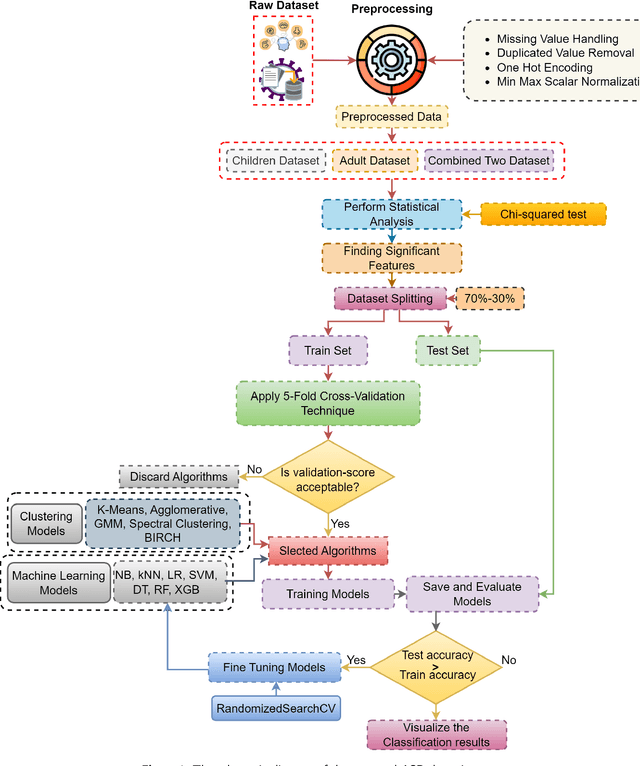
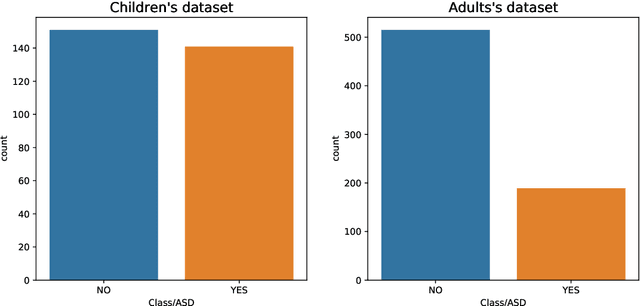
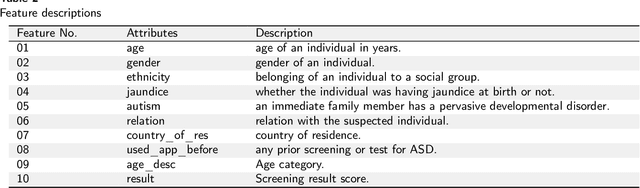
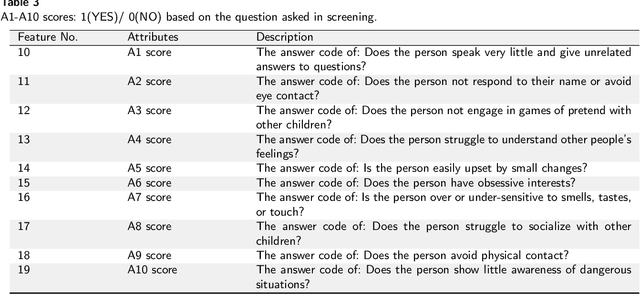
Autistic Spectrum Disorder (ASD) is a neurological disease characterized by difficulties with social interaction, communication, and repetitive activities. The severity of these difficulties varies, and those with this diagnosis face unique challenges. While its primary origin lies in genetics, identifying and addressing it early can contribute to the enhancement of the condition. In recent years, machine learning-driven intelligent diagnosis has emerged as a supplement to conventional clinical approaches, aiming to address the potential drawbacks of time-consuming and costly traditional methods. In this work, we utilize different machine learning algorithms to find the most significant traits responsible for ASD and to automate the diagnostic process. We study six classification models to see which model works best to identify ASD and also study five popular clustering methods to get a meaningful insight of these ASD datasets. To find the best classifier for these binary datasets, we evaluate the models using accuracy, precision, recall, specificity, F1-score, AUC, kappa and log loss metrics. Our evaluation demonstrates that five out of the six selected models perform exceptionally, achieving a 100% accuracy rate on the ASD datasets when hyperparameters are meticulously tuned for each model. As almost all classification models are able to get 100% accuracy, we become interested in observing the underlying insights of the datasets by implementing some popular clustering algorithms on these datasets. We calculate Normalized Mutual Information (NMI), Adjusted Rand Index (ARI) & Silhouette Coefficient (SC) metrics to select the best clustering models. Our evaluation finds that spectral clustering outperforms all other benchmarking clustering models in terms of NMI & ARI metrics and it also demonstrates comparability to the optimal SC achieved by k-means.