 Add to Chrome
 Add to Firefox
 Add to Edge
FineREX: Fine-Tuned NER-RE for Human Smuggling Knowledge Graphs
Jun 18, 2026
Court proceedings contain valuable evidence about human smuggling networks, but this information is often buried within unstructured, jargon-heavy legal documents. While large language models (LLMs) can support knowledge graph construction through automated information extraction, existing approaches rely on general-purpose models that are not tailored to the entity and relationship definitions required in this domain. We introduce FineREX, a streamlined knowledge graph construction pipeline built around a fine-tuned LLM for named entity recognition and relationship extraction (NER-RE). Using a manually annotated dataset of $512$ text chunks, FineREX achieves absolute improvements of 15.50% and 31.46% in entity and relationship F1-score, respectively, compared to a larger general-purpose baseline. These gains translate into higher-quality knowledge graphs, reducing legal noise by nearly half and lowering node duplication on long documents from 17.78% to 11.17%. By eliminating document rewriting and redundant extraction stages, FineREX also reduces end-to-end processing time by 50.0%. Our results demonstrate that domain-specific fine-tuning can substantially outperform larger general-purpose models while improving both the quality and efficiency of knowledge graph construction for illicit network analysis.

LINK-KG: LLM-Driven Coreference-Resolved Knowledge Graphs for Human Smuggling Networks
Oct 30, 2025Human smuggling networks are complex and constantly evolving, making them difficult to analyze comprehensively. Legal case documents offer rich factual and procedural insights into these networks but are often long, unstructured, and filled with ambiguous or shifting references, posing significant challenges for automated knowledge graph (KG) construction. Existing methods either overlook coreference resolution or fail to scale beyond short text spans, leading to fragmented graphs and inconsistent entity linking. We propose LINK-KG, a modular framework that integrates a three-stage, LLM-guided coreference resolution pipeline with downstream KG extraction. At the core of our approach is a type-specific Prompt Cache, which consistently tracks and resolves references across document chunks, enabling clean and disambiguated narratives for structured knowledge graph construction from both short and long legal texts. LINK-KG reduces average node duplication by 45.21% and noisy nodes by 32.22% compared to baseline methods, resulting in cleaner and more coherent graph structures. These improvements establish LINK-KG as a strong foundation for analyzing complex criminal networks.
Inside CORE-KG: Evaluating Structured Prompting and Coreference Resolution for Knowledge Graphs
Oct 30, 2025Human smuggling networks are increasingly adaptive and difficult to analyze. Legal case documents offer critical insights but are often unstructured, lexically dense, and filled with ambiguous or shifting references, which pose significant challenges for automated knowledge graph (KG) construction. While recent LLM-based approaches improve over static templates, they still generate noisy, fragmented graphs with duplicate nodes due to the absence of guided extraction and coreference resolution. The recently proposed CORE-KG framework addresses these limitations by integrating a type-aware coreference module and domain-guided structured prompts, significantly reducing node duplication and legal noise. In this work, we present a systematic ablation study of CORE-KG to quantify the individual contributions of its two key components. Our results show that removing coreference resolution results in a 28.32% increase in node duplication and a 4.32% increase in noisy nodes, while removing structured prompts leads to a 4.34% increase in node duplication and a 73.33% increase in noisy nodes. These findings offer empirical insights for designing robust LLM-based pipelines for extracting structured representations from complex legal texts.
Cross-Domain Recommendation Meets Large Language Models
Nov 29, 2024

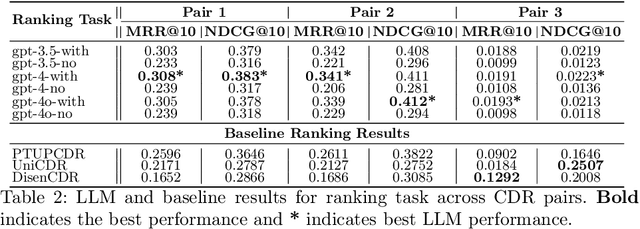
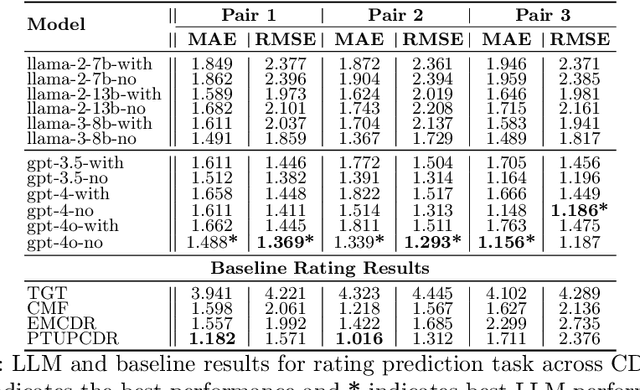
Cross-domain recommendation (CDR) has emerged as a promising solution to the cold-start problem, faced by single-domain recommender systems. However, existing CDR models rely on complex neural architectures, large datasets, and significant computational resources, making them less effective in data-scarce scenarios or when simplicity is crucial. In this work, we leverage the reasoning capabilities of large language models (LLMs) and explore their performance in the CDR domain across multiple domain pairs. We introduce two novel prompt designs tailored for CDR and demonstrate that LLMs, when prompted effectively, outperform state-of-the-art CDR baselines across various metrics and domain combinations in the rating prediction and ranking tasks. This work bridges the gap between LLMs and recommendation systems, showcasing their potential as effective cross-domain recommenders.