 Add to Chrome
 Add to Firefox
 Add to Edge
TwinMixing: A Shuffle-Aware Feature Interaction Model for Multi-Task Segmentation
Mar 30, 2026
Accurate and efficient perception is essential for autonomous driving, where segmentation tasks such as drivable-area and lane segmentation provide critical cues for motion planning and control. However, achieving high segmentation accuracy while maintaining real-time performance on low-cost hardware remains a challenging problem. To address this issue, we introduce TwinMixing, a lightweight multi-task segmentation model designed explicitly for drivable-area and lane segmentation. The proposed network features a shared encoder and task-specific decoders, enabling both feature sharing and task specialization. Within the encoder, we propose an Efficient Pyramid Mixing (EPM) module that enhances multi-scale feature extraction through a combination of grouped convolutions, depthwise dilated convolutions and channel shuffle operations, effectively expanding the receptive field while minimizing computational cost. Each decoder adopts a Dual-Branch Upsampling (DBU) Block composed of a learnable transposed convolution-based Fine detailed branch and a parameter-free bilinear interpolation-based Coarse grained branch, achieving detailed yet spatially consistent feature reconstruction. Extensive experiments on the BDD100K dataset validate the effectiveness of TwinMixing across three configurations - tiny, base, and large. Among them, the base configuration achieves the best trade-off between accuracy and computational efficiency, reaching 92.0% mIoU for drivable-area segmentation and 32.3% IoU for lane segmentation with only 0.43M parameters and 3.95 GFLOPs. Moreover, TwinMixing consistently outperforms existing segmentation models on the same tasks, as illustrated in Fig. 1. Thanks to its compact and modular design, TwinMixing demonstrates strong potential for real-time deployment in autonomous driving and embedded perception systems. The source code: https://github.com/Jun0se7en/TwinMixing.

R&D: Balancing Reliability and Diversity in Synthetic Data Augmentation for Semantic Segmentation
Mar 19, 2026Collecting and annotating datasets for pixel-level semantic segmentation tasks are highly labor-intensive. Data augmentation provides a viable solution by enhancing model generalization without additional real-world data collection. Traditional augmentation techniques, such as translation, scaling, and color transformations, create geometric variations but fail to generate new structures. While generative models have been employed to extend semantic information of datasets, they often struggle to maintain consistency between the original and generated images, particularly for pixel-level tasks. In this work, we propose a novel synthetic data augmentation pipeline that integrates controllable diffusion models. Our approach balances diversity and reliability data, effectively bridging the gap between synthetic and real data. We utilize class-aware prompting and visual prior blending to improve image quality further, ensuring precise alignment with segmentation labels. By evaluating benchmark datasets such as PASCAL VOC and BDD100K, we demonstrate that our method significantly enhances semantic segmentation performance, especially in data-scarce scenarios, while improving model robustness in real-world applications. Our code is available at \href{https://github.com/chequanghuy/Enhanced-Generative-Data-Augmentation-for-Semantic-Segmentation-via-Stronger-Guidance}{https://github.com/chequanghuy/Enhanced-Generative-Data-Augmentation-for-Semantic-Segmentation-via-Stronger-Guidance}.
A Re-ranking Method using K-nearest Weighted Fusion for Person Re-identification
Sep 04, 2025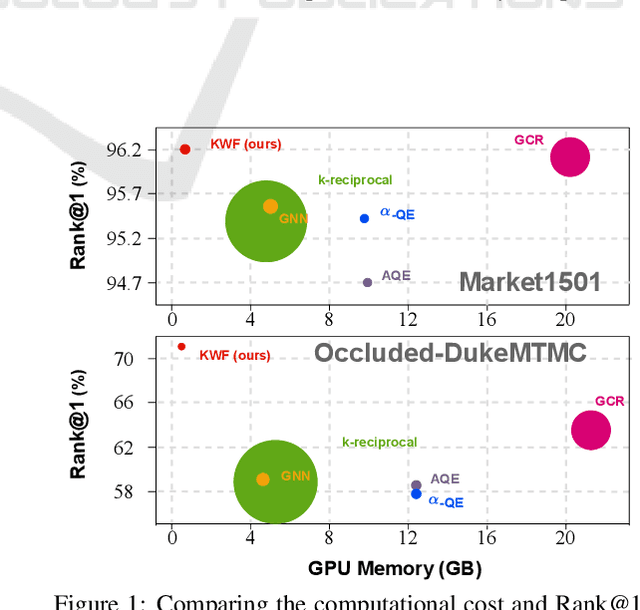
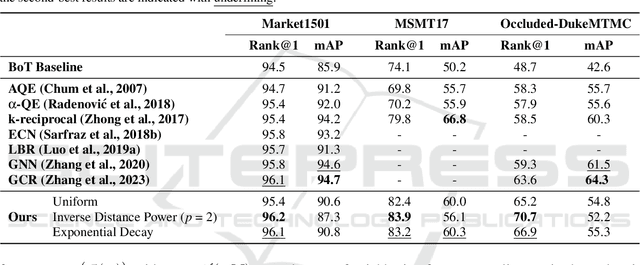
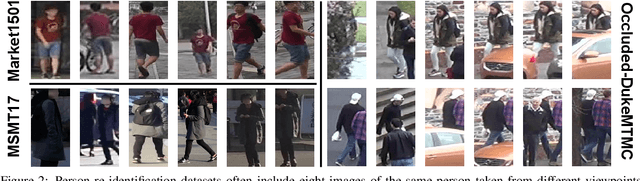
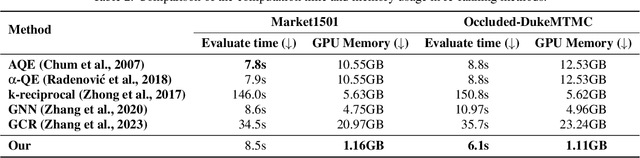
In person re-identification, re-ranking is a crucial step to enhance the overall accuracy by refining the initial ranking of retrieved results. Previous studies have mainly focused on features from single-view images, which can cause view bias and issues like pose variation, viewpoint changes, and occlusions. Using multi-view features to present a person can help reduce view bias. In this work, we present an efficient re-ranking method that generates multi-view features by aggregating neighbors' features using K-nearest Weighted Fusion (KWF) method. Specifically, we hypothesize that features extracted from re-identification models are highly similar when representing the same identity. Thus, we select K neighboring features in an unsupervised manner to generate multi-view features. Additionally, this study explores the weight selection strategies during feature aggregation, allowing us to identify an effective strategy. Our re-ranking approach does not require model fine-tuning or extra annotations, making it applicable to large-scale datasets. We evaluate our method on the person re-identification datasets Market1501, MSMT17, and Occluded-DukeMTMC. The results show that our method significantly improves Rank@1 and mAP when re-ranking the top M candidates from the initial ranking results. Specifically, compared to the initial results, our re-ranking method achieves improvements of 9.8%/22.0% in Rank@1 on the challenging datasets: MSMT17 and Occluded-DukeMTMC, respectively. Furthermore, our approach demonstrates substantial enhancements in computational efficiency compared to other re-ranking methods.
* Published in ICPRAM 2025, ISBN 978-989-758-730-6, ISSN 2184-4313