 Add to Chrome
 Add to Firefox
 Add to Edge
Fairness Is Not Just Ethical: Performance Trade-Off via Data Correlation Tuning to Mitigate Bias in ML Software
Dec 19, 2025
Traditional software fairness research typically emphasizes ethical and social imperatives, neglecting that fairness fundamentally represents a core software quality issue arising directly from performance disparities across sensitive user groups. Recognizing fairness explicitly as a software quality dimension yields practical benefits beyond ethical considerations, notably improved predictive performance for unprivileged groups, enhanced out-of-distribution generalization, and increased geographic transferability in real-world deployments. Nevertheless, existing bias mitigation methods face a critical dilemma: while pre-processing methods offer broad applicability across model types, they generally fall short in effectiveness compared to post-processing techniques. To overcome this challenge, we propose Correlation Tuning (CoT), a novel pre-processing approach designed to mitigate bias by adjusting data correlations. Specifically, CoT introduces the Phi-coefficient, an intuitive correlation measure, to systematically quantify correlation between sensitive attributes and labels, and employs multi-objective optimization to address the proxy biases. Extensive evaluations demonstrate that CoT increases the true positive rate of unprivileged groups by an average of 17.5% and reduces three key bias metrics, including statistical parity difference (SPD), average odds difference (AOD), and equal opportunity difference (EOD), by more than 50% on average. CoT outperforms state-of-the-art methods by three and ten percentage points in single attribute and multiple attributes scenarios, respectively. We will publicly release our experimental results and source code to facilitate future research.

FITNESS: A Causal De-correlation Approach for Mitigating Bias in Machine Learning Software
May 23, 2023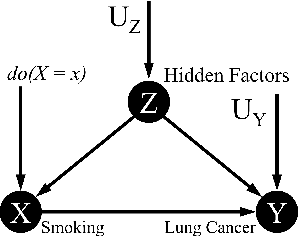

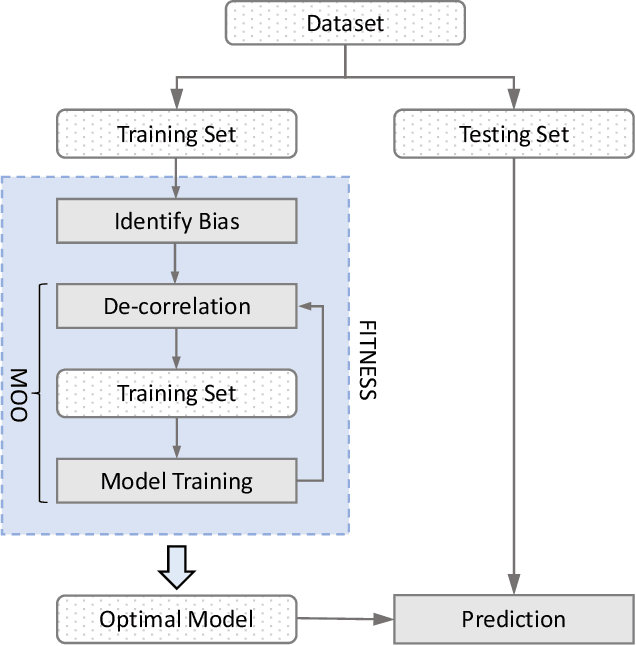
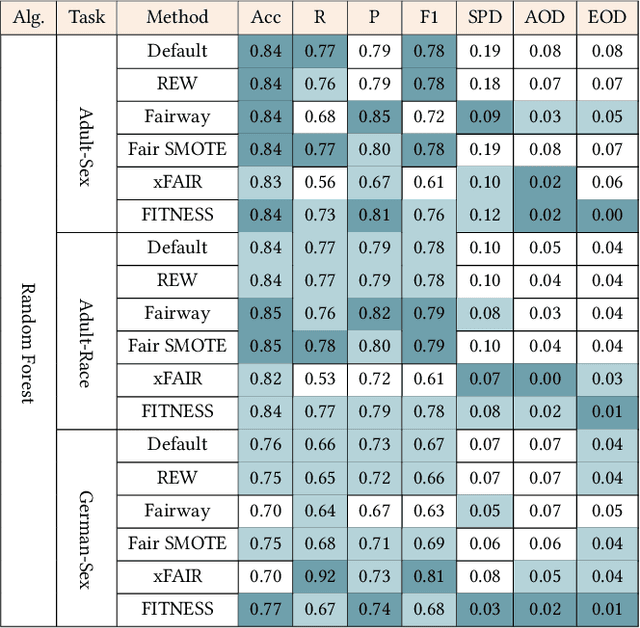
Software built on top of machine learning algorithms is becoming increasingly prevalent in a variety of fields, including college admissions, healthcare, insurance, and justice. The effectiveness and efficiency of these systems heavily depend on the quality of the training datasets. Biased datasets can lead to unfair and potentially harmful outcomes, particularly in such critical decision-making systems where the allocation of resources may be affected. This can exacerbate discrimination against certain groups and cause significant social disruption. To mitigate such unfairness, a series of bias-mitigating methods are proposed. Generally, these studies improve the fairness of the trained models to a certain degree but with the expense of sacrificing the model performance. In this paper, we propose FITNESS, a bias mitigation approach via de-correlating the causal effects between sensitive features (e.g., the sex) and the label. Our key idea is that by de-correlating such effects from a causality perspective, the model would avoid making predictions based on sensitive features and thus fairness could be improved. Furthermore, FITNESS leverages multi-objective optimization to achieve a better performance-fairness trade-off. To evaluate the effectiveness, we compare FITNESS with 7 state-of-the-art methods in 8 benchmark tasks by multiple metrics. Results show that FITNESS can outperform the state-of-the-art methods on bias mitigation while preserve the model's performance: it improved the model's fairness under all the scenarios while decreased the model's performance under only 26.67% of the scenarios. Additionally, FITNESS surpasses the Fairea Baseline in 96.72% cases, outperforming all methods we compared.