 Add to Chrome
 Add to Firefox
 Add to Edge
Character-aware Transformers Learn an Irregular Morphological Pattern Yet None Generalize Like Humans
Feb 15, 2026
Whether neural networks can serve as cognitive models of morphological learning remains an open question. Recent work has shown that encoder-decoder models can acquire irregular patterns, but evidence that they generalize these patterns like humans is mixed. We investigate this using the Spanish \emph{L-shaped morphome}, where only the first-person singular indicative (e.g., \textit{pongo} `I put') shares its stem with all subjunctive forms (e.g., \textit{ponga, pongas}) despite lacking apparent phonological, semantic, or syntactic motivation. We compare five encoder-decoder transformers varying along two dimensions: sequential vs. position-invariant positional encoding, and atomic vs. decomposed tag representations. Positional encoding proves decisive: position-invariant models recover the correct L-shaped paradigm clustering even when L-shaped verbs are scarce in training, whereas sequential positional encoding models only partially capture the pattern. Yet none of the models productively generalize this pattern to novel forms. Position-invariant models generalize the L-shaped stem across subjunctive cells but fail to extend it to the first-person singular indicative, producing a mood-based generalization rather than the L-shaped morphomic pattern. Humans do the opposite, generalizing preferentially to the first-person singular indicative over subjunctive forms. None of the models reproduce the human pattern, highlighting the gap between statistical pattern reproduction and morphological abstraction.

Frequency matters: Modeling irregular morphological patterns in Spanish with Transformers
Oct 28, 2024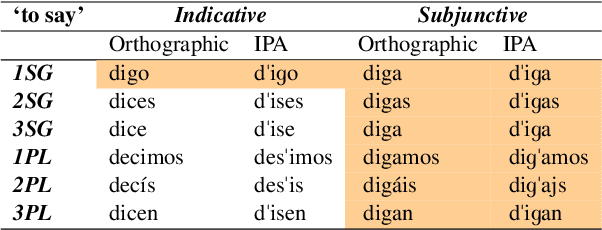
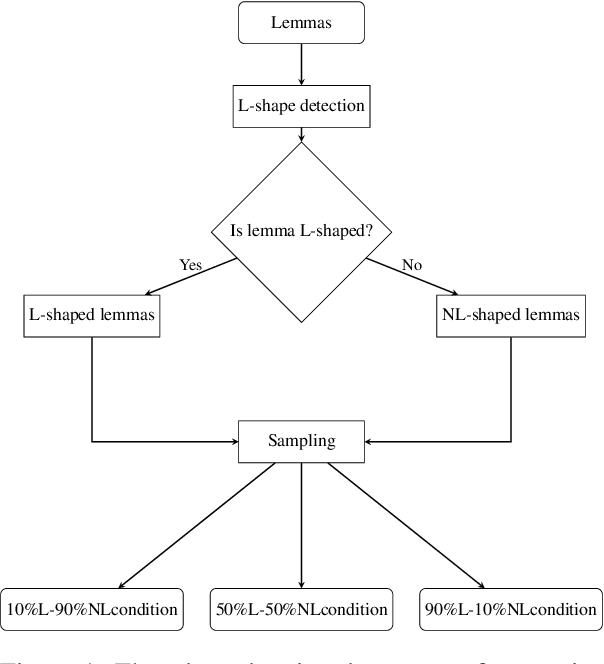
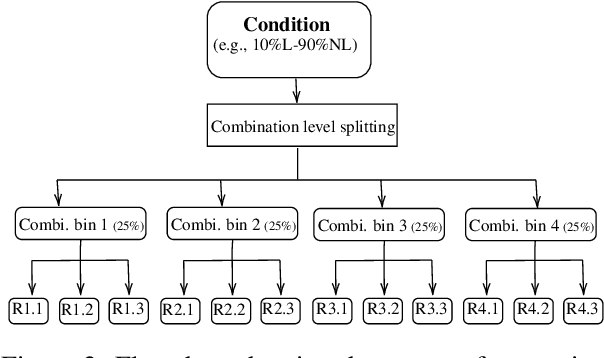
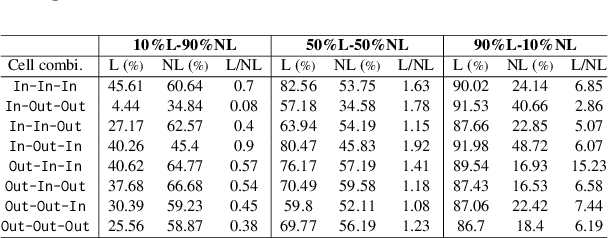
The present paper evaluates the learning behaviour of a transformer-based neural network with regard to an irregular inflectional paradigm. We apply the paradigm cell filling problem to irregular patterns. We approach this problem using the morphological reinflection task and model it as a character sequence-to-sequence learning problem. The test case under investigation are irregular verbs in Spanish. Besides many regular verbs in Spanish L-shaped verbs the first person singular indicative stem irregularly matches the subjunctive paradigm, while other indicative forms remain unaltered. We examine the role of frequency during learning and compare models under differing input frequency conditions. We train the model on a corpus of Spanish with a realistic distribution of regular and irregular verbs to compare it with models trained on input with augmented distributions of (ir)regular words. We explore how the neural models learn this L-shaped pattern using post-hoc analyses. Our experiments show that, across frequency conditions, the models are surprisingly capable of learning the irregular pattern. Furthermore, our post-hoc analyses reveal the possible sources of errors. All code and data are available at \url{https://anonymous.4open.science/r/modeling_spanish_acl-7567/} under MIT license.