 Add to Chrome
 Add to Firefox
 Add to Edge
AI Co-Mathematician: Accelerating Mathematicians with Agentic AI
May 07, 2026
We introduce the AI co-mathematician, a workbench for mathematicians to interactively leverage AI agents to pursue open-ended research. The AI co-mathematician is optimized to provide holistic support for the exploratory and iterative reality of mathematical workflows, including ideation, literature search, computational exploration, theorem proving and theory building. By providing an asynchronous, stateful workspace that manages uncertainty, refines user intent, tracks failed hypotheses, and outputs native mathematical artifacts, the system mirrors human collaborative workflows. In early tests, the AI co-mathematician helped researchers solve open problems, identify new research directions, and uncover overlooked literature references. Besides demonstrating a highly interactive paradigm for AI-assisted mathematical discovery, the AI co-mathematician also achieves state of the art results on hard problem-solving benchmarks, including scoring 48% on FrontierMath Tier 4, a new high score among all AI systems evaluated.

$R$-equivalence on Cubic Surfaces I: Existing Cases with Non-Trivial Universal Equivalence
Mar 19, 2026Let $V$ be a smooth cubic surface over a $p$-adic field $k$ with good reduction. Swinnerton-Dyer (1981) proved that $R$-equivalence is trivial on $V(k)$ except perhaps if $V$ is one of three special types--those whose $R$-equivalence he could not bound by proving the universal (admissible) equivalence is trivial. We consider all surfaces $V$ currently known to have non-trivial universal equivalence. Beyond being intractable to Swinnerton-Dyer's approach, we observe that if these surfaces also had non-trivial $R$-equivalence, they would contradict Colliot-Thélène and Sansuc's conjecture regarding the $k$-rationality of universal torsors for geometrically rational surfaces. By devising new methods to study $R$-equivalence, we prove that for 2-adic surfaces with all-Eckardt reductions (the third special type, which contains every existing case of non-trivial universal equivalence), $R$-equivalence is trivial or of exponent 2. For the explicit cases, we confirm triviality: the diagonal cubic $X^3+Y^3+Z^3+ζ_3 T^3=0$ over $\mathbb{Q}_2(ζ_3)$--answering a long-standing question of Manin's (Cubic Forms, 1972)--and the cubic with universal equivalence of exponent 2 (Kanevsky, 1982). This is the first in a series of works derived from a year of interactions with generative AI models such as AlphaEvolve and Gemini 3 Deep Think, with the latter proving many of our lemmas. We disclose the timeline and nature of their use towards this paper, and describe our broader AI-assisted research program in a companion report (in preparation).
Semistochastic Quadratic Bound Methods
Feb 17, 2014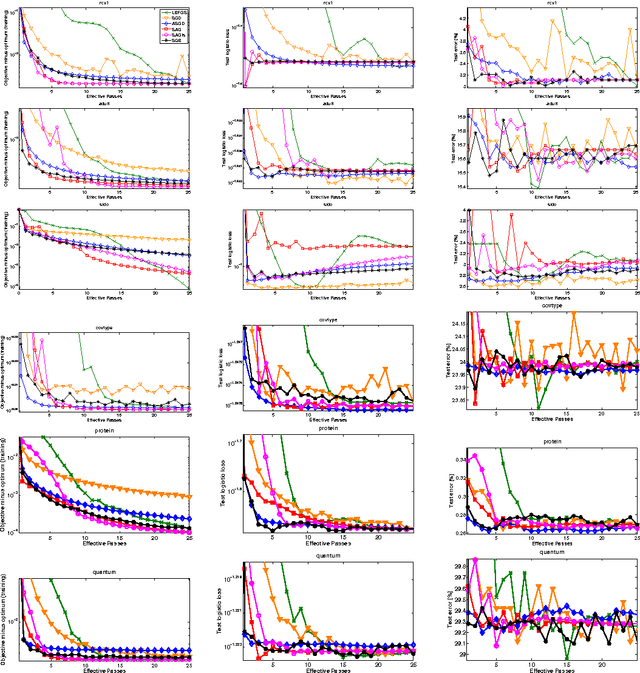
Partition functions arise in a variety of settings, including conditional random fields, logistic regression, and latent gaussian models. In this paper, we consider semistochastic quadratic bound (SQB) methods for maximum likelihood inference based on partition function optimization. Batch methods based on the quadratic bound were recently proposed for this class of problems, and performed favorably in comparison to state-of-the-art techniques. Semistochastic methods fall in between batch algorithms, which use all the data, and stochastic gradient type methods, which use small random selections at each iteration. We build semistochastic quadratic bound-based methods, and prove both global convergence (to a stationary point) under very weak assumptions, and linear convergence rate under stronger assumptions on the objective. To make the proposed methods faster and more stable, we consider inexact subproblem minimization and batch-size selection schemes. The efficacy of SQB methods is demonstrated via comparison with several state-of-the-art techniques on commonly used datasets.