 Add to Chrome
 Add to Firefox
 Add to Edge
Reasoning Core: Designing Broad Procedural Data for Completion-Supervised Reasoning Training
Aug 05, 2026
Procedural generators produce useful verifiable reasoning problems at scale, but have received less attention as data for completion-supervised fine-tuning. We introduce Reasoning Core, a collection of 50 generators spanning mathematics, logic, planning, state tracking, formal languages, structured data, games, causality, and code, with semantic scorers, difficulty controls, and task evaluators. Under a matched completion-supervised protocol, we compare Reasoning Core with Procedural Warmup, Reasoning Gym, and SynLogic across four base-model settings and multiple training durations. In the primary 3B comparison, Reasoning Core achieves the highest mean scores on DROP, LogiQA, and ARC-Challenge, exceeding both the baseline without procedural data and all three alternative procedural collections. Task-level analyses show that semantic validity alone does not ensure training utility, highlighting compact targets and calibrated difficulty as important design factors. We ran audits combining model-assisted review, human adjudication, and regression testing. Applied throughout Reasoning Core development and to the other collections, they reveal subtle mismatches among generation, rendering, targets, and scoring, a reminder that procedural generation alone does not guarantee correctness. The library, generated datasets, and audit material are publicly available.

Influcoder: Distilling Decoders' Gradient Influence Rankings into an Encoder for Data Attribution
Jun 11, 2026With the growth of LLMs' (Large Language Models) capabilities, there has been an increasing push to curate high quality datasets by filtering samples in the training data. In general, Data Attribution (DA) methods aim to estimate how individual samples in a training dataset can precondition a model to generate certain outputs. As an example, one might be interested in which samples in the data could be the source of toxic behavior after training the LLM. Many methods quantify this conditioning through the paradigm of influence functions. While methods of this family are effective in its function, they lack the necessary processing speed and storage compactness to be practically implemented on large datasets. We propose a method, Influcoder, as a quick and cost-effective approach to influence-based Data Attribution at scale.
Open-endedness induced through a predator-prey scenario using modular robots
Sep 20, 2023
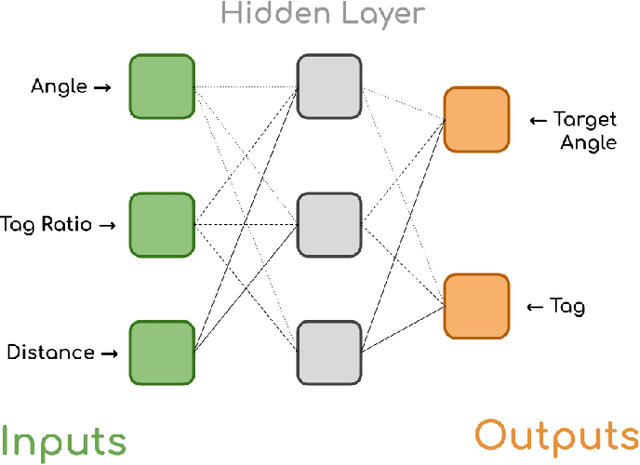
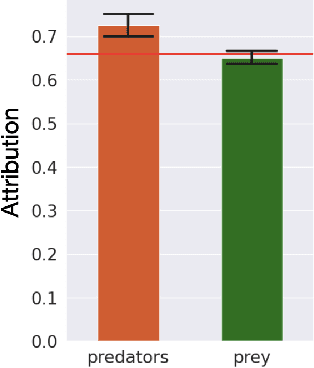
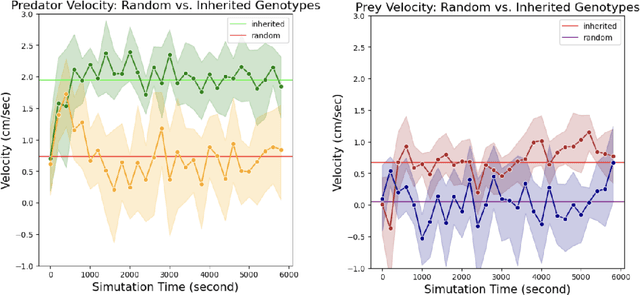
This work investigates how a predator-prey scenario can induce the emergence of Open-Ended Evolution (OEE). We utilize modular robots of fixed morphologies whose controllers are subject to evolution. In both species, robots can send and receive signals and perceive the relative positions of other robots in the environment. Specifically, we introduce a feature we call a tagging system: it modifies how individuals can perceive each other and is expected to increase behavioral complexity. Our results show the emergence of adaptive strategies, demonstrating the viability of inducing OEE through predator-prey dynamics using modular robots. Such emergence, nevertheless, seemed to depend on conditioning reproduction to an explicit behavioral criterion.