 Add to Chrome
 Add to Firefox
 Add to Edge
Efficient Fine-Tuning Methods for Portuguese Question Answering: A Comparative Study of PEFT on BERTimbau and Exploratory Evaluation of Generative LLMs
Mar 22, 2026
Although large language models have transformed natural language processing, their computational costs create accessibility barriers for low-resource languages such as Brazilian Portuguese. This work presents a systematic evaluation of Parameter-Efficient Fine-Tuning (PEFT) and quantization techniques applied to BERTimbau for Question Answering on SQuAD-BR, the Brazilian Portuguese translation of SQuAD v1. We evaluate 40 configurations combining four PEFT methods (LoRA, DoRA, QLoRA, QDoRA) across two model sizes (Base: 110M, Large: 335M parameters). Our findings reveal three critical insights: (1) LoRA achieves 95.8\% of baseline performance on BERTimbau-Large while reducing training time by 73.5\% (F1=81.32 vs 84.86); (2) higher learning rates (2e-4) substantially improve PEFT performance, with F1 gains of up to +19.71 points over standard rates; and (3) larger models show twice the quantization resilience (loss of 4.83 vs 9.56 F1 points). These results demonstrate that encoder-based models can be efficiently fine-tuned for extractive Brazilian Portuguese QA with substantially lower computational cost than large generative LLMs, promoting more sustainable approaches aligned with \textit{Green AI} principles. An exploratory evaluation of Tucano and Sabiá on the same extractive QA benchmark shows that while generative models can reach competitive F1 scores with LoRA fine-tuning, they require up to 4.2$\times$ more GPU memory and 3$\times$ more training time than BERTimbau-Base, reinforcing the efficiency advantage of smaller encoder-based architectures for this task.

Chronnet: a network-based model for spatiotemporal data analysis
Apr 23, 2020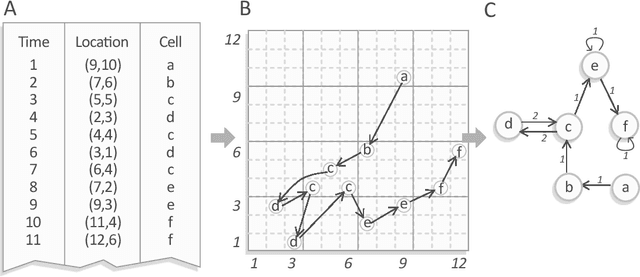
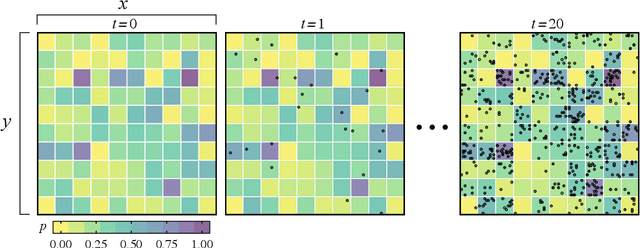
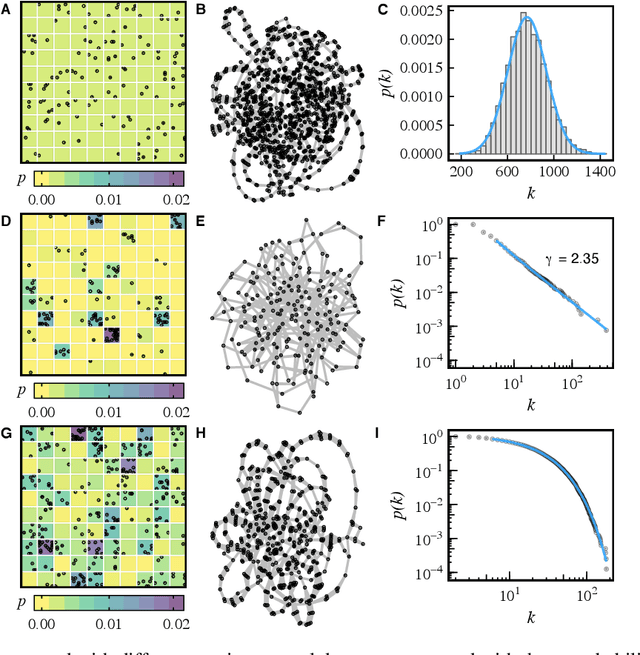
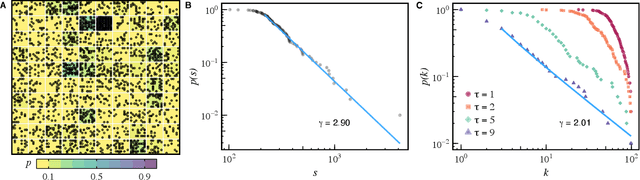
The amount and size of spatiotemporal data sets from different domains have been rapidly increasing in the last years, which demands the development of robust and fast methods to analyze and extract information from them. In this paper, we propose a network-based model for spatiotemporal data analysis called chronnet. It consists of dividing a geometrical space into grid cells represented by nodes connected chronologically. The main goal of this model is to represent consecutive recurrent events between cells with strong links in the network. This representation permits the use of network science and graphing mining tools to extract information from spatiotemporal data. The chronnet construction process is fast, which makes it suitable for large data sets. In this paper, we describe how to use our model considering artificial and real data. For this purpose, we propose an artificial spatiotemporal data set generator to show how chronnets capture not just simple statistics, but also frequent patterns, spatial changes, outliers, and spatiotemporal clusters. Additionally, we analyze a real-world data set composed of global fire detections, in which we describe the frequency of fire events, outlier fire detections, and the seasonal activity, using a single chronnet.