 Add to Chrome
 Add to Firefox
 Add to Edge
PRISM-Net: Patient-specific reference-guided inter-breast symmetry matching for three-class breast DCE-MRI classification
Jul 29, 2026
Breast DCE-MRI AI is increasingly being explored for breast-level classification of no-lesion, benign, and malignant findings, beyond conventional lesion-centered diagnosis. Within this broader diagnostic scope, however, patient-specific background variability remains a major source of imaging confounding across classification tasks. Existing approaches predominantly focus on unilateral or lesion-centric analysis, whereas bilateral methods offer limited explicit modeling of spatially adaptive cross-breast correspondence. We propose PRISM-Net, a registration-free bilateral framework that leverages contralateral breast features as patient-specific references for background-aware representation learning. PRISM-Net integrates bilateral feature matching and asymmetry-aware attention to establish adaptive inter-breast correspondence and enhance representations of discriminative asymmetric patterns. On ODELIA, Macro AUC, Micro AUC, and quadratic weighted kappa were $84.11 \pm 2.33$, $90.64 \pm 1.61$, and $60.94 \pm 5.64$ on the in-distribution test set, and $68.51 \pm 4.54$, $80.74 \pm 2.68$, and $43.45 \pm 7.10$ on the held-out institution, respectively, outperforming the evaluated baseline methods across the primary evaluation metrics. PRISM-Net further demonstrated performance on independent institutional and background-complexity evaluations. Ablation experiments revealed that both bilateral relation modeling and asymmetry-aware reweighting contributed to improved classification performance. These findings highlight patient-specific bilateral reference modeling as a clinically grounded strategy for DCE-MRI interpretation, improving asymmetric pattern discrimination through explicit modeling of background complexity.

GaussianPile: A Unified Sparse Gaussian Splatting Framework for Slice-based Volumetric Reconstruction
Mar 21, 2026Slice-based volumetric imaging is widely applied and it demands representations that compress aggressively while preserving internal structure for analysis. We introduce GaussianPile, unifying 3D Gaussian splatting with an imaging system-aware focus model to address this challenge. Our proposed method introduces three key innovations: (i) a slice-aware piling strategy that positions anisotropic 3D Gaussians to model through-slice contributions, (ii) a differentiable projection operator that encodes the finite-thickness point spread function of the imaging acquisition system, and (iii) a compact encoding and joint optimization pipeline that simultaneously reconstructs and compresses the Gaussian sets. Our CUDA-based design retains the compression and real-time rendering efficiency of Gaussian primitives while preserving high-frequency internal volumetric detail. Experiments on microscopy and ultrasound datasets demonstrate that our method reduces storage and reconstruction cost, sustains diagnostic fidelity, and enables fast 2D visualization, along with 3D voxelization. In practice, it delivers high-quality results in as few as 3 minutes, up to 11x faster than NeRF-based approaches, and achieves consistent 16x compression over voxel grids, offering a practical path to deployable compression and exploration of slice-based volumetric datasets.
DiffS-NOCS: 3D Point Cloud Reconstruction through Coloring Sketches to NOCS Maps Using Diffusion Models
Jun 15, 2025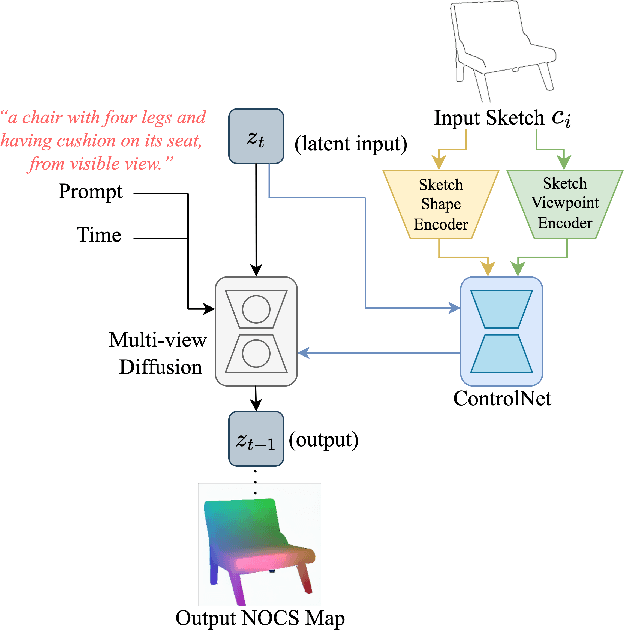
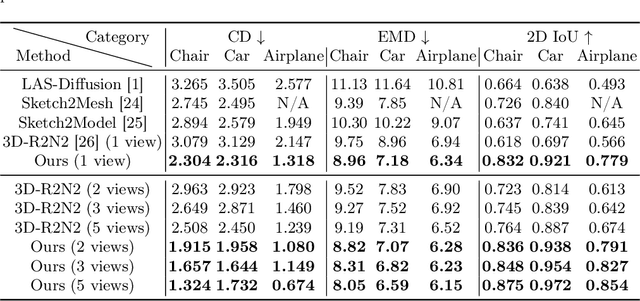
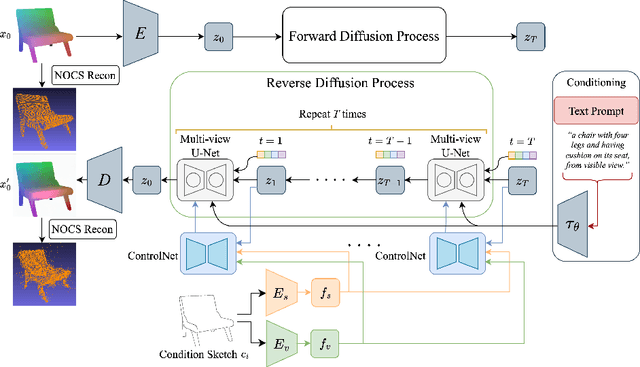

Reconstructing a 3D point cloud from a given conditional sketch is challenging. Existing methods often work directly in 3D space, but domain variability and difficulty in reconstructing accurate 3D structures from 2D sketches remain significant obstacles. Moreover, ideal models should also accept prompts for control, in addition with the sparse sketch, posing challenges in multi-modal fusion. We propose DiffS-NOCS (Diffusion-based Sketch-to-NOCS Map), which leverages ControlNet with a modified multi-view decoder to generate NOCS maps with embedded 3D structure and position information in 2D space from sketches. The 3D point cloud is reconstructed by combining multiple NOCS maps from different views. To enhance sketch understanding, we integrate a viewpoint encoder for extracting viewpoint features. Additionally, we design a feature-level multi-view aggregation network as the denoising module, facilitating cross-view information exchange and improving 3D consistency in NOCS map generation. Experiments on ShapeNet demonstrate that DiffS-NOCS achieves controllable and fine-grained point cloud reconstruction aligned with sketches.
DiffSketching: Sketch Control Image Synthesis with Diffusion Models
May 30, 2023


Creative sketch is a universal way of visual expression, but translating images from an abstract sketch is very challenging. Traditionally, creating a deep learning model for sketch-to-image synthesis needs to overcome the distorted input sketch without visual details, and requires to collect large-scale sketch-image datasets. We first study this task by using diffusion models. Our model matches sketches through the cross domain constraints, and uses a classifier to guide the image synthesis more accurately. Extensive experiments confirmed that our method can not only be faithful to user's input sketches, but also maintain the diversity and imagination of synthetic image results. Our model can beat GAN-based method in terms of generation quality and human evaluation, and does not rely on massive sketch-image datasets. Additionally, we present applications of our method in image editing and interpolation.