 Add to Chrome
 Add to Firefox
 Add to Edge
Nemotron 3 Ultra: Open, Efficient Mixture-of-Experts Hybrid Mamba-Transformer Model for Agentic Reasoning
Jun 12, 2026
We introduce Nemotron 3 Ultra, a 550 billion total and 55 billion active parameter Mixture-of-Experts Hybrid Mamba-Attention language model. We pre-trained Nemotron 3 Ultra on 20 trillion text tokens, then extended the context length to 1M tokens, and post-trained using Supervised Fine Tuning (SFT), Reinforcement Learning (RL), and Multi-teacher On-Policy Distillation (MOPD). Nemotron 3 Ultra is our most capable model yet, employing multiple key technologies - LatentMoE, Multi Token Prediction (MTP), NVFP4 pre-training, multi-environment RLVR, MOPD, and reasoning budget control. Nemotron 3 Ultra achieves up to ~6x higher inference throughput as compared to state-of-the-art publicly available LLMs while attaining on-par accuracy. The state-of-the-art accuracy, high inference throughput, and 1M token context length make Nemotron 3 Ultra ideal for long-running autonomous agentic tasks. We open-source the base, post-trained, and quantized checkpoints, along with the training data and recipe on HuggingFace.

Bilevel Optimization, Deep Learning and Fractional Laplacian Regularization with Applications in Tomography
Jul 22, 2019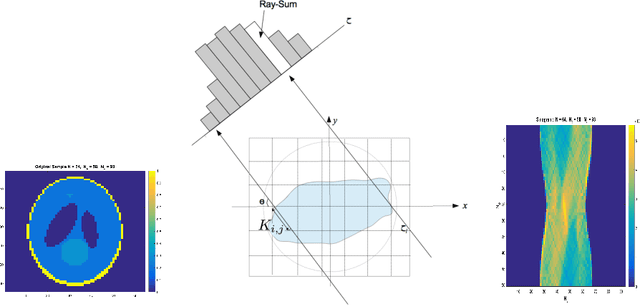
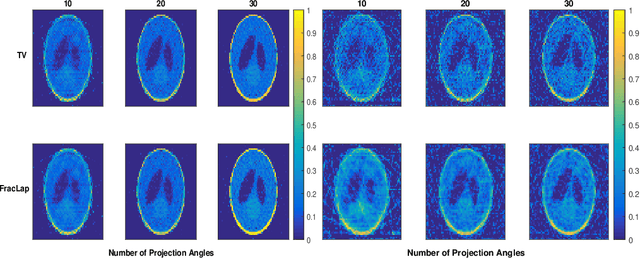
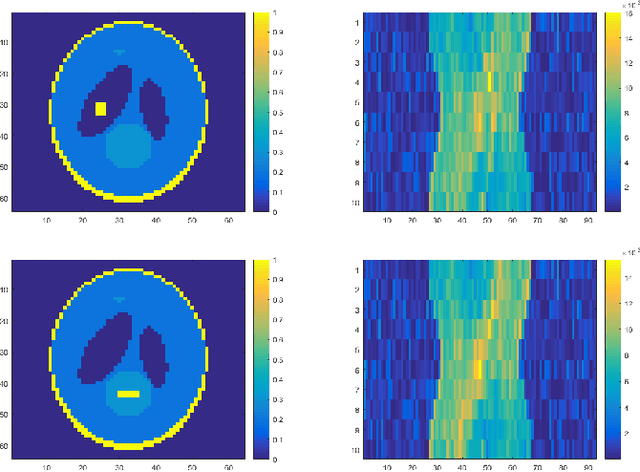
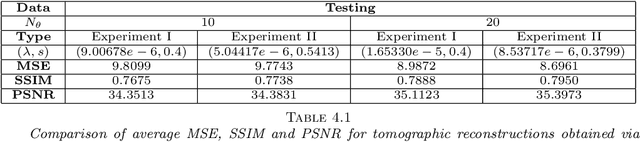
In this work we consider a generalized bilevel optimization framework for solving inverse problems. We introduce fractional Laplacian as a regularizer to improve the reconstruction quality, and compare it with the total variation regularization. We emphasize that the key advantage of using fractional Laplacian as a regularizer is that it leads to a linear operator, as opposed to the total variation regularization which results in a nonlinear degenerate operator. Inspired by residual neural networks, to learn the optimal strength of regularization and the exponent of fractional Laplacian, we develop a dedicated bilevel optimization neural network with a variable depth for a general regularized inverse problem. We also draw some parallels between an activation function in a neural network and regularization. We illustrate how to incorporate various regularizer choices into our proposed network. As an example, we consider tomographic reconstruction as a model problem and show an improvement in reconstruction quality, especially for limited data, via fractional Laplacian regularization. We successfully learn the regularization strength and the fractional exponent via our proposed bilevel optimization neural network. We observe that the fractional Laplacian regularization outperforms total variation regularization. This is specially encouraging, and important, in the case of limited and noisy data.