 Add to Chrome
 Add to Firefox
 Add to Edge
WARP: A Benchmark for Primal-Dual Warm-Starting of Interior-Point Solvers
May 07, 2026
Solving AC Optimal Power Flow (AC-OPF) is of central importance in electricity market operations, where interior-point methods (IPMs) such as IPOPT are the standard solvers. A growing body of work uses machine learning to predict primal warm-start iterates, reporting iteration reductions of 30-46\%. We show that these reported gains rest on an inappropriate evaluation baseline: prior methods benchmark against the flat start $V_m = 1, V_a = 0$, whereas the solver's actual default - the variable-bound midpoint $(l+u)/2$ - is near-optimal for log-barrier centrality. Against this corrected baseline, no primal-only warm-start method reduces solver iterations. We trace the failure to a geometric property of interior-point methods: primal prediction accuracy is anticorrelated with convergence speed, and providing the ground-truth optimal solution $x^*$ without dual variables causes the solver to diverge. Oracle experiments establish that the complete primal-dual-barrier state $(x^*, λ^*, z^*, μ^*)$ reduces IPOPT iterations from 23 to 3 - an 85\% reduction that is structurally inaccessible to primal-only methods. To enable rigorous evaluation of warm-start methods on this task, we release a benchmark suite comprising dual-labeled AC-OPF datasets with IPOPT-extracted solutions, a corrected evaluation protocol, and WARP - a topology-conditioned encode-process-decode interaction network that predicts the full interior-point state $(\hat{x}, \hatλ, \hat{z}, \hatμ)$ on the heterogeneous constraint graph. WARP achieves a 76\% reduction in IPOPT iterations while natively accommodating N-1 contingency topology variations without retraining.

Operational Wind Speed Forecasts for Chile's Electric Power Sector Using a Hybrid ML Model
Sep 17, 2024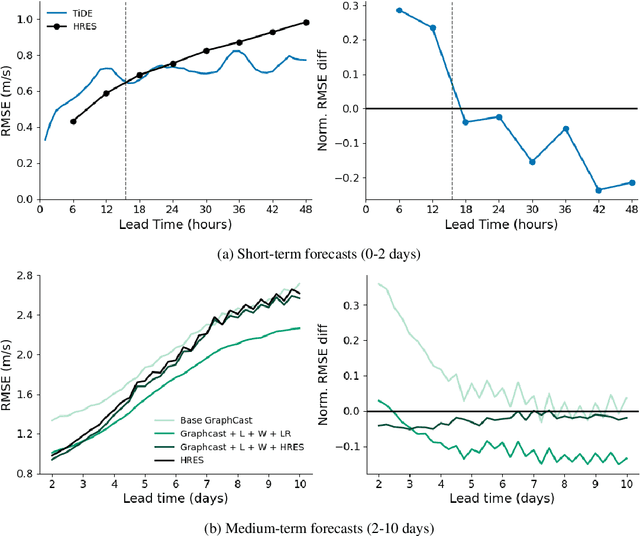
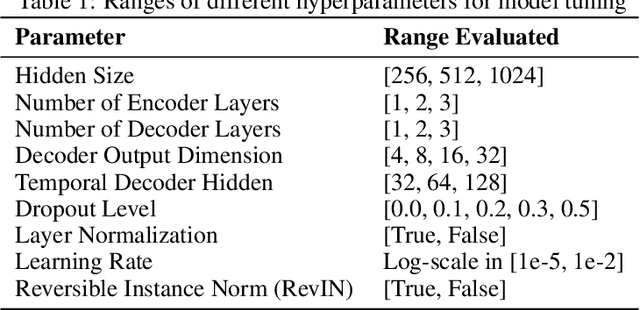
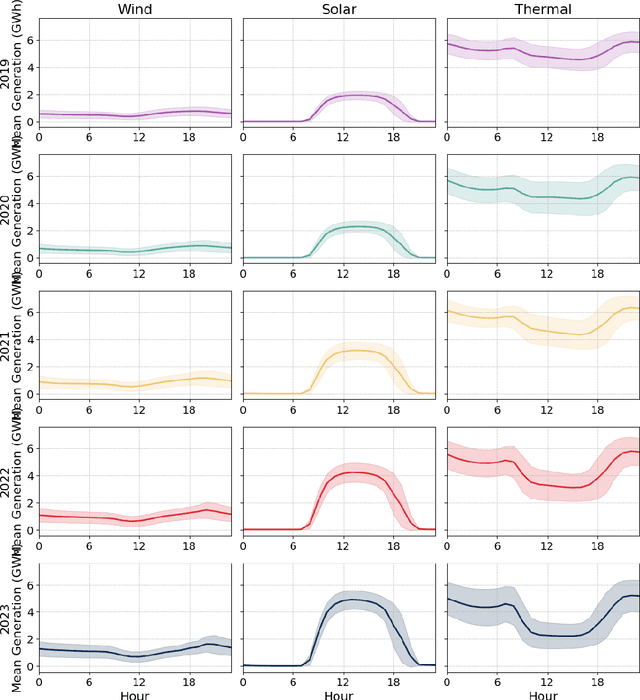

As Chile's electric power sector advances toward a future powered by renewable energy, accurate forecasting of renewable generation is essential for managing grid operations. The integration of renewable energy sources is particularly challenging due to the operational difficulties of managing their power generation, which is highly variable compared to fossil fuel sources, delaying the availability of clean energy. To mitigate this, we quantify the impact of increasing intermittent generation from wind and solar on thermal power plants in Chile and introduce a hybrid wind speed forecasting methodology which combines two custom ML models for Chile. The first model is based on TiDE, an MLP-based ML model for short-term forecasts, and the second is based on a graph neural network, GraphCast, for medium-term forecasts up to 10 days. Our hybrid approach outperforms the most accurate operational deterministic systems by 4-21% for short-term forecasts and 5-23% for medium-term forecasts and can directly lower the impact of wind generation on thermal ramping, curtailment, and system-level emissions in Chile.
Nowcasting day-ahead marginal emissions using multi-headed CNNs and deep generative models
Oct 02, 2023Nowcasting day-ahead marginal emissions factors is increasingly important for power systems with high flexibility and penetration of distributed energy resources. With a significant share of firm generation from natural gas and coal power plants, forecasting day-ahead emissions in the current energy system has been widely studied. In contrast, as we shift to an energy system characterized by flexible power markets, dispatchable sources, and competing low-cost generation such as large-scale battery or hydrogen storage, system operators will be able to choose from a mix of different generation as well as emission pathways. To fully develop the emissions implications of a given dispatch schedule, we need a near real-time workflow with two layers. The first layer is a market model that continuously solves a security-constrained economic dispatch model. The second layer determines the marginal emissions based on the output of the market model, which is the subject of this paper. We propose using multi-headed convolutional neural networks to generate day-ahead forecasts of marginal and average emissions for a given independent system operator.