 Add to Chrome
 Add to Firefox
 Add to Edge
Robust Federated Learning Under Real-World Client Churn
Jul 08, 2026
Federated Learning (FL) enables training shared models on private, on-device data, but production deployments remain constrained to slow, multi-day refresh cycles due to the complexity of coordinating massive client populations. For applications such as feed ranking, ad targeting, and personalized recommendation, model freshness: the ability to rapidly adapt to new user-local data is critical for maximizing objectives like click-through rate. This lag leaves models stale and unresponsive to volatile data distributions driven by viral trends and shifting user intent. Bridging this gap requires addressing three challenges overlooked by existing FL systems: transient client availability, dynamic data heterogeneity, and delays between model predictions and observable outcomes. We present FeLiX, an FL orchestration framework that minimizes wall-clock time-to-target accuracy on live interaction streams. FeLiX introduces three primitives: (i) streaming-aware availability tiers that leverage lightweight telemetry to identify ready clients at scale; (ii) fresh-utility selection, a dual-tier mechanism that prioritizes statistically valuable updates from devices able to meet tight refresh deadlines; and (iii) informativeness-aware, delay-robust aggregation that incorporates late, high-value updates containing ground-truth outcomes without biasing the global model toward stale distributions. Unlike prior systems that rely on unrealistic oracular knowledge of client availability, FeLiX achieves near-oracular performance in real-world settings. Across CIFAR-10, Google Speech, and realistic low-availability traces, FeLiX reduces wall-clock time-to-target accuracy by up to 2.37X while reducing communication bandwidth by 1.30X compared to state-of-the-art synchronous and asynchronous FL baselines.

SuperServe: Fine-Grained Inference Serving for Unpredictable Workloads
Dec 27, 2023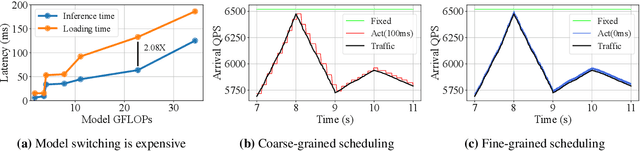
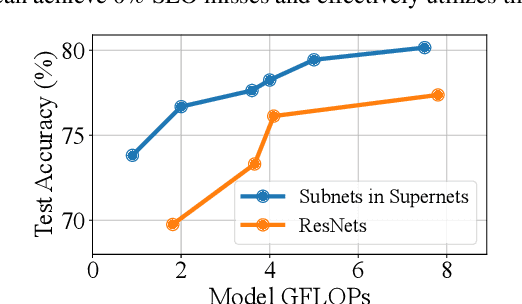
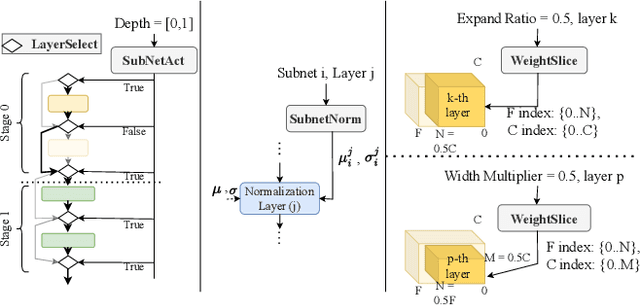
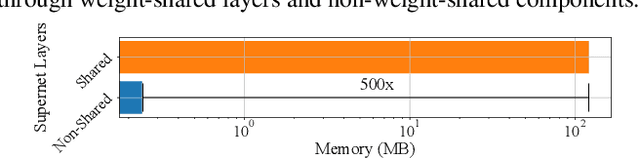
The increasing deployment of ML models on the critical path of production applications in both datacenter and the edge requires ML inference serving systems to serve these models under unpredictable and bursty request arrival rates. Serving models under such conditions requires these systems to strike a careful balance between the latency and accuracy requirements of the application and the overall efficiency of utilization of scarce resources. State-of-the-art systems resolve this tension by either choosing a static point in the latency-accuracy tradeoff space to serve all requests or load specific models on the critical path of request serving. In this work, we instead resolve this tension by simultaneously serving the entire-range of models spanning the latency-accuracy tradeoff space. Our novel mechanism, SubNetAct, achieves this by carefully inserting specialized operators in weight-shared SuperNetworks. These operators enable SubNetAct to dynamically route requests through the network to meet a latency and accuracy target. SubNetAct requires upto 2.6x lower memory to serve a vastly-higher number of models than prior state-of-the-art. In addition, SubNetAct's near-instantaneous actuation of models unlocks the design space of fine-grained, reactive scheduling policies. We explore the design of one such extremely effective policy, SlackFit and instantiate both SubNetAct and SlackFit in a real system, SuperServe. SuperServe achieves 4.67% higher accuracy for the same SLO attainment and 2.85x higher SLO attainment for the same accuracy on a trace derived from the real-world Microsoft Azure Functions workload and yields the best trade-offs on a wide range of extremely-bursty synthetic traces automatically.
Federated Learning Operations Made Simple with Flame
May 09, 2023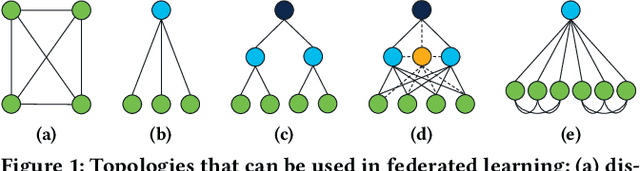


Distributed machine learning approaches, including a broad class of federated learning techniques, present a number of benefits when deploying machine learning applications over widely distributed infrastructures. To realize the expected benefits, however, introduces substantial operational challenges due to required application and configuration-level changes related to deployment-specific details. Such complexities can be greatly reduced by introducing higher-level abstractions -- role and channel -- using which federated learning applications are described as Topology Abstraction Graphs (TAGs). TAGs decouple the ML application logic from the underlying deployment details, making it possible to specialize the application deployment, thus reducing development effort and paving the way for improved automation and tuning. We present Flame, the first system that supports these abstractions, and demonstrate its benefits for several use cases.