 Add to Chrome
 Add to Firefox
 Add to Edge
Assessing Pause Thresholds for empirical Translation Process Research
Apr 01, 2026
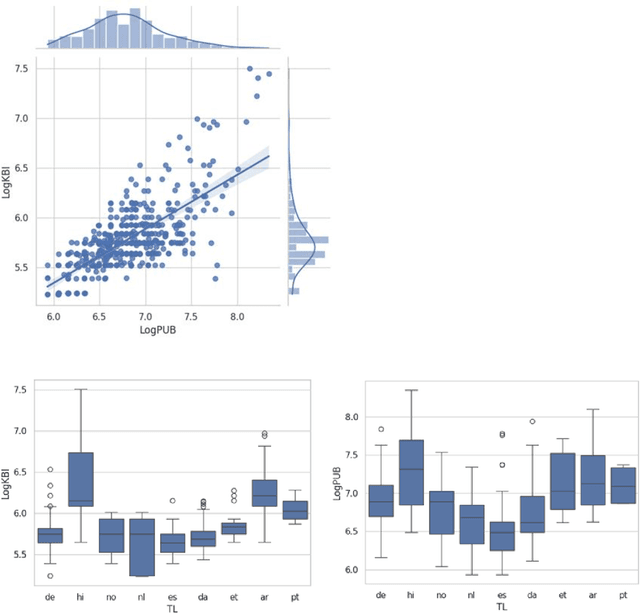
Text production (and translations) proceeds in the form of stretches of typing, interrupted by keystroke pauses. It is often assumed that fast typing reflects unchallenged/automated translation production while long(er) typing pauses are indicative of translation problems, hurdles or difficulties. Building on a long discussion concerning the determination of pause thresholds that separate automated from presumably reflective translation processes (O'Brien, 2006; Alves and Vale, 2009; Timarova et al., 2011; Dragsted and Carl, 2013; Lacruz et al., 2014; Kumpulainen, 2015; Heilmann and Neumann 2016), this paper compares three recent approaches for computing these pause thresholds, and suggest and evaluate a novel method for computing Production Unit Breaks.

Toward a Behavioural Translation Style Space: Simulating the Temporal Dynamics of Affect, Behaviour, and Cognition in Human Translation Production
Jul 16, 2025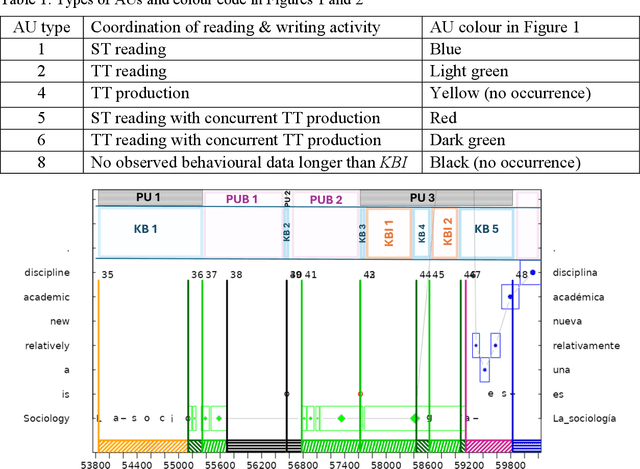
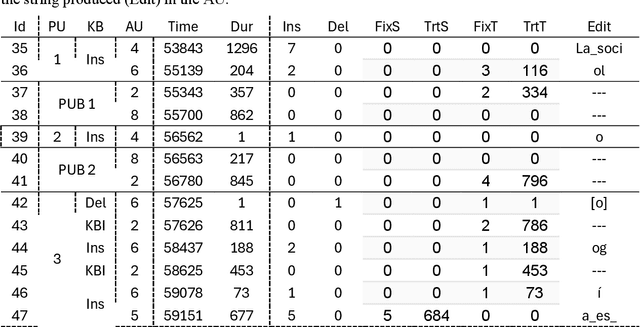
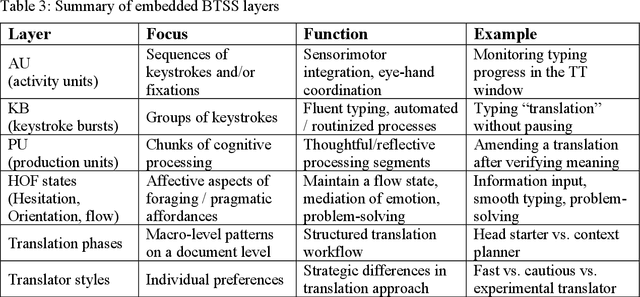
The paper introduces a Behavioural Translation Style Space (BTSS) that describes possible behavioural translation patterns. The suggested BTSS is organized as a hierarchical structure that entails various embedded processing layers. We posit that observable translation behaviour - i.e., eye and finger movements - is fundamental when executing the physical act of translation but it is caused and shaped by higher-order cognitive processes and affective translation states. We analyse records of keystrokes and gaze data as indicators of the hidden mental processing structure and organize the behavioural patterns as a multi-layered embedded BTSS. The BTSS serves as the basis for a computational translation agent to simulate the temporal dynamics of affect, automatized behaviour and cognition during human translation production.