 Add to Chrome
 Add to Firefox
 Add to Edge
PRecG: Legal Precedent Retrieval with Graph Neural Networks and Rhetorical Role Segmentation
Jul 10, 2026
Legal precedent retrieval is a fundamental task in legal case preparation, planning, litigation strategy, and legal research. Current approaches for automatic precedent retrieval map legal documents to a low-dimensional semantic space and compute similarity based on the proximity of their representations. These approaches treat legal documents as monolithic texts, ignoring the rhetorical organization of the legal technicalities. Ergo, they overlook nuanced legal meanings and fail to distinguish the contextual significance of legal entities and concepts that vary based on their rhetorical roles within the document. To address this insufficiency, we propose the PRecG pipeline that computes the similarity between pairs of legal judgments by hierarchically learning their representations. The process begins by decomposing each document into distinct semantic units (segments) based on the rhetorical roles of sentences. For each rhetorical segment, a knowledge graph is constructed to capture the legal entities and their relationships within the segment. Contextual representations of the entities are then learned and aggregated to derive segment-level embeddings. These embeddings are further integrated to produce a unified document-level representation, and finally, the semantic similarity between a pair of documents is computed. We validate the performance of the proposed approach through extensive experiments on a benchmark Indian legal dataset, comparing it against state-of-the-art baselines to demonstrate its effectiveness.

Human Centered AI for Indian Legal Text Analytics
Mar 16, 2024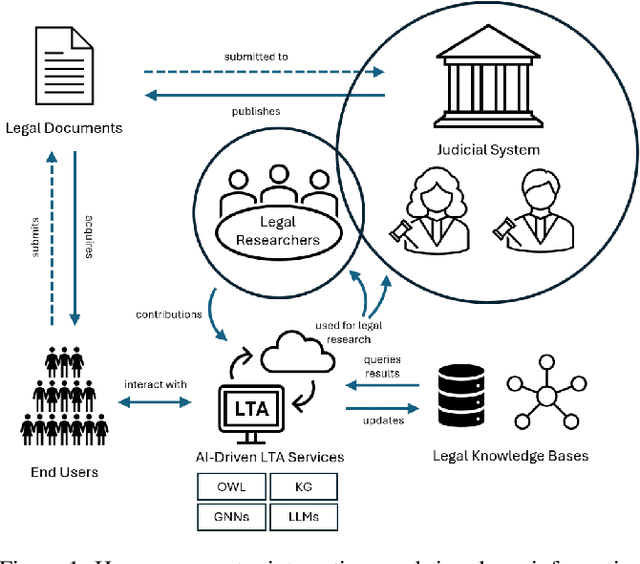
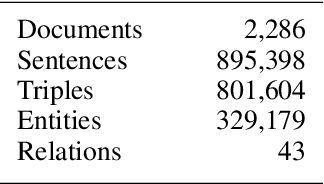
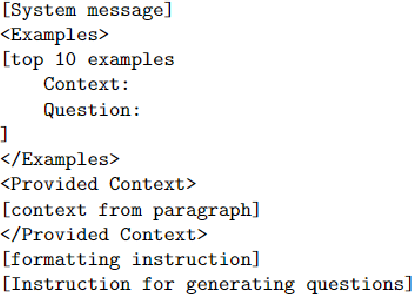
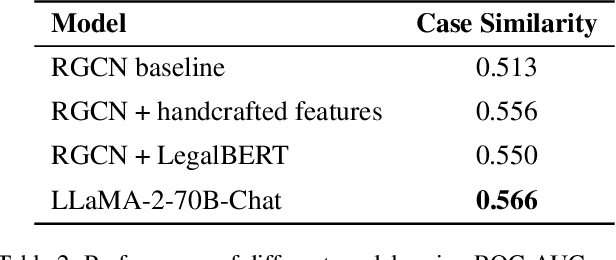
Legal research is a crucial task in the practice of law. It requires intense human effort and intellectual prudence to research a legal case and prepare arguments. Recent boom in generative AI has not translated to proportionate rise in impactful legal applications, because of low trustworthiness and and the scarcity of specialized datasets for training Large Language Models (LLMs). This position paper explores the potential of LLMs within Legal Text Analytics (LTA), highlighting specific areas where the integration of human expertise can significantly enhance their performance to match that of experts. We introduce a novel dataset and describe a human centered, compound AI system that principally incorporates human inputs for performing LTA tasks with LLMs.
Deep dive into language traits of AI-generated Abstracts
Dec 17, 2023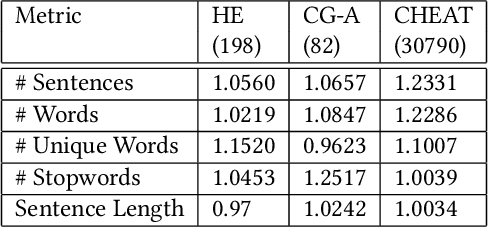
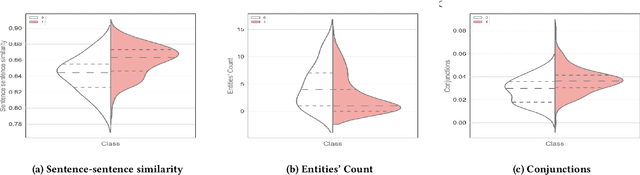
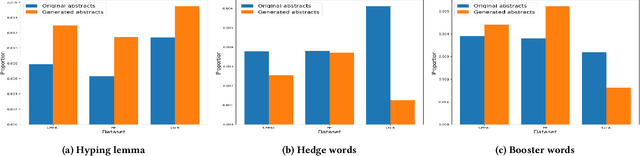

Generative language models, such as ChatGPT, have garnered attention for their ability to generate human-like writing in various fields, including academic research. The rapid proliferation of generated texts has bolstered the need for automatic identification to uphold transparency and trust in the information. However, these generated texts closely resemble human writing and often have subtle differences in the grammatical structure, tones, and patterns, which makes systematic scrutinization challenging. In this work, we attempt to detect the Abstracts generated by ChatGPT, which are much shorter in length and bounded. We extract the texts semantic and lexical properties and observe that traditional machine learning models can confidently detect these Abstracts.