 Add to Chrome
 Add to Firefox
 Add to Edge
From Knowledge to Action: Outcomes of the 2025 Large Language Model (LLM) Hackathon for Applications in Materials Science and Chemistry
May 04, 2026
Large language models (LLMs) are rapidly changing how researchers in materials science and chemistry discover, organize, and act on scientific knowledge. This paper analyzes a broad set of community-developed LLM applications in an effort to identify emerging patterns in how these systems can be used across the scientific research lifecycle. We organize the projects into two complementary categories: Knowledge Infrastructure, systems that structure, retrieve, synthesize, and validate scientific information; and Action Systems, systems that execute, coordinate, or automate scientific work across computational and experimental environments. The submissions reveal a shift from single-purpose LLM tools toward integrated, multi-agent workflows that combine retrieval, reasoning, tool use, and domain-specific validation. Prominent themes include retrieval-augmented generation as grounding infrastructure, persistent structured knowledge representations, multimodal and multilingual scientific inputs, and early progress toward laboratory-integrated closed-loop systems. Together, these results suggest that LLMs are evolving from general-purpose assistants into composable infrastructure for scientific reasoning and action. This work provides a community snapshot of that transition and a practical taxonomy for understanding emerging LLM-enabled workflows in materials science and chemistry.

Composition of Relational Features with an Application to Explaining Black-Box Predictors
Jun 01, 2022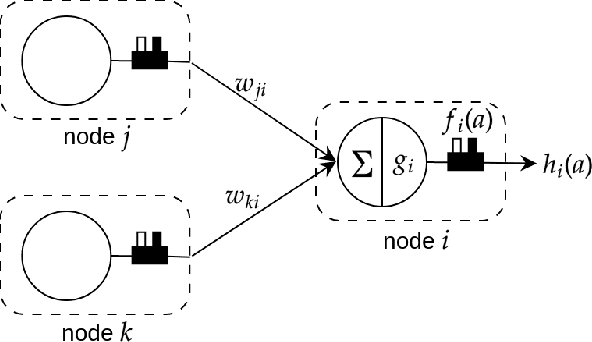
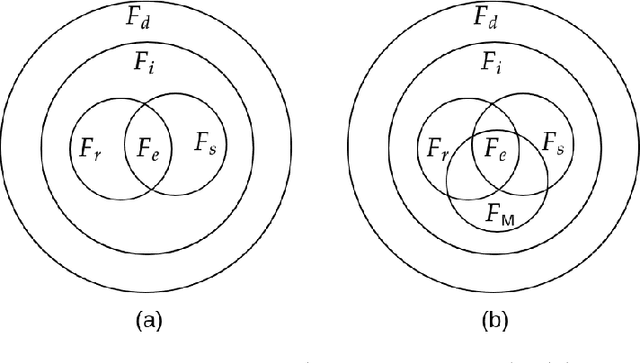
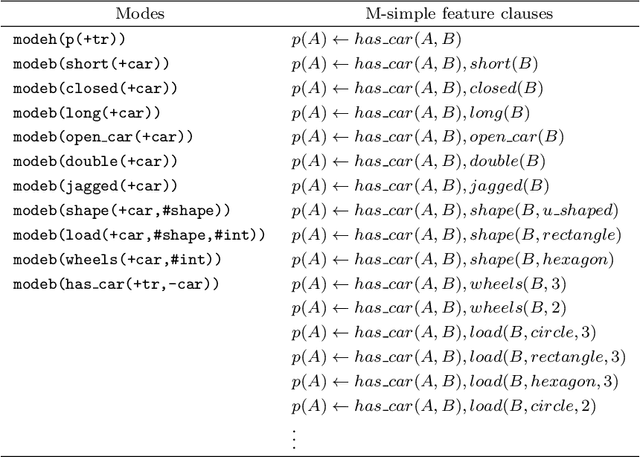
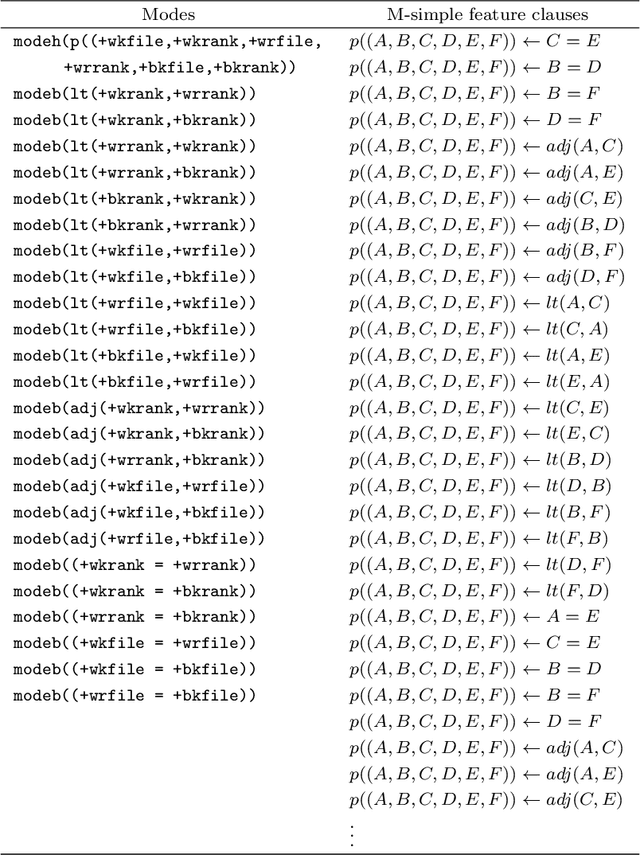
Relational machine learning programs like those developed in Inductive Logic Programming (ILP) offer several advantages: (1) The ability to model complex relationships amongst data instances; (2) The use of domain-specific relations during model construction; and (3) The models constructed are human-readable, which is often one step closer to being human-understandable. However, these ILP-like methods have not been able to capitalise fully on the rapid hardware, software and algorithmic developments fuelling current developments in deep neural networks. In this paper, we treat relational features as functions and use the notion of generalised composition of functions to derive complex functions from simpler ones. We formulate the notion of a set of $\text{M}$-simple features in a mode language $\text{M}$ and identify two composition operators ($\rho_1$ and $\rho_2$) from which all possible complex features can be derived. We use these results to implement a form of "explainable neural network" called Compositional Relational Machines, or CRMs, which are labelled directed-acyclic graphs. The vertex-label for any vertex $j$ in the CRM contains a feature-function $f_j$ and a continuous activation function $g_j$. If $j$ is a "non-input" vertex, then $f_j$ is the composition of features associated with vertices in the direct predecessors of $j$. Our focus is on CRMs in which input vertices (those without any direct predecessors) all have $\text{M}$-simple features in their vertex-labels. We provide a randomised procedure for constructing and learning such CRMs. Using a notion of explanations based on the compositional structure of features in a CRM, we provide empirical evidence on synthetic data of the ability to identify appropriate explanations; and demonstrate the use of CRMs as 'explanation machines' for black-box models that do not provide explanations for their predictions.