 Add to Chrome
 Add to Firefox
 Add to Edge
Feature-based morphological analysis of shape graph data
Feb 18, 2026
This paper introduces and demonstrates a computational pipeline for the statistical analysis of shape graph datasets, namely geometric networks embedded in 2D or 3D spaces. Unlike traditional abstract graphs, our purpose is not only to retrieve and distinguish variations in the connectivity structure of the data but also geometric differences of the network branches. Our proposed approach relies on the extraction of a specifically curated and explicit set of topological, geometric and directional features, designed to satisfy key invariance properties. We leverage the resulting feature representation for tasks such as group comparison, clustering and classification on cohorts of shape graphs. The effectiveness of this representation is evaluated on several real-world datasets including urban road/street networks, neuronal traces and astrocyte imaging. These results are benchmarked against several alternative methods, both feature-based and not.

Fast $k$-means clustering in Riemannian manifolds via Fréchet maps: Applications to large-dimensional SPD matrices
Nov 12, 2025We introduce a novel, efficient framework for clustering data on high-dimensional, non-Euclidean manifolds that overcomes the computational challenges associated with standard intrinsic methods. The key innovation is the use of the $p$-Fréchet map $F^p : \mathcal{M} \to \mathbb{R}^\ell$ -- defined on a generic metric space $\mathcal{M}$ -- which embeds the manifold data into a lower-dimensional Euclidean space $\mathbb{R}^\ell$ using a set of reference points $\{r_i\}_{i=1}^\ell$, $r_i \in \mathcal{M}$. Once embedded, we can efficiently and accurately apply standard Euclidean clustering techniques such as k-means. We rigorously analyze the mathematical properties of $F^p$ in the Euclidean space and the challenging manifold of $n \times n$ symmetric positive definite matrices $\mathit{SPD}(n)$. Extensive numerical experiments using synthetic and real $\mathit{SPD}(n)$ data demonstrate significant performance gains: our method reduces runtime by up to two orders of magnitude compared to intrinsic manifold-based approaches, all while maintaining high clustering accuracy, including scenarios where existing alternative methods struggle or fail.
Blind Image Inpainting with Sparse Directional Filter Dictionaries for Lightweight CNNs
May 13, 2022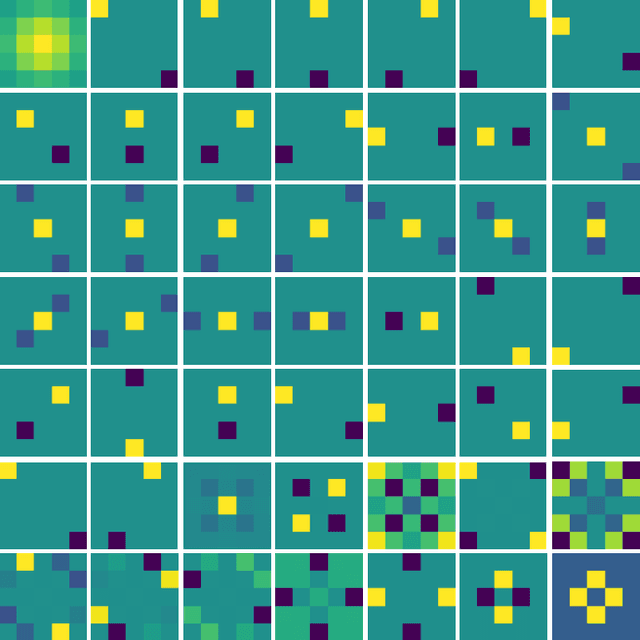
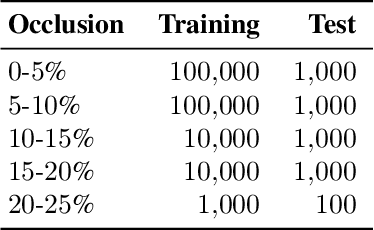
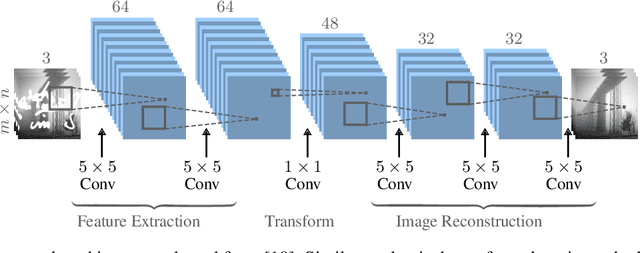
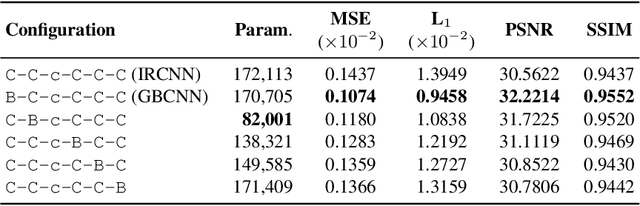
Blind inpainting algorithms based on deep learning architectures have shown a remarkable performance in recent years, typically outperforming model-based methods both in terms of image quality and run time. However, neural network strategies typically lack a theoretical explanation, which contrasts with the well-understood theory underlying model-based methods. In this work, we leverage the advantages of both approaches by integrating theoretically founded concepts from transform domain methods and sparse approximations into a CNN-based approach for blind image inpainting. To this end, we present a novel strategy to learn convolutional kernels that applies a specifically designed filter dictionary whose elements are linearly combined with trainable weights. Numerical experiments demonstrate the competitiveness of this approach. Our results show not only an improved inpainting quality compared to conventional CNNs but also significantly faster network convergence within a lightweight network design.