 Add to Chrome
 Add to Firefox
 Add to Edge
ActivityNarrated: An Open-Ended Narrative Paradigm for Wearable Human Activity Understanding
Apr 01, 2026
Wearable HAR has improved steadily, but most progress still relies on closed-set classification, which limits real-world use. In practice, human activity is open-ended, unscripted, personalized, and often compositional, unfolding as narratives rather than instances of fixed classes. We argue that addressing this gap does not require simply scaling datasets or models. It requires a fundamental shift in how wearable HAR is formulated, supervised, and evaluated. This work shows how to model open-ended activity narratives by aligning wearable sensor data with natural-language descriptions in an open-vocabulary setting. Our framework has three core components. First, we introduce a naturalistic data collection and annotation pipeline that combines multi-position wearable sensing with free-form, time-aligned narrative descriptions of ongoing behavior, allowing activity semantics to emerge without a predefined vocabulary. Second, we define a retrieval-based evaluation framework that measures semantic alignment between sensor data and language, enabling principled evaluation without fixed classes while also subsuming closed-set classification as a special case. Third, we present a language-conditioned learning architecture that supports sensor-to-text inference over variable-length sensor streams and heterogeneous sensor placements. Experiments show that models trained with fixed-label objectives degrade sharply under real-world variability, while open-vocabulary sensor-language alignment yields robust and semantically grounded representations. Once this alignment is learned, closed-set activity recognition becomes a simple downstream task. Under cross-participant evaluation, our method achieves 65.3% Macro-F1, compared with 31-34% for strong closed-set HAR baselines. These results establish open-ended narrative modeling as a practical and effective foundation for real-world wearable HAR.

SPECTRA: An Efficient Spectral-Informed Neural Network for Sensor-Based Activity Recognition
Mar 27, 2026Real time sensor based applications in pervasive computing require edge deployable models to ensure low latency privacy and efficient interaction. A prime example is sensor based human activity recognition where models must balance accuracy with stringent resource constraints. Yet many deep learning approaches treat temporal sensor signals as black box sequences overlooking spectral temporal structure while demanding excessive computation. We present SPECTRA a deployment first co designed spectral temporal architecture that integrates short time Fourier transform STFT feature extraction depthwise separable convolutions and channel wise self attention to capture spectral temporal dependencies under real edge runtime and memory constraints. A compact bidirectional GRU with attention pooling summarizes within window dynamics at low cost reducing downstream model burden while preserving accuracy. Across five public HAR datasets SPECTRA matches or approaches larger CNN LSTM and Transformer baselines while substantially reducing parameters latency and energy. Deployments on a Google Pixel 9 smartphone and an STM32L4 microcontroller further demonstrate end to end deployable realtime private and efficient HAR.
SImpHAR: Advancing impedance-based human activity recognition using 3D simulation and text-to-motion models
Jul 08, 2025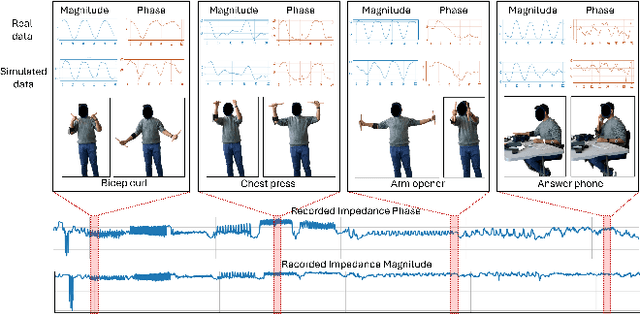
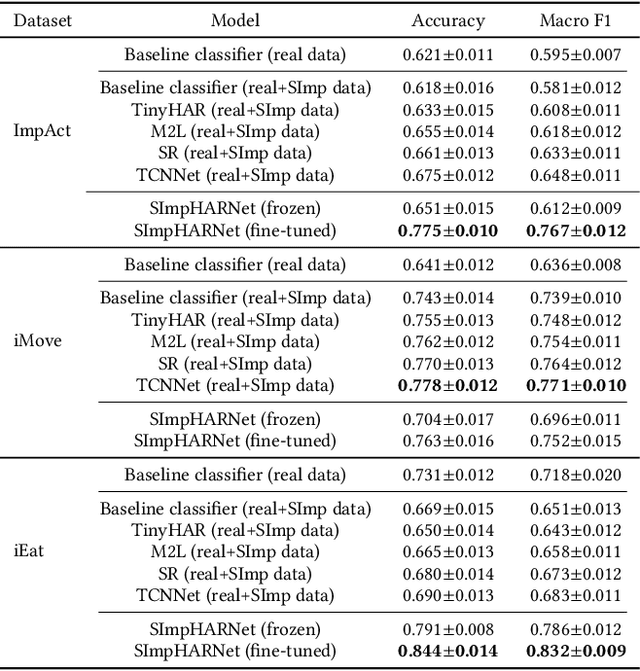
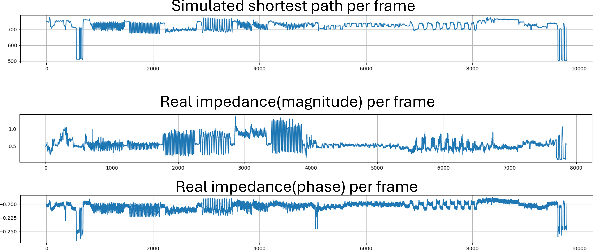
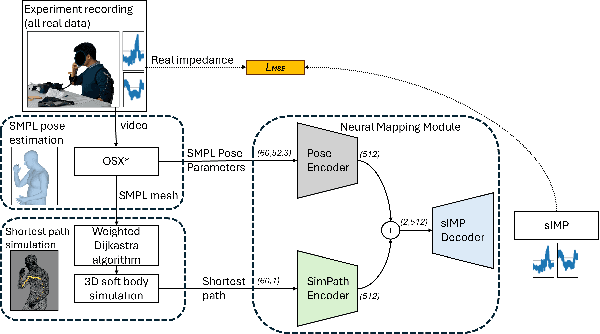
Human Activity Recognition (HAR) with wearable sensors is essential for applications in healthcare, fitness, and human-computer interaction. Bio-impedance sensing offers unique advantages for fine-grained motion capture but remains underutilized due to the scarcity of labeled data. We introduce SImpHAR, a novel framework addressing this limitation through two core contributions. First, we propose a simulation pipeline that generates realistic bio-impedance signals from 3D human meshes using shortest-path estimation, soft-body physics, and text-to-motion generation serving as a digital twin for data augmentation. Second, we design a two-stage training strategy with decoupled approach that enables broader activity coverage without requiring label-aligned synthetic data. We evaluate SImpHAR on our collected ImpAct dataset and two public benchmarks, showing consistent improvements over state-of-the-art methods, with gains of up to 22.3% and 21.8%, in terms of accuracy and macro F1 score, respectively. Our results highlight the promise of simulation-driven augmentation and modular training for impedance-based HAR.