 Add to Chrome
 Add to Firefox
 Add to Edge
FedDOSE: Federated Learning Framework Decomposing Site Effects for Modeling Brain Dynamic Functional Connectivity
Aug 07, 2026
Functional Magnetic Resonance Imaging ( fMRI ) data are often pooled into collaborative multi-site consortia, as deep learning models for analyses require large datasets to generalize well. While Federated Learning (FL) offers a privacy-preserving paradigm for collaborative training, standard approaches continue to struggle with statistical heterogeneity. In particular, site differences pose a key challenge in multi-site data settings. Additionally, existing FL approaches for fMRI rely on static Functional Connectivity ( FC), omitting dynamic information in brain networks. To address this, we propose FedDOSE, a novel framework that explicitly decomposes site differences for analysis of dynamic FC (dFC). FedDOSE introduces a Modularity-Guided Tucker Decomposition block to encode high-dimensional dFC tensors and capture modular-level spatio-temporal patterns efficiently. Class-specific prototypes are generated across all sites and subsequently aligned at the global level by using a combination of Optimal Transport (OT) barycenter formulation and Procrustes analysis. Extensive experiments for diagnosing Autism Spectrum Disorder (ASD) and Attention-Deficit Hyperactivity Disorder (ADHD) on three multi-site resting-state fMRI datasets: ABIDE-I, ABIDE-II, and ADHD-200, demonstrate that FedDOSE outperforms state-of-the-art methods in ASD and ADHD detection. Our results highlight its effectiveness in learning robust representations from multi-site datasets for reliable analysis.

Discovering robust biomarkers of neurological disorders from functional MRI using graph neural networks: A Review
May 01, 2024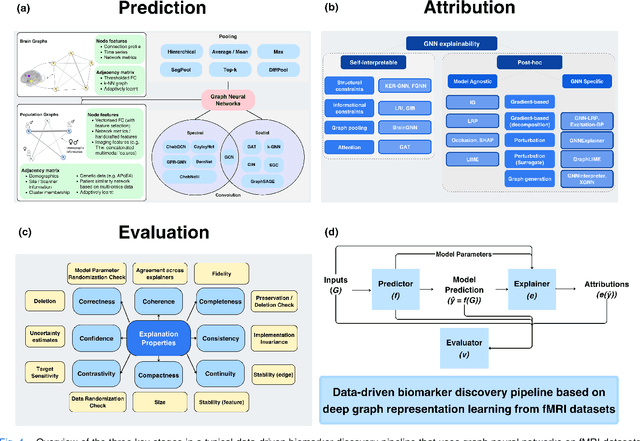
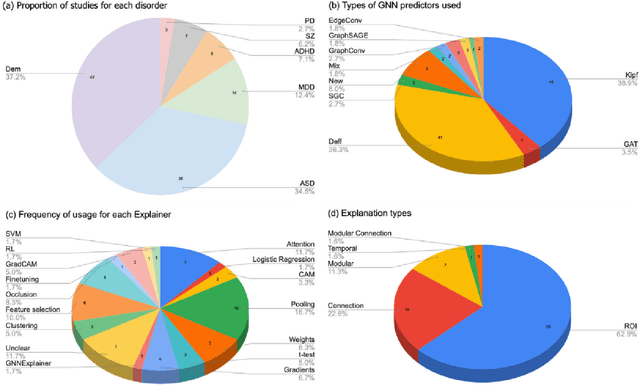
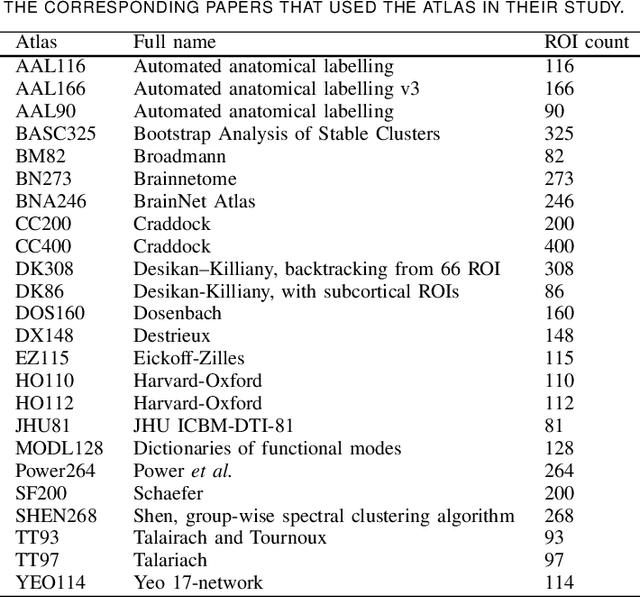
Graph neural networks (GNN) have emerged as a popular tool for modelling functional magnetic resonance imaging (fMRI) datasets. Many recent studies have reported significant improvements in disorder classification performance via more sophisticated GNN designs and highlighted salient features that could be potential biomarkers of the disorder. In this review, we provide an overview of how GNN and model explainability techniques have been applied on fMRI datasets for disorder prediction tasks, with a particular emphasis on the robustness of biomarkers produced for neurodegenerative diseases and neuropsychiatric disorders. We found that while most studies have performant models, salient features highlighted in these studies vary greatly across studies on the same disorder and little has been done to evaluate their robustness. To address these issues, we suggest establishing new standards that are based on objective evaluation metrics to determine the robustness of these potential biomarkers. We further highlight gaps in the existing literature and put together a prediction-attribution-evaluation framework that could set the foundations for future research on improving the robustness of potential biomarkers discovered via GNNs.