 Add to Chrome
 Add to Firefox
 Add to Edge
Hallucination Rates in Language Generation
Jul 25, 2026
Language generation in the limit is an elegant model introduced by Kleinberg and Mullainathan [KM24] to formally study language generation by an algorithm that learns solely based on example strings. In this model, an algorithm is said to correctly generate from a language if it never makes an error after some finite time. In contrast, even sophisticated language models are known to regularly hallucinate in practice. In this paper, we initiate the study of language generation in the limit with (infinite) hallucination, i.e., the algorithm may generate incorrect strings infinitely often, but the errors occur at a limited rate (possibly even with 0-measure). We first show that hallucination, even at rate 0, makes generation in the limit strictly more powerful: there are language collections that cannot be generated with finite error but can be generated with infinite error, even when errors occur on a 0-measure set of time-steps. Furthermore, while all countable collections are generatable with finite error, we show a strict hierarchy of (uncountable) language collections characterized by the hallucination rate. This hierarchy extends to breadth, the fraction of the target language generated. While all countable collections can attain the optimal breadth of 1/2 [KW26b], we show strict separation at every breadth and hallucination rate. Finally, we study generation in the limit without repetition, where the algorithm may not repeat strings. This lets us compare the sets of correct and incorrect strings generated, rather than the fractions of correct and incorrect time-steps. Once again, we demonstrate a strict hierarchy at every hallucination rate and breadth. Taken together, these results reveal rich structure in language collections generatable in the limit with hallucination and establish hallucination rate as an important parameter in the theoretical study of language generation.

Selectivity Estimation for Linear Queries via Online Learning
Jul 03, 2026Learning-based approaches for selectivity estimation in databases have gained significant traction in recent years. However, theoretical studies of these learning-based approaches are essentially limited to fixed query distributions on static databases. In practice, both the underlying database and the query workload can dynamically change over time. In this work, we propose an algorithmic framework for learning selectivity of queries in this more general dynamic setup. Inspired by online learning, we measure the performance of the learning algorithm in this setting by its regret, which compares the cumulative loss incurred by the learning algorithm to that of the best fixed strategy. We establish upper and lower bounds on regret for histogram-based linear queries, such as point, range, and subset selection queries, under standard loss functions, in both static and dynamic database settings.
Learning-Augmented Algorithms for $k$-median via Online Learning
Mar 18, 2026The field of learning-augmented algorithms seeks to use ML techniques on past instances of a problem to inform an algorithm designed for a future instance. In this paper, we introduce a novel model for learning-augmented algorithms inspired by online learning. In this model, we are given a sequence of instances of a problem and the goal of the learning-augmented algorithm is to use prior instances to propose a solution to a future instance of the problem. The performance of the algorithm is measured by its average performance across all the instances, where the performance on a single instance is the ratio between the cost of the algorithm's solution and that of an optimal solution for that instance. We apply this framework to the classic $k$-median clustering problem, and give an efficient learning algorithm that can approximately match the average performance of the best fixed $k$-median solution in hindsight across all the instances. We also experimentally evaluate our algorithm and show that its empirical performance is close to optimal, and also that it automatically adapts the solution to a dynamically changing sequence.
A Regression Approach to Learning-Augmented Online Algorithms
May 25, 2022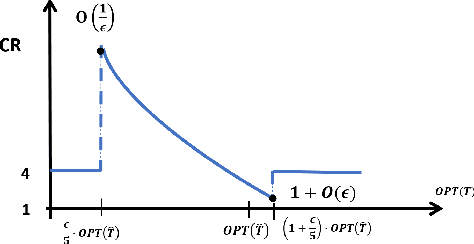
The emerging field of learning-augmented online algorithms uses ML techniques to predict future input parameters and thereby improve the performance of online algorithms. Since these parameters are, in general, real-valued functions, a natural approach is to use regression techniques to make these predictions. We introduce this approach in this paper, and explore it in the context of a general online search framework that captures classic problems like (generalized) ski rental, bin packing, minimum makespan scheduling, etc. We show nearly tight bounds on the sample complexity of this regression problem, and extend our results to the agnostic setting. From a technical standpoint, we show that the key is to incorporate online optimization benchmarks in the design of the loss function for the regression problem, thereby diverging from the use of off-the-shelf regression tools with standard bounds on statistical error.
Customizing ML Predictions for Online Algorithms
May 18, 2022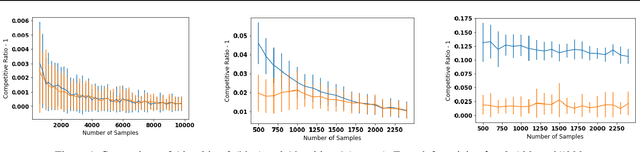
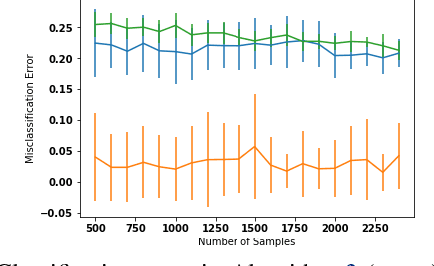
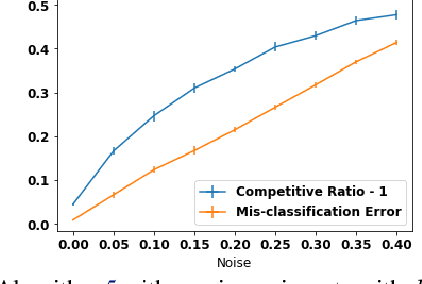
A popular line of recent research incorporates ML advice in the design of online algorithms to improve their performance in typical instances. These papers treat the ML algorithm as a black-box, and redesign online algorithms to take advantage of ML predictions. In this paper, we ask the complementary question: can we redesign ML algorithms to provide better predictions for online algorithms? We explore this question in the context of the classic rent-or-buy problem, and show that incorporating optimization benchmarks in ML loss functions leads to significantly better performance, while maintaining a worst-case adversarial result when the advice is completely wrong. We support this finding both through theoretical bounds and numerical simulations.
Online Algorithms with Multiple Predictions
May 08, 2022This paper studies online algorithms augmented with multiple machine-learned predictions. While online algorithms augmented with a single prediction have been extensively studied in recent years, the literature for the multiple predictions setting is sparse. In this paper, we give a generic algorithmic framework for online covering problems with multiple predictions that obtains an online solution that is competitive against the performance of the best predictor. Our algorithm incorporates the use of predictions in the classic potential-based analysis of online algorithms. We apply our algorithmic framework to solve classical problems such as online set cover, (weighted) caching, and online facility location in the multiple predictions setting. Our algorithm can also be robustified, i.e., the algorithm can be simultaneously made competitive against the best prediction and the performance of the best online algorithm (without prediction).