 Add to Chrome
 Add to Firefox
 Add to Edge
Identifiability and Order-Dimension Limits of In-Context Learning on Partial Orders
Aug 14, 2026
In-context learning is commonly formalized as inference from examples of a function. Partial orders instead combine transitivity, antisymmetry, and incomparability, so a finite prompt may not determine a queried comparison. We develop a theory of in-context learning on partial orders that separates logical identifiability, prompt teaching cost, structural complexity, and the exact capacity of a formal coordinate-decoder class. A version-space semantics makes background knowledge and open- versus closed-world assumptions explicit. For finite open-world prompts with positive and negative comparisons, we prove an exact completion trichotomy: after taking the reflexive transitive closure of the positive demonstrations, a query is forced true, forced false because every true completion creates a cycle or violates a negative demonstration, or remains genuinely ambiguous. For a known $n$-element universe, we characterize the open-world teaching number as the number of covers plus a blocker-set hitting number, prove that its maximum over all $n$-element posets is $n(n-1)$ and is uniquely attained by the antichain, and identify the blocker term as the exact cost of open-world rather than complete-Hasse semantics. We formalize prompt-dependent $s$-coordinate decoders and use the classical coordinate-order equivalence to obtain an exact representation boundary: dimension at most $s$ is necessary and sufficient, while width at most $s$ is a convenient sufficient condition.

Chain-of-Thought Shows the Path to a Tree: Realizing Branching Complexity
Aug 12, 2026Chain of Thought (CoT) lifts the expressive ceiling of bounded-depth Transformers, with characterizations tying the number of CoT steps to circuit complexity classes. What remains largely missing are concrete instantiations with explicit, depth-bounded constructions, and the traversal procedures such characterizations presuppose. We close this gap for branching complexity. We give CoT realizations of depth-first search (DFS) and of Dijkstra algorithm, the latter subsuming breadth-first search, by unique hard-attention decoders of at most two layers, and use them as a shared computational substrate: reusing the DFS decoder yields the Strahler number of an $n$-vertex tree in $2n-1$ steps with four layers, and reusing the Dijkstra decoder yields its width in $n-1$ steps with three. Since computing the Strahler number of a binary tree given as a term is \textsf{NC\textsuperscript{1}}-complete, and our constructions handle arbitrary $n$-ary trees without layer normalization or positional encodings, this is a non-trivial witness for the linear-step regime of the CoT hierarchy. Exploiting the classical bijection between ordered trees and Dyck paths, itself realized by our DFS construction, which emits the path as it traverses, we give independent constructions for both measures on the path representation.
Assessing the Limits of In-Context Learning beyond Functions using Partially Ordered Relation
Jun 16, 2025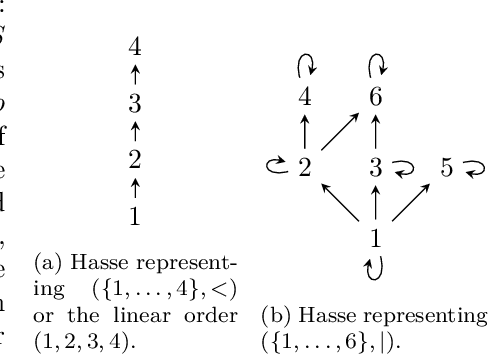
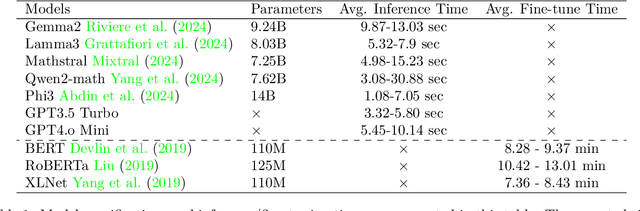
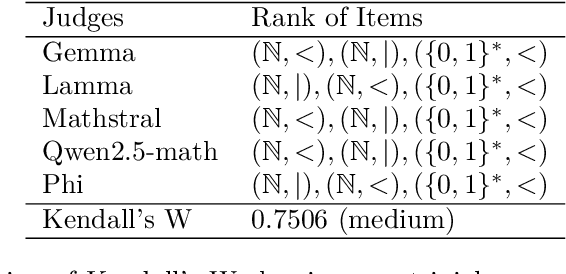
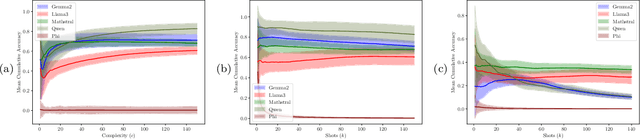
Generating rational and generally accurate responses to tasks, often accompanied by example demonstrations, highlights Large Language Model's (LLM's) remarkable In-Context Learning (ICL) capabilities without requiring updates to the model's parameter space. Despite having an ongoing exploration focused on the inference from a document-level concept, its behavior in learning well-defined functions or relations in context needs a careful investigation. In this article, we present the performance of ICL on partially ordered relation by introducing the notion of inductively increasing complexity in prompts. In most cases, the saturated performance of the chosen metric indicates that while ICL offers some benefits, its effectiveness remains constrained as we increase the complexity in the prompts even in presence of sufficient demonstrative examples. The behavior is evident from our empirical findings and has further been theoretically justified in term of its implicit optimization process. The code is available \href{https://anonymous.4open.science/r/ICLonPartiallyOrderSet}{here}.