 Add to Chrome
 Add to Firefox
 Add to Edge
Mixed-Agent Museum Tour Guide Design Improves Gendered Learning Outcomes and Visitor Preferences
Jul 16, 2026
Robots are increasingly integrated into everyday contexts, including museums, where they can both entertain and educate visitors. To enhance visitor experience and engagement, we present a novel mixed-agent tour guide system that combines a physical robot with a projected virtual agent that actively participates in the tour through conversation and interaction, achieving the interaction richness of two mobile agents from a single platform. We validate the system through a within-subjects study with 30 participants to assess engagement, quality of experience, and learning performance. Participants experienced different conversational styles and agent configurations, and data were collected via surveys, behavioral sensors, and interviews. Results showed that engagement and quality of experience remained consistent across conditions. Learning performance revealed a significant gender-moderated difference: the mixed-agent conditions improved learning performance for female participants. This suggests that the proposed dyadic conversational style in this paper influenced learning performance differently by gender. Nonetheless, in interviews, participants reported a greater preference for mixed-agent teams regardless of gender, citing interaction as a key factor in their experience.

Look Who's Talking Now: Implications of AV's Explanations on Driver's Trust, AV Preference, Anxiety and Mental Workload
May 21, 2019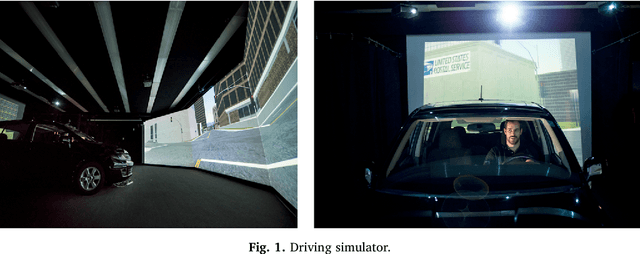
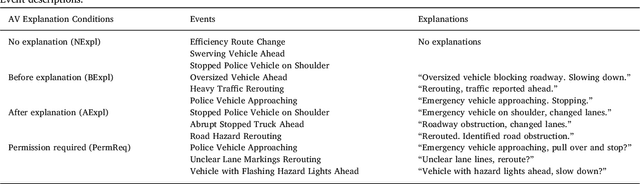
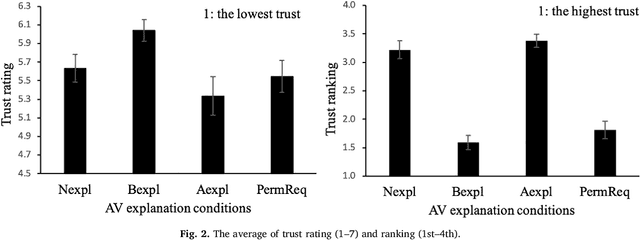
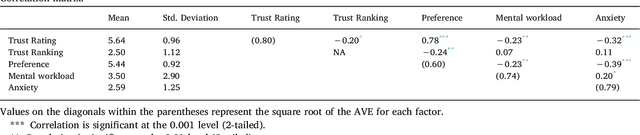
Explanations given by automation are often used to promote automation adoption. However, it remains unclear whether explanations promote acceptance of automated vehicles (AVs). In this study, we conducted a within-subject experiment in a driving simulator with 32 participants, using four different conditions. The four conditions included: (1) no explanation, (2) explanation given before or (3) after the AV acted and (4) the option for the driver to approve or disapprove the AV's action after hearing the explanation. We examined four AV outcomes: trust, preference for AV, anxiety and mental workload. Results suggest that explanations provided before an AV acted were associated with higher trust in and preference for the AV, but there was no difference in anxiety and workload. These results have important implications for the adoption of AVs.