 Add to Chrome
 Add to Firefox
 Add to Edge
Data Repetition Beats Data Scaling in Long-CoT Supervised Fine-Tuning
Feb 11, 2026
Supervised fine-tuning (SFT) on chain-of-thought data is an essential post-training step for reasoning language models. Standard machine learning intuition suggests that training with more unique training samples yields better generalization. Counterintuitively, we show that SFT benefits from repetition: under a fixed update budget, training for more epochs on smaller datasets outperforms single-epoch training on larger datasets. On AIME'24/25 and GPQA benchmarks, Olmo3-7B trained for 128 epochs on 400 samples outperforms the equivalent 1 epoch on 51200 samples by 12-26 percentage points, with no additional catastrophic forgetting. We find that training token accuracy reliably signals when repetition has saturated; improvements from additional epochs plateau at full memorization, a pattern consistent across all settings. These findings provide a practical approach for reasoning SFT, where scaling epochs with token accuracy as a stopping criterion can replace expensive undirected data scaling. We pose the repetition advantage, where full memorization coincides with improved generalization, as a new open problem for the community in understanding the training dynamics of large language models.

Bitune: Bidirectional Instruction-Tuning
May 23, 2024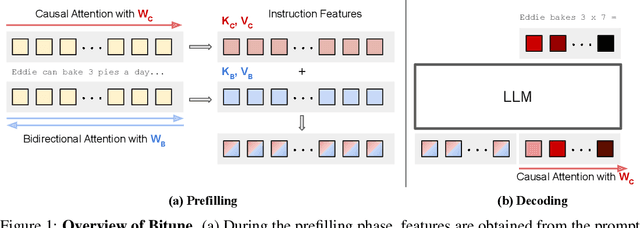
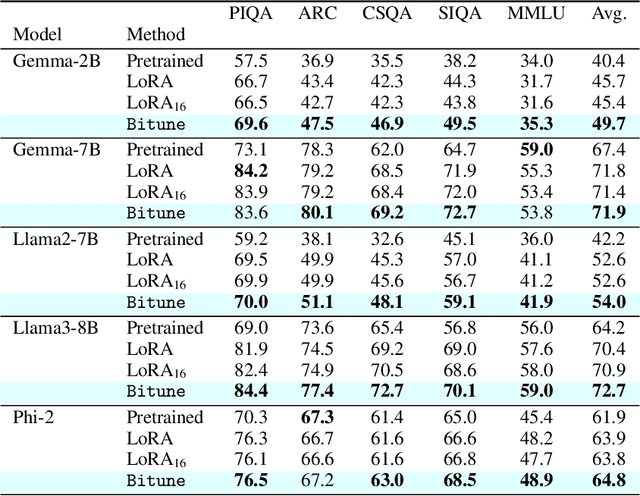
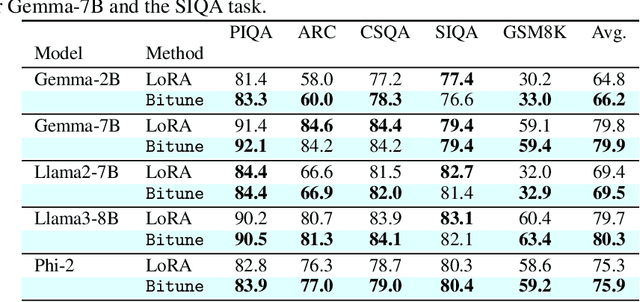
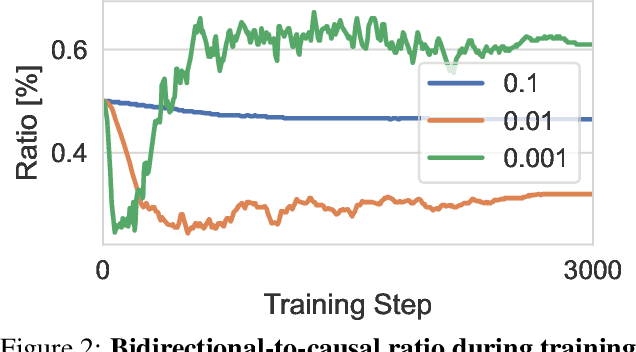
We introduce Bitune, a method that improves instruction-tuning of pretrained decoder-only large language models, leading to consistent gains on downstream tasks. Bitune applies both causal and bidirectional attention to the prompt, to obtain a better representation of the query or instruction. We realize this by introducing two sets of parameters, for which we apply parameter-efficient finetuning techniques. These causal and bidirectional features are then combined into a weighted average with trainable coefficients, which is subsequently used to generate new tokens. We demonstrate significant improvements in zero-shot performance on commonsense reasoning, arithmetic, and language understanding tasks, while extensive ablation studies validate the role of each component and demonstrate the method's agnosticism to different PEFT techniques.