 Add to Chrome
 Add to Firefox
 Add to Edge
Contrastive Learning for Diversity-Aware Product Recommendations in Retail
Feb 09, 2026
Recommender systems often struggle with long-tail distributions and limited item catalog exposure, where a small subset of popular items dominates recommendations. This challenge is especially critical in large-scale online retail settings with extensive and diverse product assortments. This paper introduces an approach to enhance catalog coverage without compromising recommendation quality in the existing digital recommendation pipeline at IKEA Retail. Drawing inspiration from recent advances in negative sampling to address popularity bias, we integrate contrastive learning with carefully selected negative samples. Through offline and online evaluations, we demonstrate that our method improves catalog coverage, ensuring a more diverse set of recommendations yet preserving strong recommendation performance.

Efficient Optimization of Hierarchical Identifiers for Generative Recommendation
Dec 20, 2025SEATER is a generative retrieval model that improves recommendation inference efficiency and retrieval quality by utilizing balanced tree-structured item identifiers and contrastive training objectives. We reproduce and validate SEATER's reported improvements in retrieval quality over strong baselines across all datasets from the original work, and extend the evaluation to Yambda, a large-scale music recommendation dataset. Our experiments verify SEATER's strong performance, but show that its tree construction step during training becomes a major bottleneck as the number of items grows. To address this, we implement and evaluate two alternative construction algorithms: a greedy method optimized for minimal build time, and a hybrid method that combines greedy clustering at high levels with more precise grouping at lower levels. The greedy method reduces tree construction time to less than 2% of the original with only a minor drop in quality on the dataset with the largest item collection. The hybrid method achieves retrieval quality on par with the original, and even improves on the largest dataset, while cutting construction time to just 5-8%. All data and code are publicly available for full reproducibility at https://github.com/joshrosie/re-seater.
Revisiting Language Models in Neural News Recommender Systems
Jan 20, 2025
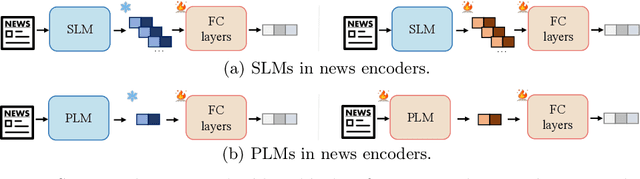
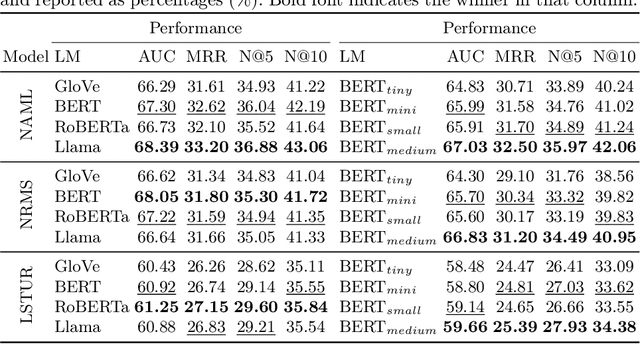
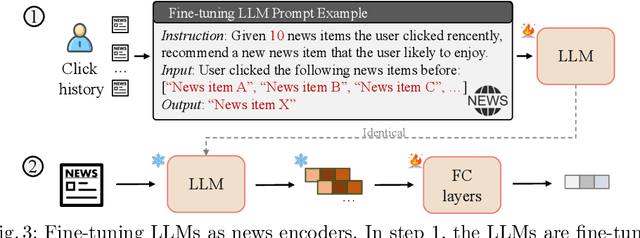
Neural news recommender systems (RSs) have integrated language models (LMs) to encode news articles with rich textual information into representations, thereby improving the recommendation process. Most studies suggest that (i) news RSs achieve better performance with larger pre-trained language models (PLMs) than shallow language models (SLMs), and (ii) that large language models (LLMs) outperform PLMs. However, other studies indicate that PLMs sometimes lead to worse performance than SLMs. Thus, it remains unclear whether using larger LMs consistently improves the performance of news RSs. In this paper, we revisit, unify, and extend these comparisons of the effectiveness of LMs in news RSs using the real-world MIND dataset. We find that (i) larger LMs do not necessarily translate to better performance in news RSs, and (ii) they require stricter fine-tuning hyperparameter selection and greater computational resources to achieve optimal recommendation performance than smaller LMs. On the positive side, our experiments show that larger LMs lead to better recommendation performance for cold-start users: they alleviate dependency on extensive user interaction history and make recommendations more reliant on the news content.