 Add to Chrome
 Add to Firefox
 Add to Edge
Trustworthy Privacy-Preserving Multimodal Federated Learning for Personalised Breast Cancer Prediction
Jul 21, 2026
Federated learning has emerged as a potential solution to privacy concerns associated with using sensitive health data for training predictive models, particularly in personalised cancer care. This research investigates whether federated learning can support the development of robust models for predicting tumour progression in breast cancer patients while addressing four critical deployment pillars: transparency, scalability, security, and fairness. This study evaluates a federated learning framework using multimodal data, including clinical information, tumour characteristics, biomarker data, and patient demographics, alongside medical imaging data such as MRI scans, to model changes in tumour characteristics over time. The performance of the federated approach was compared with that of a centralised model trained on aggregated data. The report then further examines strategies to enhance secure model updates, maintain performance across patient subgroups, and support scalability across institutions. The findings assess whether federated learning can achieve predictive performance comparable to centralised learning while preserving data locality. These results contribute to understanding the feasibility of privacy-preserving, multimodal predictive modelling and support future applications such as digital twins to assist clinicians and patients in personalised treatment planning.

SynPre-FL: Synthetic data-driven pretraining integrated Federated Learning training framework
Jul 21, 2026Federated learning (FL) offers a promising approach to privacy-preserving clinical risk prediction, but its deployment remains limited by restricted data sharing, client heterogeneity, class imbalance, and the lack of realistic tabular electronic health record (EHR) benchmarks. Synthetic data generation may alleviate data scarcity, yet its integration with federated optimisation has received limited systematic study. We propose SynPre-FL, a unified framework combining high-fidelity synthetic EHR generation with synthetic-pretrained FL for robust prediction under non-IID conditions. A latent autoencoder-diffusion model generates privacy-preserving synthetic cohorts, which are used to warm-start federated training. This pretraining is followed by heterogeneity-aware optimisation using class-balanced local objectives, proximal regularisation, and adaptive server aggregation. Post-hoc calibration and federated-safe explainability support reliable and interpretable risk estimates. Experiments show that the synthetic generator preserves univariate, bivariate, and multivariate structure while protecting against membership-inference and reconstruction attacks. The generated data achieve strong downstream utility under TSTR, TRTS, and model-based evaluations. Across federated settings with 5, 10, and 15 heterogeneous clients, SynPre-FL consistently improves robustness and scalability over baseline methods, especially under severe non-IID fragmentation. Calibration improves probability reliability, while SHAP analysis produces stable and clinically coherent feature attributions across federation sizes. SynPre-FL therefore provides a practical and reproducible framework for combining synthetic data with FL to enable privacy-aware, interpretable, and robust clinical prediction from distributed tabular EHR data.
A Platform-Agnostic Multimodal Digital Human Modelling Framework: Neurophysiological Sensing in Game-Based Interaction
Mar 11, 2026Digital Human Modelling (DHM) is increasingly shaped by advances in AI, wearable biosensing, and interactive digital environments, particularly in research addressing accessibility and inclusion. However, many AI-enabled DHM approaches remain tightly coupled to specific platforms, tasks, or interpretative pipelines, limiting reproducibility, scalability, and ethical reuse. This paper presents a platform-agnostic DHM framework designed to support AI-ready multimodal interaction research by explicitly separating sensing, interaction modelling, and inference readiness. The framework integrates the OpenBCI Galea headset as a unified multimodal sensing layer, providing concurrent EEG, EMG, EOG, PPG, and inertial data streams, alongside a reproducible, game-based interaction environment implemented using SuperTux. Rather than embedding AI models or behavioural inference, physiological signals are represented as structured, temporally aligned observables, enabling downstream AI methods to be applied under appropriate ethical approval. Interaction is modelled using computational task primitives and timestamped event markers, supporting consistent alignment across heterogeneous sensors and platforms. Technical verification via author self-instrumentation confirms data integrity, stream continuity, and synchronisation; no human-subjects evaluation or AI inference is reported. Scalability considerations are discussed with respect to data throughput, latency, and extension to additional sensors or interaction modalities. Illustrative use cases demonstrate how the framework can support AI-enabled DHM and HCI studies, including accessibility-oriented interaction design and adaptive systems research, without requiring architectural modifications. The proposed framework provides an emerging-technology-focused infrastructure for future ethics-approved, inclusive DHM research.
On-Device Transfer Learning for Personalising Psychological Stress Modelling using a Convolutional Neural Network
Apr 03, 2020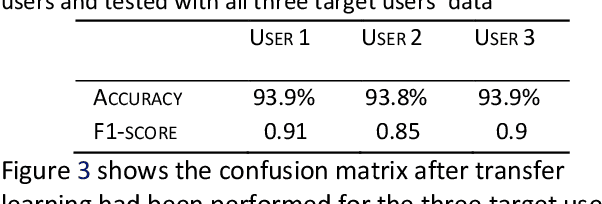
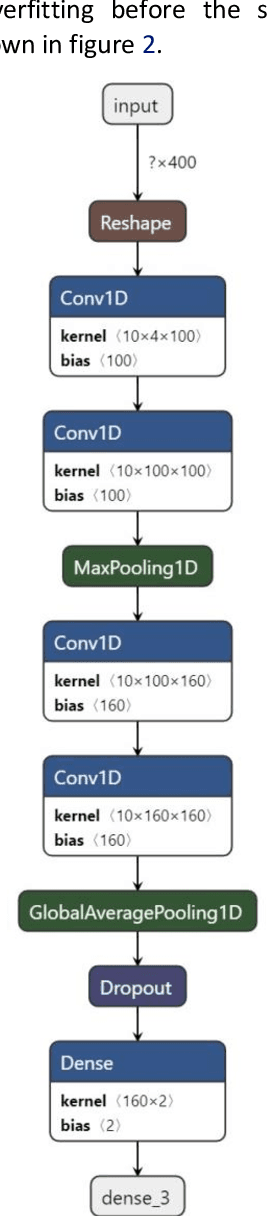
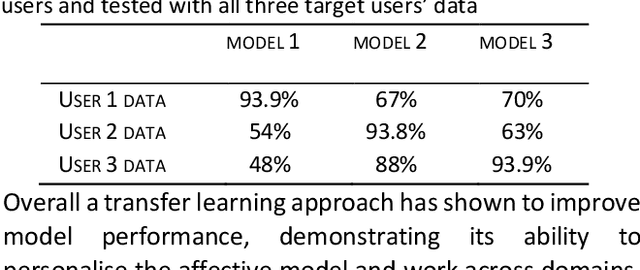
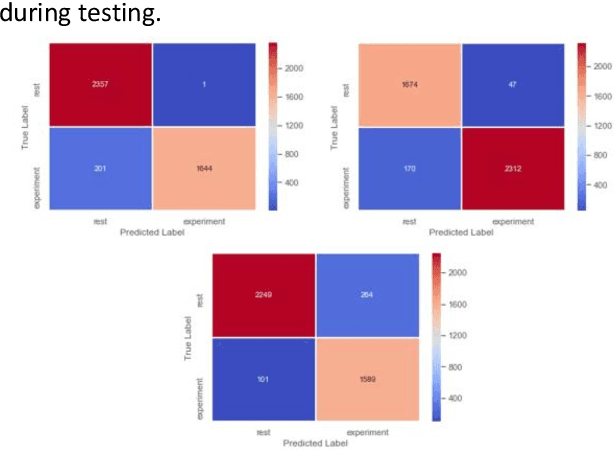
Stress is a growing concern in modern society adversely impacting the wider population more than ever before. The accurate inference of stress may result in the possibility for personalised interventions. However, individual differences between people limits the generalisability of machine learning models to infer emotions as people's physiology when experiencing the same emotions widely varies. In addition, it is time consuming and extremely challenging to collect large datasets of individuals' emotions as it relies on users labelling sensor data in real-time for extended periods. We propose the development of a personalised, cross-domain 1D CNN by utilising transfer learning from an initial base model trained using data from 20 participants completing a controlled stressor experiment. By utilising physiological sensors (HR, HRV EDA) embedded within edge computing interfaces that additionally contain a labelling technique, it is possible to collect a small real-world personal dataset that can be used for on-device transfer learning to improve model personalisation and cross-domain performance.