 Add to Chrome
 Add to Firefox
 Add to Edge
Assessing Automated Prompt Injection Attacks in Agentic Environments
Jun 09, 2026
Indirect prompt injection poses a critical threat to LLM agents that interact with untrusted external data, yet automated attack methods--proven effective for jailbreaking--remain underexplored in realistic agentic settings. We present a comprehensive empirical evaluation of automated prompt injection attacks against LLM agents, adapting both white-box (GCG) and black-box (TAP) methods to the agentic setting within the AgentDojo framework. We evaluate across 80 task pairs spanning four domains and multiple models, and find that black-box optimization substantially outperforms gradient-based methods, a gap we attribute to GCG's optimization instability under reasonable compute budgets. We also find that TAP's effectiveness depends on the attacker model, as both general capability and safety tuning affect attack success--stronger models produce more effective injections, while safety-tuned attackers can refuse to generate adversarial prompts. Task-universal attacks transfer effectively to unseen tasks and out-of-distribution domains, but attacks optimized on smaller open-source models do not transfer to frontier models like GPT-5. These findings highlight automated prompt injection as a credible but model-dependent threat, with significant barriers remaining for model-agnostic exploitation.

A Neural Model for Regular Grammar Induction
Oct 01, 2022
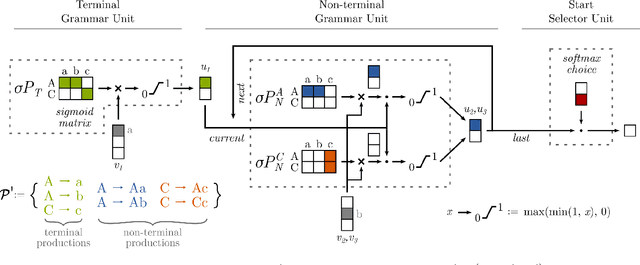
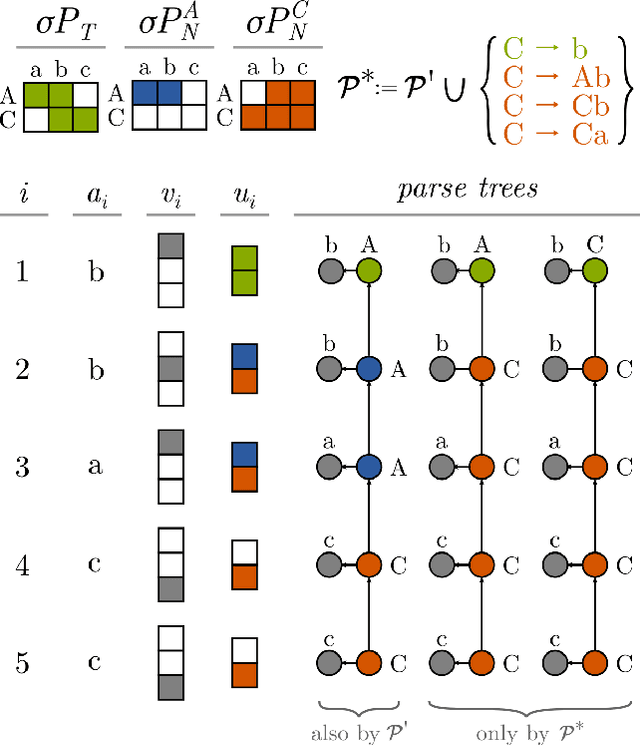
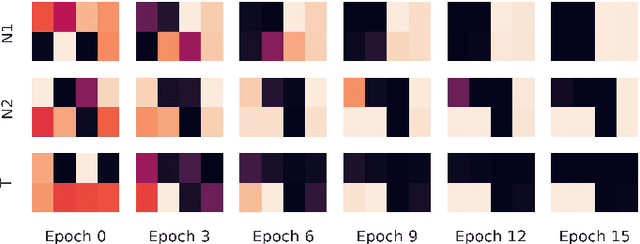
Grammatical inference is a classical problem in computational learning theory and a topic of wider influence in natural language processing. We treat grammars as a model of computation and propose a novel neural approach to induction of regular grammars from positive and negative examples. Our model is fully explainable, its intermediate results are directly interpretable as partial parses, and it can be used to learn arbitrary regular grammars when provided with sufficient data. We find that our method consistently attains high recall and precision scores across a range of tests of varying complexity.