 Add to Chrome
 Add to Firefox
 Add to Edge
Towards Automated Initial Probe Placement in Transthoracic Teleultrasound Using Human Mesh and Skeleton Recovery
Mar 11, 2026
Cardiac and lung ultrasound are technically demanding because operators must identify patient-specific intercostal acoustic windows and then navigate between standard views by adjusting probe position, rotation, and force across different imaging planes. These challenges are amplified in teleultrasound when a novice or robot faces the difficult task of first placing the probe on the patient without in-person expert assistance. We present a framework for automating Patient registration and anatomy-informed Initial Probe placement Guidance (PIPG) using only RGB images from a calibrated camera. The novice first captures the patient using the camera on a mixed reality (MR) head-mounted display (HMD). An edge server then infers a patient-specific body-surface and skeleton model, with spatial smoothing across multiple views. Using bony landmarks from the predicted skeleton, we estimate the intercostal region and project the guidance back onto the reconstructed body surface. To validate the framework, we overlaid the reconstructed body mesh and the virtual probe pose guidance across multiple transthoracic echocardiography scan planes in situ and measured the quantitative placement error. Pilot experiments with healthy volunteers suggest that the proposed probe placement prediction and MR guidance yield consistent initial placement within anatomical variability acceptable for teleultrasound setup

Measurement and Potential Field-Based Patient Modeling for Model-Mediated Tele-ultrasound
Sep 18, 2025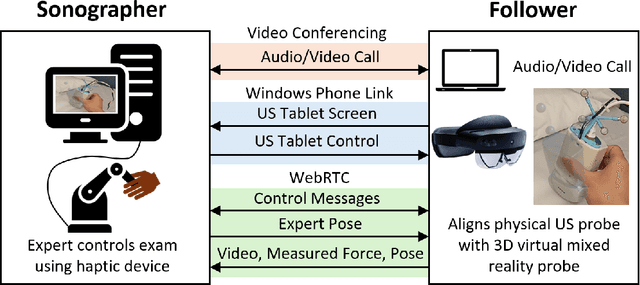
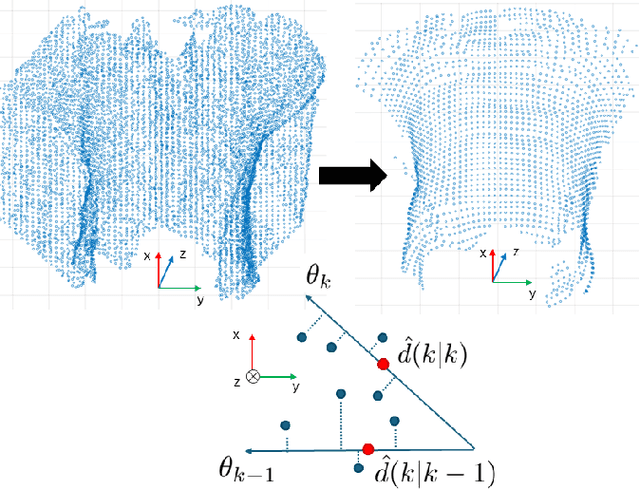
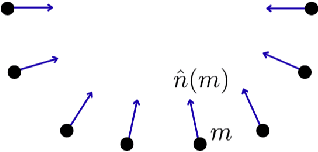
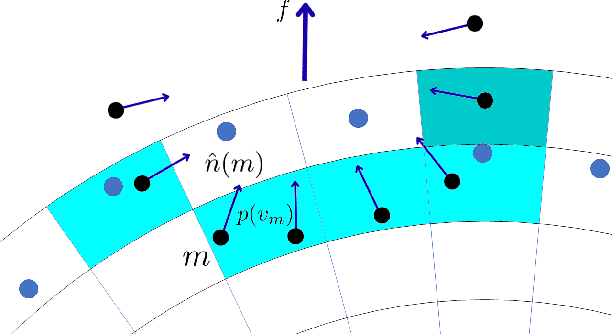
Teleoperated ultrasound can improve diagnostic medical imaging access for remote communities. Having accurate force feedback is important for enabling sonographers to apply the appropriate probe contact force to optimize ultrasound image quality. However, large time delays in communication make direct force feedback impractical. Prior work investigated using point cloud-based model-mediated teleoperation and internal potential field models to estimate contact forces and torques. We expand on this by introducing a method to update the internal potential field model of the patient with measured positions and forces for more transparent model-mediated tele-ultrasound. We first generate a point cloud model of the patient's surface and transmit this to the sonographer in a compact data structure. This is converted to a static voxelized volume where each voxel contains a potential field value. These values determine the forces and torques, which are rendered based on overlap between the voxelized volume and a point shell model of the ultrasound transducer. We solve for the potential field using a convex quadratic that combines the spatial Laplace operator with measured forces. This was evaluated on volunteer patients ($n=3$) by computing the accuracy of rendered forces. Results showed the addition of measured forces to the model reduced the force magnitude error by an average of 7.23 N and force vector angle error by an average of 9.37$^{\circ}$ compared to using only Laplace's equation.