 Add to Chrome
 Add to Firefox
 Add to Edge
Flowing with Confidence
May 18, 2026
Generative models can produce nonsensical text, unrealistic images, and unstable materials faster than simulation or human review can absorb; without per-sample confidence, trust erodes. Existing fixes run $k$ ensembles or stochastic trajectories at $k\times$ compute, measuring variability between models, not model confidence. We propose Flow Matching with Confidence (FMwC). FMwC injects input-dependent multiplicative noise at selected layers, propagates its variance through the network in closed form, and integrates it along the ODE trajectory, yielding a per-sample confidence score at standard sampling cost. The score supports multiple uses: filtering improves image quality and thermodynamic stability of crystals; editing rewinds trajectories to the points where the model commits and redirects them; and adaptive stepping concentrates ODE compute where the flow is ambiguous. We find that the confidence score correlates with the magnitude of the divergence of the learned velocity field, which gives us a window to understand the generative process, opening up surgical forms of guidance that target the moments that matter, new sampling algorithms and interpretability of generative models.

BARNN: A Bayesian Autoregressive and Recurrent Neural Network
Jan 30, 2025

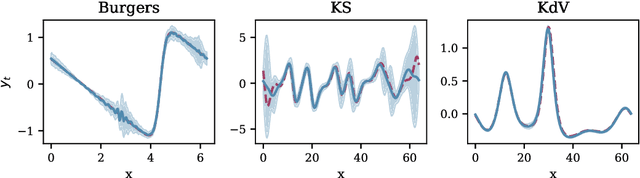

Autoregressive and recurrent networks have achieved remarkable progress across various fields, from weather forecasting to molecular generation and Large Language Models. Despite their strong predictive capabilities, these models lack a rigorous framework for addressing uncertainty, which is key in scientific applications such as PDE solving, molecular generation and Machine Learning Force Fields. To address this shortcoming we present BARNN: a variational Bayesian Autoregressive and Recurrent Neural Network. BARNNs aim to provide a principled way to turn any autoregressive or recurrent model into its Bayesian version. BARNN is based on the variational dropout method, allowing to apply it to large recurrent neural networks as well. We also introduce a temporal version of the "Variational Mixtures of Posteriors" prior (tVAMP-prior) to make Bayesian inference efficient and well-calibrated. Extensive experiments on PDE modelling and molecular generation demonstrate that BARNN not only achieves comparable or superior accuracy compared to existing methods, but also excels in uncertainty quantification and modelling long-range dependencies.
Generative Adversarial Reduced Order Modelling
May 25, 2023In this work, we present GAROM, a new approach for reduced order modelling (ROM) based on generative adversarial networks (GANs). GANs have the potential to learn data distribution and generate more realistic data. While widely applied in many areas of deep learning, little research is done on their application for ROM, i.e. approximating a high-fidelity model with a simpler one. In this work, we combine the GAN and ROM framework, by introducing a data-driven generative adversarial model able to learn solutions to parametric differential equations. The latter is achieved by modelling the discriminator network as an autoencoder, extracting relevant features of the input, and applying a conditioning mechanism to the generator and discriminator networks specifying the differential equation parameters. We show how to apply our methodology for inference, provide experimental evidence of the model generalisation, and perform a convergence study of the method.
A Continuous Convolutional Trainable Filter for Modelling Unstructured Data
Oct 25, 2022Convolutional Neural Network (CNN) is one of the most important architectures in deep learning. The fundamental building block of a CNN is a trainable filter, represented as a discrete grid, used to perform convolution on discrete input data. In this work, we propose a continuous version of a trainable convolutional filter able to work also with unstructured data. This new framework allows exploring CNNs beyond discrete domains, enlarging the usage of this important learning technique for many more complex problems. Our experiments show that the continuous filter can achieve a level of accuracy comparable to the state-of-the-art discrete filter, and that it can be used in current deep learning architectures as a building block to solve problems with unstructured domains as well.