 Add to Chrome
 Add to Firefox
 Add to Edge
How can embedding models bind concepts?
May 29, 2026
Humans easily determine which color belongs to which shape in multi-object scenes, an ability known as concept binding. Vision-language embedding models such as CLIP struggle with binding: they recognize individual concepts but fail to represent which concepts form which objects. Although CLIP behaves like a bag-of-concepts model in cross-modal retrieval, object information is recoverable from its image and text embeddings separately. We study this tension through the binding function, which maps concepts to scene embeddings. We find that scene embeddings decompose additively into object representations, explaining why uni-modal probes can recover object information. However, CLIP's binding function is high-complexity, which likely prevents the image and text encoders from learning a shared binding mechanism that generalizes to unseen concept combinations. We then ask whether this limitation is fundamental. We show that it is not. In controlled transformer models trained from scratch, binding generalization emerges with sufficient data coverage. These models learn low-complexity binding functions characterized by multiplicative interactions between concepts, enabling systematic generalization. Code is publicly available at https://github.com/oshapio/binding-concepts-complexity.

CLIP Behaves like a Bag-of-Words Model Cross-modally but not Uni-modally
Feb 05, 2025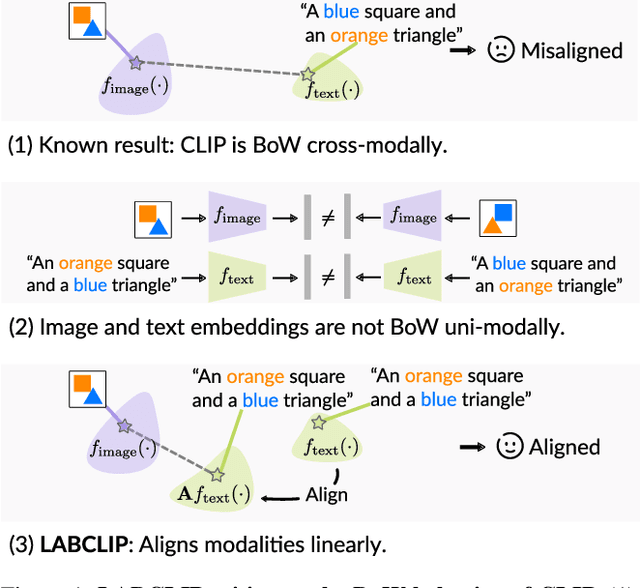
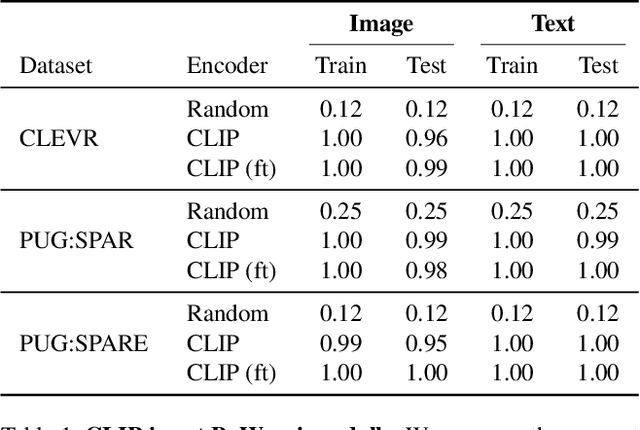
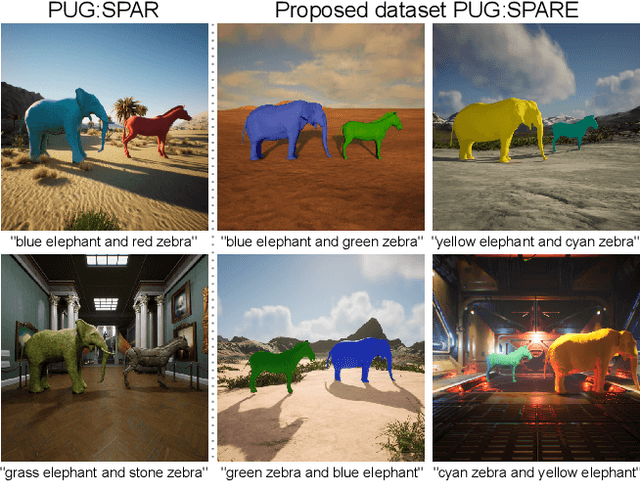
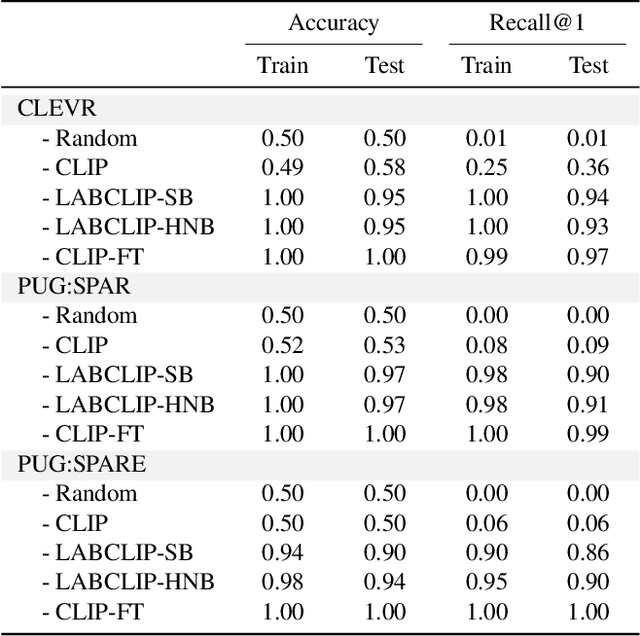
CLIP (Contrastive Language-Image Pretraining) has become a popular choice for various downstream tasks. However, recent studies have questioned its ability to represent compositional concepts effectively. These works suggest that CLIP often acts like a bag-of-words (BoW) model, interpreting images and text as sets of individual concepts without grasping the structural relationships. In particular, CLIP struggles to correctly bind attributes to their corresponding objects when multiple objects are present in an image or text. In this work, we investigate why CLIP exhibits this BoW-like behavior. We find that the correct attribute-object binding information is already present in individual text and image modalities. Instead, the issue lies in the cross-modal alignment, which relies on cosine similarity. To address this, we propose Linear Attribute Binding CLIP or LABCLIP. It applies a linear transformation to text embeddings before computing cosine similarity. This approach significantly improves CLIP's ability to bind attributes to correct objects, thereby enhancing its compositional understanding.