 Add to Chrome
 Add to Firefox
 Add to Edge
Causal Optimal Coupling for Gaussian Input-Output Distributional Data
Apr 01, 2026
We study the problem of identifying an optimal coupling between input-output distributional data generated by a causal dynamical system. The coupling is required to satisfy prescribed marginal distributions and a causality constraint reflecting the temporal structure of the system. We formulate this problem as a Schr"odinger Bridge, which seeks the coupling closest - in Kullback-Leibler divergence - to a given prior while enforcing both marginal and causality constraints. For the case of Gaussian marginals and general time-dependent quadratic cost functions, we derive a fully tractable characterization of the Sinkhorn iterations that converges to the optimal solution. Beyond its theoretical contribution, the proposed framework provides a principled foundation for applying causal optimal transport methods to system identification from distributional data.

TrafficFlowGAN: Physics-informed Flow based Generative Adversarial Network for Uncertainty Quantification
Jun 19, 2022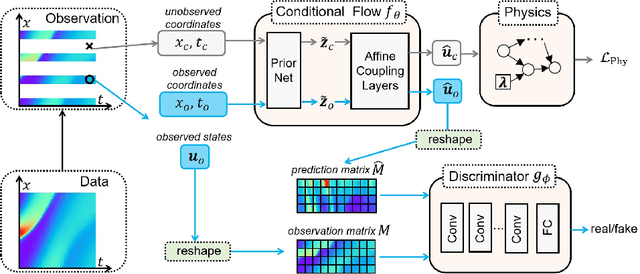
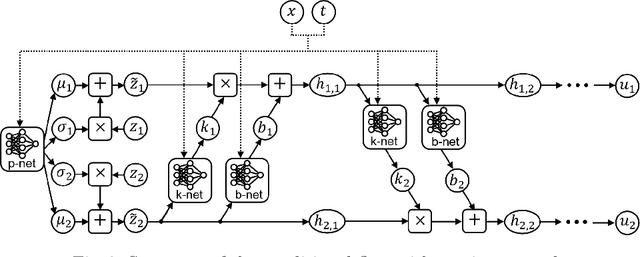
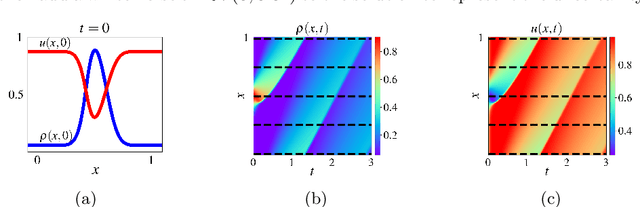
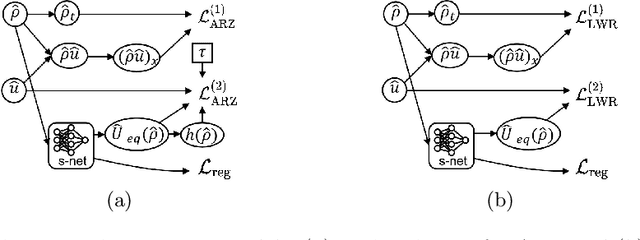
This paper proposes the TrafficFlowGAN, a physics-informed flow based generative adversarial network (GAN), for uncertainty quantification (UQ) of dynamical systems. TrafficFlowGAN adopts a normalizing flow model as the generator to explicitly estimate the data likelihood. This flow model is trained to maximize the data likelihood and to generate synthetic data that can fool a convolutional discriminator. We further regularize this training process using prior physics information, so-called physics-informed deep learning (PIDL). To the best of our knowledge, we are the first to propose an integration of flow, GAN and PIDL for the UQ problems. We take the traffic state estimation (TSE), which aims to estimate the traffic variables (e.g. traffic density and velocity) using partially observed data, as an example to demonstrate the performance of our proposed model. We conduct numerical experiments where the proposed model is applied to learn the solutions of stochastic differential equations. The results demonstrate the robustness and accuracy of the proposed model, together with the ability to learn a machine learning surrogate model. We also test it on a real-world dataset, the Next Generation SIMulation (NGSIM), to show that the proposed TrafficFlowGAN can outperform the baselines, including the pure flow model, the physics-informed flow model, and the flow based GAN model.