 Add to Chrome
 Add to Firefox
 Add to Edge
RPM-Net Reciprocal Point MLP Network for Unknown Network Security Threat Detection
Apr 08, 2026
Effective detection of unknown network security threats in multi-class imbalanced environments is critical for maintaining cyberspace security. Current methods focus on learning class representations but face challenges with unknown threat detection, class imbalance, and lack of interpretability, limiting their practical use. To address this, we propose RPM-Net, a novel framework that introduces reciprocal point mechanism to learn "non-class" representations for each known attack category, coupled with adversarial margin constraints that provide geometric interpretability for unknown threat detection. RPM-Net++ further enhances performance through Fisher discriminant regularization. Experimental results show that RPM-Net achieves superior performance across multiple metrics including F1-score, AUROC, and AUPR-OUT, significantly outperforming existing methods and offering practical value for real-world network security applications. Our code is available at:https://github.com/chiachen-chang/RPM-Net

A Hierarchical Terminal Recognition Approach based on Network Traffic Analysis
Apr 16, 2022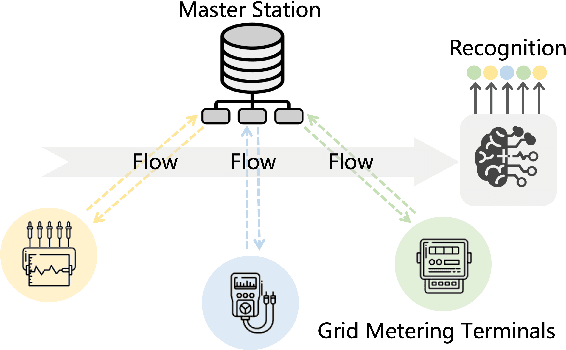



Recognizing the type of connected devices to a network helps to perform security policies. In smart grids, identifying massive number of grid metering terminals based on network traffic analysis is almost blank and existing research has not proposed a targeted end-to-end model to solve the flow classification problem. Therefore, we proposed a hierarchical terminal recognition approach that applies the details of grid data. We have formed a two-level model structure by segmenting the grid data, which uses the statistical characteristics of network traffic and the specific behavior characteristics of grid metering terminals. Moreover, through the selection and reconstruction of features, we combine three algorithms to achieve accurate identification of terminal types that transmit network traffic. We conduct extensive experiments on a real dataset containing three types of grid metering terminals, and the results show that our research has improved performance compared to common recognition models. The combination of an autoencoder, K-Means and GradientBoost algorithm achieved the best recognition rate with F1 value of 98.3%.