 Add to Chrome
 Add to Firefox
 Add to Edge
Anytime Plug-and-Play Control with Contract-Based Distributed MPC
Jul 05, 2026
A central challenge in many mobile multi-robot applications is that communication topologies are inherently time-varying. Agents may enter or exit the network and such changes cannot generally be restricted a priori. This work introduces a distributed multi-agent control algorithm based on local communication that supports anytime agent joining and leaving the communication network without centralized coordination. The method scales efficiently with the number of agents by relying on a distance-based neighbor definition and on contracts derived from predicted trajectories. The resulting contract constraints guarantee collision avoidance and constraint satisfaction. We validate the proposed method in an autonomous multi-agent driving scenario, demonstrating effective collision avoidance in high-speed, dynamic environments with agents moving in opposite directions, in both simulated and real-world experiments.

Stability-Preserving Online Adaptation of Neural Closed-loop Maps
Mar 23, 2026The growing complexity of modern control tasks calls for controllers that can react online as objectives and disturbances change, while preserving closed-loop stability. Recent approaches for improving the performance of nonlinear systems while preserving closed-loop stability rely on time-invariant recurrent neural-network controllers, but offer no principled way to update the controller during operation. Most importantly, switching from one stabilizing policy to another can itself destabilize the closed-loop. We address this problem by introducing a stability-preserving update mechanism for nonlinear, neural-network-based controllers. Each controller is modeled as a causal operator with bounded $\ell_p$-gain, and we derive gain-based conditions under which the controller may be updated online. These conditions yield two practical update schemes, time-scheduled and state-triggered, that guarantee the closed-loop remains $\ell_p$-stable after any number of updates. Our analysis further shows that stability is decoupled from controller optimality, allowing approximate or early-stopped controller synthesis. We demonstrate the approach on nonlinear systems with time-varying objectives and disturbances, and show consistent performance improvements over static and naive online baselines while guaranteeing stability.
MAD: A Magnitude And Direction Policy Parametrization for Stability Constrained Reinforcement Learning
Apr 03, 2025
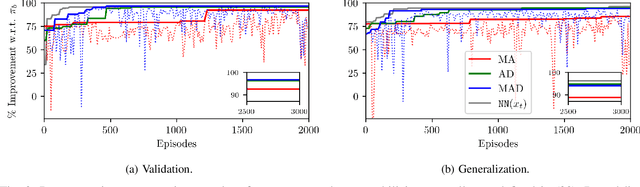

We introduce magnitude and direction (MAD) policies, a policy parameterization for reinforcement learning (RL) that preserves Lp closed-loop stability for nonlinear dynamical systems. Although complete in their ability to describe all stabilizing controllers, methods based on nonlinear Youla and system-level synthesis are significantly affected by the difficulty of parameterizing Lp-stable operators. In contrast, MAD policies introduce explicit feedback on state-dependent features - a key element behind the success of RL pipelines - without compromising closed-loop stability. This is achieved by describing the magnitude of the control input with a disturbance-feedback Lp-stable operator, while selecting its direction based on state-dependent features through a universal function approximator. We further characterize the robust stability properties of MAD policies under model mismatch. Unlike existing disturbance-feedback policy parameterizations, MAD policies introduce state-feedback components compatible with model-free RL pipelines, ensuring closed-loop stability without requiring model information beyond open-loop stability. Numerical experiments show that MAD policies trained with deep deterministic policy gradient (DDPG) methods generalize to unseen scenarios, matching the performance of standard neural network policies while guaranteeing closed-loop stability by design.