 Add to Chrome
 Add to Firefox
 Add to Edge
AI Lifecycle-Aware Feasibility Framework for Split-RIC Orchestration in NTN O-RAN
Mar 24, 2026
Integrating Artificial Intelligence (AI) into Non-Terrestrial Networks (NTN) is constrained by the joint limits of satellite SWaP and feeder-link capacity, which directly impact O-RAN closed-loop control and model lifecycle management. This paper studies the feasibility of distributing the O-RAN control hierarchy across Ground, LEO, and GEO segments through a Split-RIC architecture. We compare three deployment scenarios: (i) ground-centric control with telemetry streaming, (ii) ground--LEO Split-RIC with on-board inference and store-and-forward learning, and (iii) GEO--LEO multi-layer control enabled by inter-satellite links. For each scenario, we derive closed-form expressions for lifecycle energy and lifecycle latency that account for training-data transfer, model dissemination, and near-real-time inference. Numerical sensitivity analysis over feeder-link conditions, model complexity, and orbital intermittency yields operator-relevant feasibility regions that delineate when on-board inference and non-terrestrial learning loops are physically preferable to terrestrial offloading.

Computation Offloading in Heterogeneous Vehicular Edge Networks: On-line and Off-policy Bandit Solutions
Aug 14, 2020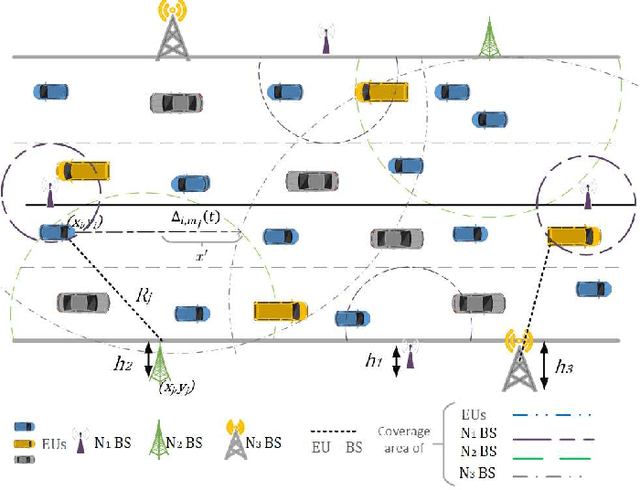
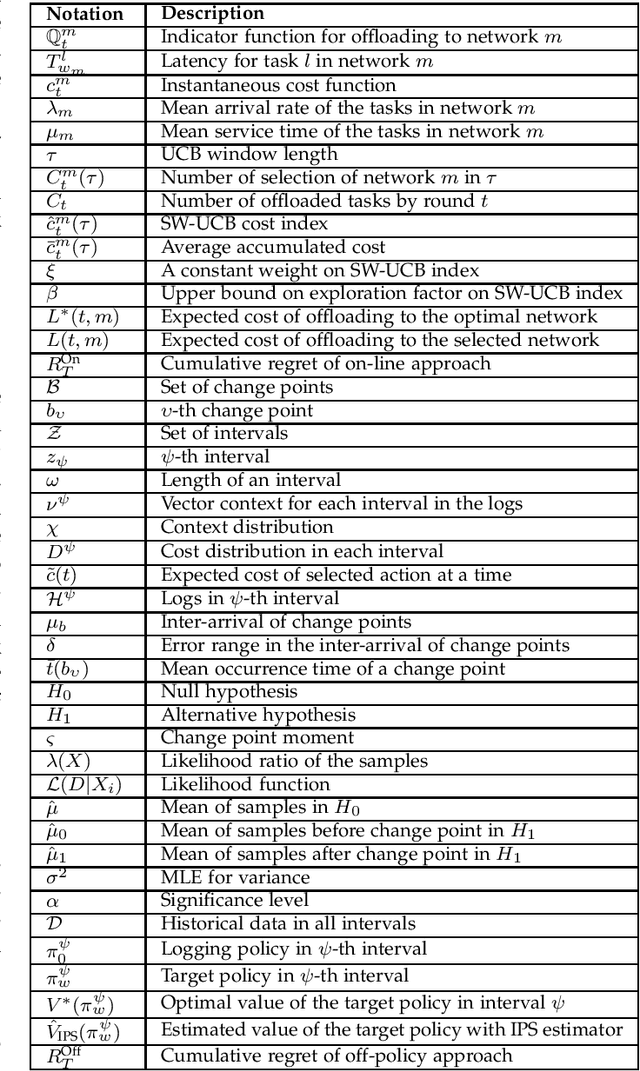
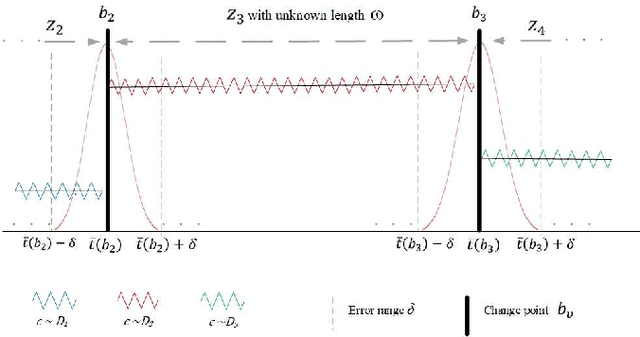
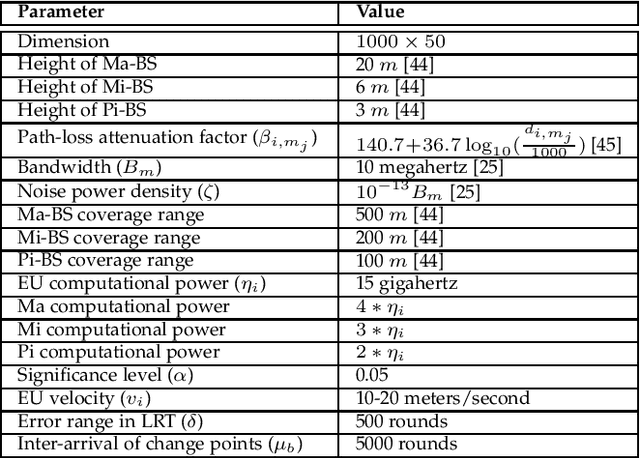
With the rapid advancement in vehicular communications and intelligent transportation systems technologies, task offloading in vehicular networking scenarios is emerging as a promising, yet challenging, paradigm in mobile edge computing. In this paper, we study the computation offloading problem from mobile vehicles/users, more specifically, the network- and base station selection problem, in a heterogeneous Vehicular Edge Computing (VEC) scenario, where networks have different traffic loads. In a fast-varying vehicular environment, the latency in computation offloading that arises as a result of network congestion (e.g. at the edge computing servers co-located with the base stations) is a key performance metric. However, due to the non-stationary property of such environments, predicting network congestion is an involved task. To address this challenge, we propose an on-line algorithm and an off-policy learning algorithm based on bandit theory. To dynamically select the least congested network in a piece-wise stationary environment, from the offloading history, these algorithms learn the latency that the offloaded tasks experience. In addition, to minimize the task loss due to the mobility of the vehicles, we develop a method for base station selection and a relaying mechanism in the chosen network based on the sojourn time of the vehicles. Through extensive numerical analysis, we demonstrate that the proposed learning-based solutions adapt to the traffic changes of the network by selecting the least congested network. Moreover, the proposed approaches improve the latency of offloaded tasks.