 Add to Chrome
 Add to Firefox
 Add to Edge
Adversarial Camouflage
Mar 23, 2026
While the rapid development of facial recognition algorithms has enabled numerous beneficial applications, their widespread deployment has raised significant concerns about the risks of mass surveillance and threats to individual privacy. In this paper, we introduce \textit{Adversarial Camouflage} as a novel solution for protecting users' privacy. This approach is designed to be efficient and simple to reproduce for users in the physical world. The algorithm starts by defining a low-dimensional pattern space parameterized by color, shape, and angle. Optimized patterns, once found, are projected onto semantically valid facial regions for evaluation. Our method maximizes recognition error across multiple architectures, ensuring high cross-model transferability even against black-box systems. It significantly degrades the performance of all tested state-of-the-art face recognition models during simulations and demonstrates promising results in real-world human experiments, while revealing differences in model robustness and evidence of attack transferability across architectures.

FRAUD-RLA: A new reinforcement learning adversarial attack against credit card fraud detection
Feb 04, 2025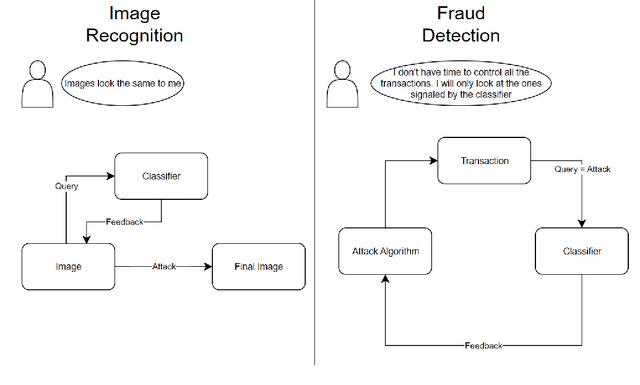


Adversarial attacks pose a significant threat to data-driven systems, and researchers have spent considerable resources studying them. Despite its economic relevance, this trend largely overlooked the issue of credit card fraud detection. To address this gap, we propose a new threat model that demonstrates the limitations of existing attacks and highlights the necessity to investigate new approaches. We then design a new adversarial attack for credit card fraud detection, employing reinforcement learning to bypass classifiers. This attack, called FRAUD-RLA, is designed to maximize the attacker's reward by optimizing the exploration-exploitation tradeoff and working with significantly less required knowledge than competitors. Our experiments, conducted on three different heterogeneous datasets and against two fraud detection systems, indicate that FRAUD-RLA is effective, even considering the severe limitations imposed by our threat model.