 Add to Chrome
 Add to Firefox
 Add to Edge
The Sample Complexity of Distributionally Robust PAC Learning under Cressie--Read Divergences
Aug 05, 2026
We study distributionally robust PAC learning for the $0$--$1$-loss, where adversarial perturbations of the data distribution are constrained by a Cressie--Read divergence of order $k>1$ and radius $ρ\geq 0$. For hypothesis classes with VC dimension $d$, we establish realizable and agnostic sample-complexity bounds tight up to constant and logarithmic factors, respectively; ordinary empirical risk minimization attains both rates up to logarithmic factors. For target accuracy $\varepsilon\in(0,1)$ and confidence $δ\in(0,1)$, their respective orders are \[ \max\!\left\{\frac{1}{\varepsilon}, \frac{ρ^{\frac 1{k-1}}}{\varepsilon^{k_\star}} \right\}\cdot(d+\log δ^{-1}) \qquad\text{and}\qquad \max\!\left\{\frac{1}{\varepsilon^2}, \frac{ρ^{\frac1{k-1}}}{\varepsilon^{k_\star\vee 2}} \right\}\cdot(d+\log δ^{-1}), \] where $k_\star={k}/{(k-1)}$. For every fixed $ρ>0$, robustness changes the realizable $\varepsilon$-dependence from $\varepsilon^{-1}$ to $\varepsilon^{-k_\star}$ as $\varepsilon\downarrow0$. In the agnostic case, for $1<k<2$, robustness changes the $\varepsilon$-dependence from $\varepsilon^{-2}$ to $\varepsilon^{-k_\star}$, whereas for $k\geq2$ the exponent remains the classical $2$, with nontrivial $ρ$-dependence. Building on the known scalar reduction of robust $0$--$1$ risk to ordinary classification error, our analysis reveals a scale-sensitive interaction between the statistical estimation of classification error and its amplification by robustness, sharply explaining the transition in the agnostic rate. We extend the previously studied $χ^2$-divergence case to every Cressie--Read order $k>1$, close its upper--lower gaps, and recover standard PAC learning rates as $ρ\to0$, unlike previous bounds that fail to interpolate correctly in this limit.

Are VQA Systems RAD? Measuring Robustness to Augmented Data with Focused Interventions
Jun 08, 2021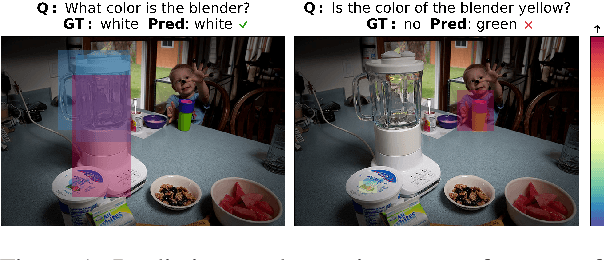
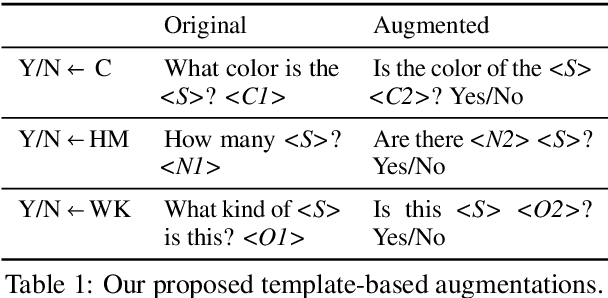
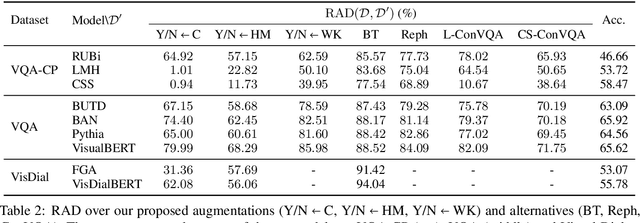
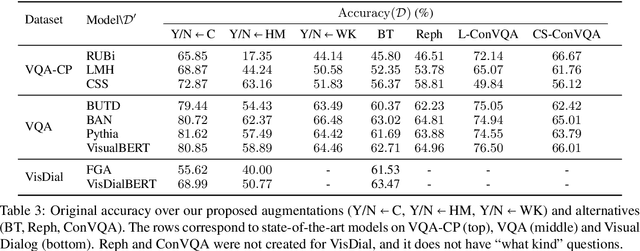
Deep learning algorithms have shown promising results in visual question answering (VQA) tasks, but a more careful look reveals that they often do not understand the rich signal they are being fed with. To understand and better measure the generalization capabilities of VQA systems, we look at their robustness to counterfactually augmented data. Our proposed augmentations are designed to make a focused intervention on a specific property of the question such that the answer changes. Using these augmentations, we propose a new robustness measure, Robustness to Augmented Data (RAD), which measures the consistency of model predictions between original and augmented examples. Through extensive experimentation, we show that RAD, unlike classical accuracy measures, can quantify when state-of-the-art systems are not robust to counterfactuals. We find substantial failure cases which reveal that current VQA systems are still brittle. Finally, we connect between robustness and generalization, demonstrating the predictive power of RAD for performance on unseen augmentations.