 Add to Chrome
 Add to Firefox
 Add to Edge
Multimodal Analysis of State-Funded News Coverage of the Israel-Hamas War on YouTube Shorts
Apr 01, 2026
YouTube Shorts have become central to news consumption on the platform, yet research on how geopolitical events are represented in this format remains limited. To address this gap, we present a multimodal pipeline that combines automatic transcription, aspect-based sentiment analysis (ABSA), and semantic scene classification. The pipeline is first assessed for feasibility and then applied to analyze short-form coverage of the Israel-Hamas war by state-funded outlets. Using over 2,300 conflict-related Shorts and more than 94,000 visual frames, we systematically examine war reporting across major international broadcasters. Our findings reveal that the sentiment expressed in transcripts regarding specific aspects differs across outlets and over time, whereas scene-type classifications reflect visual cues consistent with real-world events. Notably, smaller domain-adapted models outperform large transformers and even LLMs for sentiment analysis, underscoring the value of resource-efficient approaches for humanities research. The pipeline serves as a template for other short-form platforms, such as TikTok and Instagram, and demonstrates how multimodal methods, combined with qualitative interpretation, can characterize sentiment patterns and visual cues in algorithmically driven video environments.

Antisemitic Messages? A Guide to High-Quality Annotation and a Labeled Dataset of Tweets
Apr 28, 2023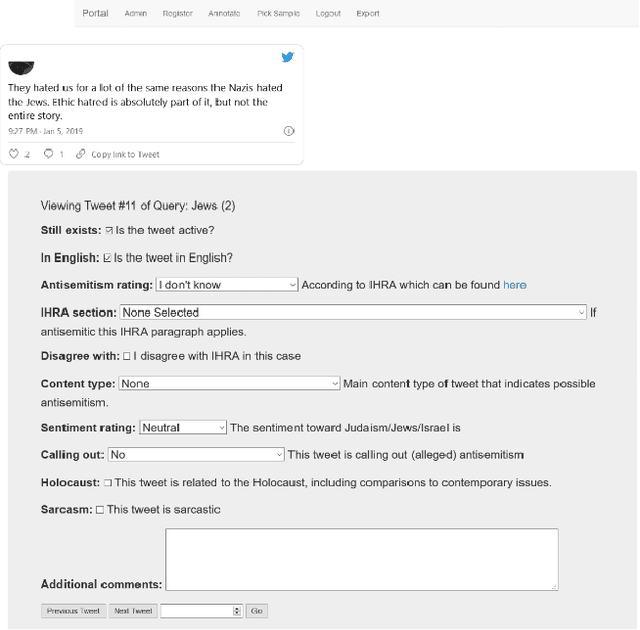
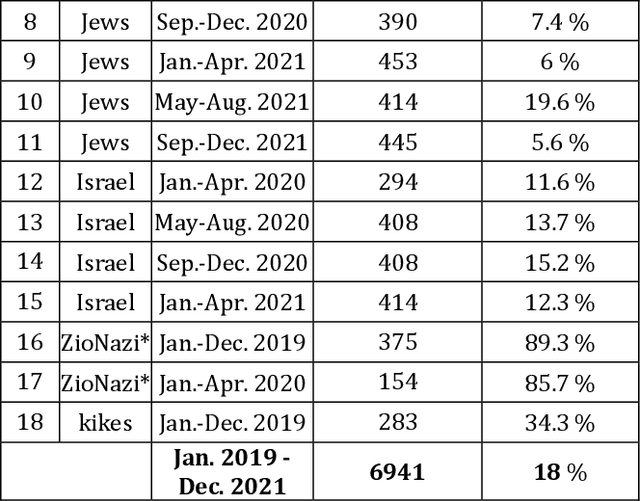
One of the major challenges in automatic hate speech detection is the lack of datasets that cover a wide range of biased and unbiased messages and that are consistently labeled. We propose a labeling procedure that addresses some of the common weaknesses of labeled datasets. We focus on antisemitic speech on Twitter and create a labeled dataset of 6,941 tweets that cover a wide range of topics common in conversations about Jews, Israel, and antisemitism between January 2019 and December 2021 by drawing from representative samples with relevant keywords. Our annotation process aims to strictly apply a commonly used definition of antisemitism by forcing annotators to specify which part of the definition applies, and by giving them the option to personally disagree with the definition on a case-by-case basis. Labeling tweets that call out antisemitism, report antisemitism, or are otherwise related to antisemitism (such as the Holocaust) but are not actually antisemitic can help reduce false positives in automated detection. The dataset includes 1,250 tweets (18%) that are antisemitic according to the International Holocaust Remembrance Alliance (IHRA) definition of antisemitism. It is important to note, however, that the dataset is not comprehensive. Many topics are still not covered, and it only includes tweets collected from Twitter between January 2019 and December 2021. Additionally, the dataset only includes tweets that were written in English. Despite these limitations, we hope that this is a meaningful contribution to improving the automated detection of antisemitic speech.