 Add to Chrome
 Add to Firefox
 Add to Edge
A Guide to Estimating Conditional Average Treatment Effects in Competing Risks Settings
Jun 08, 2026
Conditional average treatment effects (CATEs) are central to treatment decision-making in personalized medicine. In competing risks settings, estimating CATEs from survival data allows for patient-specific assessments of treatment effectiveness for a specific event of interest while properly accounting for alternative event types. This distinction is essential in the presence of comorbidities, where competing causes of death may otherwise confound the therapeutic benefit. Focusing on right-censored survival times with binary treatment, we examine CATEs defined as covariate-conditional differences in the absolute risk for the event of interest at a fixed time. To this end, we study meta-learners which adapt machine learning algorithms for CATE estimation in competing risks scenarios. We systematically compare six meta-learners, combining Cox regression or random survival forests for risk modeling with elastic net regression or random forests for direct CATE modeling. To provide practical guidance on model selection, we evaluate their performance in multiple simulation settings, that differ in hazard complexity, treatment heterogeneity, treatment assignment, event type distribution and censoring. To facilitate applied use, we provide the R package, crsurvlearners, which implements all considered approaches.

Skewness-Robust Causal Discovery in Location-Scale Noise Models
Nov 18, 2025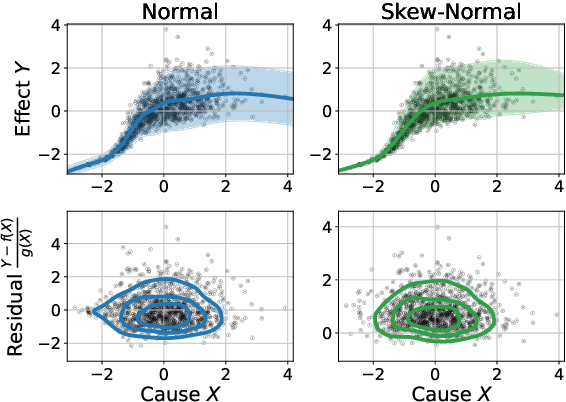
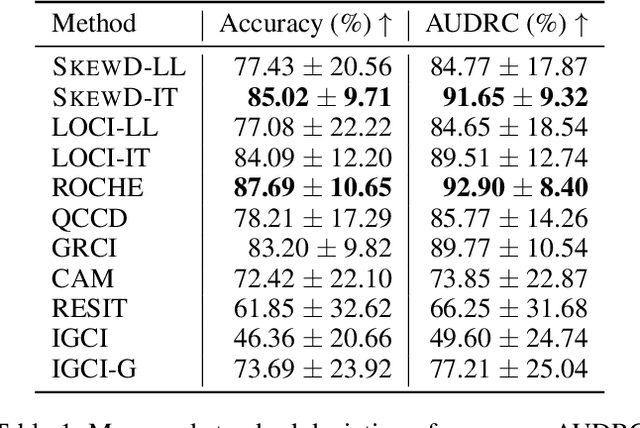
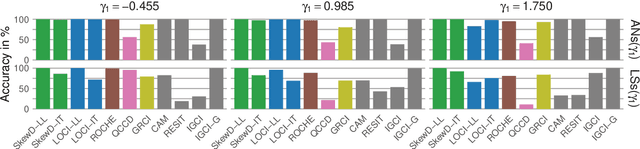

To distinguish Markov equivalent graphs in causal discovery, it is necessary to restrict the structural causal model. Crucially, we need to be able to distinguish cause $X$ from effect $Y$ in bivariate models, that is, distinguish the two graphs $X \to Y$ and $Y \to X$. Location-scale noise models (LSNMs), in which the effect $Y$ is modeled based on the cause $X$ as $Y = f(X) + g(X)N$, form a flexible class of models that is general and identifiable in most cases. Estimating these models for arbitrary noise terms $N$, however, is challenging. Therefore, practical estimators are typically restricted to symmetric distributions, such as the normal distribution. As we showcase in this paper, when $N$ is a skewed random variable, which is likely in real-world domains, the reliability of these approaches decreases. To approach this limitation, we propose SkewD, a likelihood-based algorithm for bivariate causal discovery under LSNMs with skewed noise distributions. SkewD extends the usual normal-distribution framework to the skew-normal setting, enabling reliable inference under symmetric and skewed noise. For parameter estimation, we employ a combination of a heuristic search and an expectation conditional maximization algorithm. We evaluate SkewD on novel synthetically generated datasets with skewed noise as well as established benchmark datasets. Throughout our experiments, SkewD exhibits a strong performance and, in comparison to prior work, remains robust under high skewness.